Upgrade & Secure Your Future with DevOps, SRE, DevSecOps, MLOps!
We spend hours scrolling social media and waste money on things we forget, but won’t spend 30 minutes a day earning certifications that can change our lives.
Master in DevOps, SRE, DevSecOps & MLOps by DevOps School!
Learn from Guru Rajesh Kumar and double your salary in just one year.
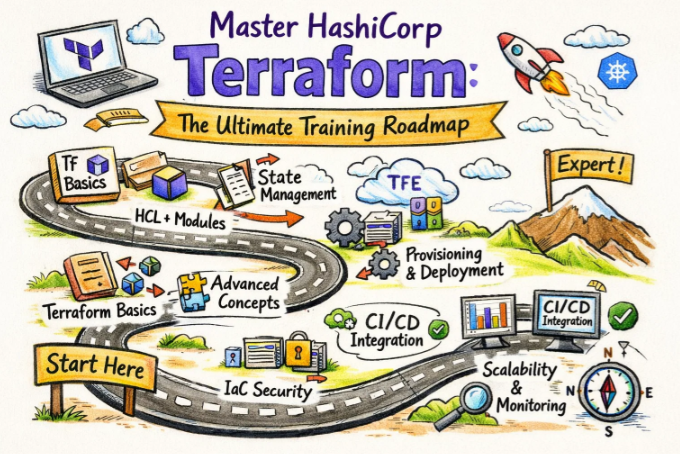
In the earlier days of IT, building an environment was like building a house by hand—one brick at a time, often without a formal plan. Today, we are architects. We use code to design, deploy, and scale massive digital ecosystems. If you want to move from being someone who simply “uses the cloud” to someone who “orchestrates the cloud,” you need to master Infrastructure as Code (IaC).
HashiCorp Terraform has emerged as the universal language for this orchestration. Whether you are an engineer in a fast-paced startup in Bangalore or a manager in a global enterprise, Terraform is the tool that ensures your infrastructure is predictable, repeatable, and safe. This guide is designed to help you navigate the Terraform certification journey and understand how it connects to the broader world of Kubernetes and cloud-native engineering.
Navigating the HashiCorp Terraform Certification Program
The certification landscape for Terraform is built to prove that you don’t just know the commands, but you understand the logic behind automation. It is the gold standard for anyone working in cloud infrastructure today.
The Certification Matrix
| Track | Level | Who it’s for | Prerequisites | Skills Covered | Recommended Order |
| Cloud Automation | Associate | Engineers, SREs, Platform Admins | Basic CLI & Cloud awareness | HCL Syntax, State, Modules, Provisioners, Workflows | 1st |
Detailed Breakdown: HashiCorp Certified: Terraform Associate
This credential is more than just a line on your resume; it is a validation of your ability to handle modern production environments. It focuses on the open-source version of the tool, ensuring your skills are portable across any company.
What it is
The HashiCorp Certified: Terraform Associate is a professional-level exam that tests your foundational knowledge of HashiCorp Configuration Language (HCL). It validates that you can use the Terraform ecosystem to manage the lifecycle of resources across multiple cloud providers. It proves you understand how to keep your infrastructure in sync with your code.
Who should take it
- Infrastructure Engineers: Who need to move away from manual console changes.
- Software Developers: Who want “Full Cycle” ownership of their applications.
- Site Reliability Engineers (SREs): Seeking to build self-healing systems.
- Technical Managers: Who need to oversee automation strategies and team standards.
Skills you’ll gain
Gaining this certification means you have shifted your mindset from “ordering servers” to “programming environments.”
- Declarative Programming: Learning to describe the result you want, rather than the steps to get there.
- Resource Lifecycle Management: Understanding how Terraform creates, updates, and safely deletes cloud resources.
- Collaboration at Scale: Mastering the use of Remote State and Locking to ensure teams don’t overwrite each other’s work.
- Modular Design: Learning how to package infrastructure into reusable components, much like software libraries.
- Provider Ecosystem: Gaining the ability to talk to AWS, Azure, GCP, and even SaaS platforms like Datadog through a single tool.
Real-world projects you should be able to do after it
Once you’ve mastered these concepts, you will have the confidence to handle high-stakes projects.
- Global Networking Hub: Using code to connect VPCs across different continents with standardized security rules.
- Disaster Recovery Pipelines: Creating “One-Click” recovery environments that can rebuild an entire data center in minutes.
- Standardized Developer Sandboxes: Providing your dev teams with pre-configured, secure environments they can launch on demand.
- Policy-as-Code Implementation: Integrating checks that automatically block any infrastructure that doesn’t meet company security standards.
Preparation Plan
The 7-Day “Fast Track” (For Cloud Veterans)
- Days 1-2: Deep dive into the CLI and HCL syntax. Practice
importandstatemanipulation. - Days 3-4: Study the differences between Open Source, Cloud, and Enterprise versions.
- Days 5-6: Focus on Modules and Workspace logic.
- Day 7: Final review of the “Official Exam Objectives” and exam day.
The 30-Day “Practitioner” Path (The Most Common)
- Week 1: Learn the basics of Providers and Resources. Build a small project in a free-tier cloud account.
- Week 2: Master State management. Move your local state to a remote bucket.
- Week 3: Rebuild your project using Modules to make it reusable.
- Week 4: Focus on theory, exam-style questions, and time management.
The 60-Day “Foundation” Journey (For Career Switchers)
- Month 1: Spend this time learning what you are automating. Familiarize yourself with AWS, Azure, or Linux.
- Month 2: Follow a structured course, complete at least three hands-on labs, and join a study group to discuss common errors.
Common Mistakes
Even experienced engineers hit roadblocks because they bring “old world” habits into the “new world” of IaC.
- Treating Code like a Script: Terraform is not a Bash script. If you try to force a specific sequence instead of letting Terraform’s dependency graph handle it, you’ll run into errors.
- Manual Edits (Out-of-Band): Changing things in the Cloud Console while using Terraform. This creates “State Drift,” which is the leading cause of failed deployments.
- Poor Secret Management: Hardcoding passwords or API keys in your
.tffiles. This is a massive security risk that certification tests will check for.
Best Next Certification After This
After you have mastered the “Infrastructure” layer with Terraform, you must master the “Orchestration” layer. The logical progression is the Certified Kubernetes Application Developer (CKAD). If Terraform builds the house, Kubernetes is the smart system that runs everything inside it.
Choose Your Path: 6 Specialized Career Tracks
Infrastructure is no longer a single job. It has branched into several high-paying specialties:
1. The DevOps Path
The generalist who builds the bridges. You use Terraform to create the environment where the code lives and the pipelines that move it.
- Primary Value: Consistency.
2. The DevSecOps Path
The gatekeeper. You ensure that every piece of infrastructure created by Terraform is scanned for vulnerabilities before it ever goes live.
- Primary Value: Risk Mitigation.
3. The SRE (Site Reliability Engineering) Path
The guardian of uptime. You use Terraform to build highly available, multi-region systems that can survive major outages.
- Primary Value: System Resilience.
4. The AIOps/MLOps Path
The data architect. You automate the massive, elastic computing clusters needed to train and serve Artificial Intelligence models.
- Primary Value: Computational Efficiency.
5. The DataOps Path
The data plumber. You use code to manage the lifecycle of databases and data lakes, ensuring data is always where it needs to be.
- Primary Value: Data Integrity.
6. The FinOps Path
The value optimizer. You use automation to ensure that the cloud bill doesn’t spiral out of control by rightsizing resources through code.
- Primary Value: Financial Accountability.
Role → Recommended Certifications
| Role | Recommended Certifications |
| DevOps Engineer | Terraform Associate, CKA, CKAD |
| SRE | Terraform Associate, CKAD, Professional Cloud Architect |
| Platform Engineer | Terraform Associate, CKA, CKS |
| Cloud Engineer | Terraform Associate, AWS/Azure Associate |
| Security Engineer | Terraform Associate, CKS, Security Specialty |
| Data Engineer | Terraform Associate, Big Data Specialty |
| FinOps Practitioner | Terraform Associate, FinOps Practitioner |
| Engineering Manager | Terraform Associate, Cloud Practitioner |
Next Certifications to Take
Looking at the data from expert resources like GurukulGalaxy, software engineers should consider these three strategic moves:
- Same Track: Certified Kubernetes Administrator (CKA). Deepen your control over the infrastructure by managing the clusters themselves.
- Cross-Track: Certified Kubernetes Application Developer (CKAD). Move closer to the application logic and learn to deploy scalable apps on the infra you’ve built.
- Leadership: Cloud Solutions Architect Professional. Focus on the high-level design and the “Why” behind large-scale digital transformations.
Training Institutions for CKAD (CDE)
To help you transition from Terraform into Kubernetes, these institutions offer top-tier training for the Certified Kubernetes Application Developer (CKAD):
- DevOpsSchool: Offers a deeply technical curriculum that bridges the gap between traditional IT and modern cloud-native practices with heavy hands-on labs.
- Cotocus: Provides intensive training sessions focused on real-world scenarios, ensuring you can handle a production cluster under pressure.
- Scmgalaxy: A resource-rich environment for those who want to master the entire DevOps toolchain, providing both community support and expert-led sessions.
- BestDevOps: Focuses on job-ready skills, helping engineers understand the nuances of container orchestration and application deployment.
- DevSecOpsSchool: Specializes in the intersection of security and development, ensuring your CKAD skills include best practices for secure coding.
- Sreschool: Dedicated to the principles of reliability, this institution helps you learn how to keep Kubernetes applications running smoothly.
- Aiopsschool: Helps engineers apply Kubernetes to the unique challenges of machine learning and AI workloads.
- Dataopsschool: Focuses on the complexities of running stateful applications and data pipelines within containerized environments.
- Finopsschool: Teaches you how to manage the resource consumption and costs associated with running applications on Kubernetes.
FAQs: Certified Kubernetes Application Developer (CKAD)
1. Is CKAD a theory-based exam?
No, it is 100% practical. You are given a set of problems to solve in a real Kubernetes environment within a specific time limit.
2. How long should I study for CKAD?
Most professionals find that 1-2 months of consistent practice is the sweet spot for passing comfortably.
3. Do I need to be a senior developer for this?
Not necessarily, but you should be comfortable with container concepts (like Docker) and writing application manifests in YAML.
4. Why should I take CKAD after Terraform?
Terraform sets up the playground; CKAD teaches you how to play the game. They are the two most important skills in the modern cloud era.
5. What is the most difficult part of the exam?
Time management. You need to be fast and accurate with the command line (kubectl) to finish all tasks.
6. Does the certification help with salary growth?
Yes, Kubernetes skills are currently among the highest-paid in the global tech market, especially in India and the US.
7. Can I retake the exam?
Yes, most exam purchases include one free retake if you don’t pass on your first attempt.
8. What language is the exam in?
The exam is available in English, but the core tasks involve using technical commands that are universal.
General FAQs
1. How long does the Terraform Associate exam take?
You have 60 minutes to complete the exam.
2. Is the exam proctored?
Yes, a live proctor will monitor you via your webcam to ensure the integrity of the test.
3. Can I use notes during the Terraform exam?
No, this is a closed-book exam. You must rely on your memory and experience.
4. Is there a lot of coding involved?
You will need to read and understand HCL (HashiCorp Configuration Language), which looks very similar to JSON but is more human-readable.
5. What if I work mostly with Azure? Is Terraform still relevant?
Yes! While Azure has its own tools (Bicep), Terraform is often preferred by large companies because it allows them to stay cloud-neutral.
6. Do I need to learn Vault or Consul first?
No, but knowing the basics of how Terraform interacts with them will help you answer a few specific questions on the exam.
7. How many questions are on the exam?
There are usually between 57 and 60 questions.
8. Is it possible to self-study for this?
Absolutely. Many engineers use official documentation and hands-on practice to pass without a formal classroom.
9. Are the questions very technical?
They range from high-level “Why use IaC?” to very specific “What command do you use to do X?” questions.
10. Is there a physical certificate?
You receive a digital badge and a PDF certificate that you can share on social media or with employers.
11. Does the exam change often?
Yes, HashiCorp updates the exam periodically to reflect new features in the latest versions of Terraform.
12. Can I get a refund if I cancel?
Refund policies depend on the testing provider, but generally, you can reschedule for free if you do it 24-48 hours in advance.
Conclusion
Choosing to pursue the HashiCorp Terraform certification is a clear signal that you are ready to lead in the era of automated infrastructure. It marks the transition from manual, error-prone tasks to a professional, code-driven methodology that global enterprises demand. As someone who has seen countless technology cycles, I can assure you that the principles of “Infrastructure as Code” are not a fad; they are the foundation of the future. By combining your Terraform expertise with a deep understanding of Kubernetes (via the CKAD program), you position yourself at the very top of the talent pool. This journey requires dedication and hands-on practice, but the rewards—in terms of career stability, salary, and the ability to build truly impressive systems—are immense. Start by mastering the basics of Terraform, build your own projects, and then expand your horizon into the specialized worlds of DevSecOps, SRE, and FinOps. The cloud is your canvas; use code to paint your masterpiece.