Upgrade & Secure Your Future with DevOps, SRE, DevSecOps, MLOps!
We spend hours scrolling social media and waste money on things we forget, but won’t spend 30 minutes a day earning certifications that can change our lives.
Master in DevOps, SRE, DevSecOps & MLOps by DevOps School!
Learn from Guru Rajesh Kumar and double your salary in just one year.
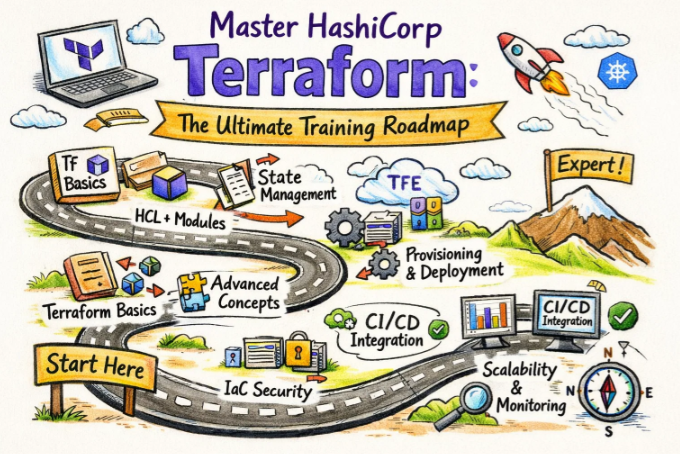
The concept of Hashicorp Terraform is understood as a fundamental pillar of modern cloud management. It is defined as a tool that enables the creation and modification of infrastructure through high-level configuration files. Instead of manual setups that are prone to errors, environments are described in code, allowing for consistency and version control. This approach is widely referred to as Infrastructure as Code (IaC).
For any professional operating in the software space, the ability to automate environment provisioning is no longer optional. It is regarded as a vital skill that separates traditional administration from modern engineering. By adopting Terraform, resources across multiple cloud providers are managed under a single, unified workflow.
The Strategic Importance of Infrastructure Automation
The transition from manual processes to automated workflows is seen as the most significant shift in the history of IT operations. When infrastructure is handled as code, the speed at which a business can innovate is greatly accelerated. Every server, network interface, and security group is documented within the code itself, ensuring that the knowledge of the system is never lost when a team member leaves.
For managers, automation represents a reduction in risk. High-stakes deployments are performed with higher confidence because the outcome is predictable. For engineers, it means the end of repetitive, boring tasks. Time is instead spent on building better architectures and improving system performance. This cultural shift toward automation is what powers the most successful tech companies today.
Expanding Horizons with Observability Engineering
Building the infrastructure is merely the first step in a long journey. Once a system is live, it must be understood from the inside out. This is where the Master in Observability Engineering Certifications Program becomes essential. While Terraform is used to construct the digital landscape, observability is used to shine a light on every corner of that landscape.
Through this specialized program, expertise is developed in monitoring, logging, and tracing. It is acknowledged that a deep understanding of system behavior is required to maintain high availability. Engineers who combine their automation skills with observability are positioned as elite architects. They don’t just build systems; they ensure those systems are resilient, transparent, and always optimized for the user experience.
Summary of Professional Certification
Choosing the right certification is a critical decision for career advancement. The following table highlights the essential details of the primary certification track.
| Track | Level | Who it’s for | Prerequisites | Skills covered | Recommended order |
| Infrastructure Automation | Associate | Engineers & Leaders | Cloud Fundamentals | HCL, State, Modules, Providers | Primary Step |
Hashicorp Certified Terraform Associate: A Detailed View
What it is
The Hashicorp Certified Terraform Associate is recognized as a prestigious validation of an individual’s ability to use the tool in a professional setting. It focuses on the core principles of the open-source software and tests the candidate on their understanding of the basic lifecycle of infrastructure. It is a benchmark for anyone who wishes to prove they are capable of working in a modern DevOps environment.
Who should take it
This credential is designed for software developers, system engineers, and security professionals. It is also highly beneficial for engineering managers who need to oversee automation projects. If a career path toward platform engineering or site reliability is desired, this certification is considered the most logical starting point.
Skills you’ll gain
The training program is designed to transform how an individual thinks about resources. Deep technical proficiency in managing the relationship between configuration files and real-world assets is developed.
- The ability to write clean, efficient code using the HashiCorp Configuration Language (HCL) is mastered.
- Complex workflows involving terraform state and locking mechanisms are understood.
- Skill in creating modular code for better reuse across different projects is acquired.
- Deep knowledge of how to interact with different cloud APIs through providers is established.
- Mastery over the command-line interface for day-to-day operations is achieved.
Real-world projects you should be able to do
After completing the certification, several advanced tasks can be handled with ease. These projects demonstrate the practical value of the training.
- An entire multi-cloud network infrastructure is deployed using a single repository.
- Automated scaling policies for web applications are written and tested.
- Security compliance is baked into the infrastructure through automated policy checks.
- Disaster recovery sites are launched automatically in response to regional outages.
Preparation plan
A disciplined study schedule is necessary to ensure success on the first attempt.
- 7–14 days: This plan is utilized by those who are already using the tool daily. Focus is placed on edge cases and less-used commands found in the official documentation.
- 30 days: This is the most common path. The first two weeks are spent on theoretical concepts, while the final two weeks are dedicated to building and destroying various lab environments.
- 60 days: This path is recommended for those new to the cloud. The first month is spent understanding how cloud providers work, followed by a month of intense Terraform practice.
Common mistakes
Many candidates fail to pass because of a few recurring errors that are easily avoided.
- Not enough time is spent practicing with the command line, leading to confusion during the exam.
- The importance of “State” management is underestimated, which is a major part of the technical assessment.
- Variables and outputs are not used correctly, leading to rigid and fragile code.
- The official documentation is not read thoroughly, causing candidates to miss important updates to the software.
Choose Your Path: 6 Strategic Learning Journeys
Automation is a versatile skill that can be applied in many different directions. The following paths are designed to help professionals specialize in their areas of interest:
- DevOps Path: Focus is placed on making infrastructure part of the continuous integration and delivery pipeline.
- DevSecOps Path: The primary goal is to ensure that security is treated as code and integrated into every deployment.
- SRE Path: Automation is used to maintain the highest levels of system uptime and reliability.
- AIOps/MLOps Path: Specialized infrastructure for artificial intelligence models is built and managed automatically.
- DataOps Path: The focus is on automating the flow of data and the infrastructure that supports large-scale analytics.
- FinOps Path: Automation is applied to cost management, ensuring that cloud resources are used efficiently without waste.
Role → Recommended Certifications Mapping
The following mapping is suggested to help individuals choose certifications based on their professional roles:
- DevOps Engineer: Terraform Associate + Kubernetes Specialist.
- SRE: Terraform Associate + Observability Expert.
- Platform Engineer: Terraform Associate + Multi-cloud Architect.
- Cloud Engineer: Terraform Associate + Specific Cloud Professional (AWS/Azure).
- Security Engineer: Terraform Associate + Security Automation.
- Data Engineer: Terraform Associate + Big Data Specialist.
- FinOps Practitioner: Terraform Associate + Cloud Economics.
- Engineering Manager: Terraform Associate + Strategic Tech Leadership.
Why Choose DevOpsSchool?
DevOpsSchool is regarded as a premier destination for high-quality technical education. The training is delivered by mentors who have spent years in the field, bringing a level of practical insight that is rarely found in standard textbooks. Every course is designed to be hands-on, ensuring that the skills learned are immediately applicable in a professional environment.
Furthermore, the support provided to students is exceptional. From comprehensive lab access to personalized guidance, every resource needed for success is made available. The community at DevOpsSchool is also a major benefit, as it allows learners to connect with other professionals and stay updated on the latest industry trends. Choosing this institution is seen as a commitment to excellence and career growth.
Next Certifications to Take
Once the initial certification is achieved, growth is encouraged in the following directions:
- Same Track: Deepen your knowledge within the Hashicorp suite by pursuing security automation or service networking.
- Cross-Track: Expand into container orchestration or advanced cloud architecture to build a more rounded skill set.
- Leadership: Focus on certifications that bridge the gap between technical execution and business strategy.
Top Institutions for Training and Certification
This institution is highly praised for its rigorous curriculum and focus on real-world application. They provide a supportive environment where complex topics are broken down into easy-to-understand modules.
Cotocus
A focus on enterprise-level training is maintained by this provider. They are known for helping large teams modernize their workflows through intensive, hands-on workshops.
Scmgalaxy
This platform is a major source of knowledge for the global DevOps community. It offers a wide array of tutorials and community support for engineers at all levels.
BestDevOps
Specialized training for career advancement is offered here. The programs are designed to help professionals transition into high-paying roles within the cloud ecosystem.
DevSecOpsSchool
Education at this school is focused on the intersection of security and automation. They teach how to build systems that are secure by design.
Sreschool
The principles of system reliability and performance are the main focus. It is an ideal choice for those looking to master the art of maintaining large-scale systems.
Aiopsschool
The future of operations is explored here, with a focus on how artificial intelligence can be used to improve system management.
Dataopsschool
This institution provides the skills needed to manage the complex infrastructure required for modern data science and analytics.
Finopsschool
The financial management of cloud resources is taught here, helping organizations save money while maintaining performance.
FAQs (Focus on Career Outcomes)
1. Is this certification considered difficult for a beginner?
It is viewed as a fair test of knowledge. With consistent study, even those new to the field can achieve success.
2. How much time should be dedicated to study each day?
One to two hours of focused study per day is usually recommended for most working professionals.
3. Are there any prerequisites for taking the exam?
While no formal certifications are required beforehand, a basic understanding of cloud concepts is expected.
4. What is the recommended sequence for someone starting in DevOps?
The Terraform Associate is often taken first, followed by a certification in container management.
5. How is the value of this certification measured in the industry?
It is recognized as a standard proof of competence in infrastructure automation by employers globally.
6. What kind of salary growth is typically seen?
Many professionals report significant salary increases after adding this certification to their profiles.
7. Can the exam be passed using only online videos?
Hands-on practice is considered essential. Video courses are helpful, but building actual projects is what ensures a pass.
8. Does the certification remain valid forever?
No, it is generally valid for two years, reflecting the fast-paced changes in the software.
9. How does Terraform differ from other configuration tools?
Its ability to work across different cloud providers is its most significant advantage.
10. Is a background in coding required to learn Terraform?
Basic logic is helpful, but the language used is designed to be simple and easy to read for everyone.
11. Why is observability mentioned alongside Terraform?
They are two sides of the same coin: one builds the system, and the other ensures it stays healthy.
12. Is it worth it for a manager to get certified?
Yes, it provides the technical context needed to lead teams and set realistic project timelines.
FAQs on Hashicorp Terraform Training & Certification Program
1. Where can I find the official registration link?
The registration and course details are located at the official site.
2. What is the format of the questions on the exam?
A mix of multiple-choice, multiple-response, and true/false questions is used to test candidates.
3. Is lab access provided during the training?
Yes, top-tier training providers like DevOpsSchool include dedicated lab environments for practice.
4. Can the exam be taken from home in India?
Online proctored exams are available globally, allowing for a convenient testing experience from any location.
5. What is the minimum score required to pass?
A score in the range of 70% is typically required to earn the certification.
6. What happens if I fail the exam on the first try?
A retake can be scheduled after paying the fee and waiting for the required period.
7. Are these certifications recognized by the major cloud providers?
Yes, Hashicorp tools are used extensively within AWS, Azure, and Google Cloud environments.
8. Will this help me in my day-to-day work as a software engineer?
The skills gained will allow for more independence in managing development and testing environments.
Testimonials
“The training offered a complete transformation in how I view system administration. The practical sessions were key to my success.” – Karan
“A very well-structured program that covers everything from the basics to advanced modules. The mentors were incredibly helpful.” – Deepika
“The best investment I have made for my career. The certification opened up new opportunities that were not available to me before.” – Rohan
Conclusion
The pursuit of mastery in Hashicorp Terraform is a transformative journey for any tech professional. It is observed that as organizations move deeper into the cloud, the reliance on manual processes is fading away. By becoming an expert in infrastructure automation, an individual is not just learning a tool; they are adopting a more efficient and reliable way of working. This guide has outlined the path from understanding the basics to achieving a professional certification that is recognized worldwide. When combined with a focus on observability and a commitment to continuous learning, the possibilities for career growth are endless. Whether the goal is to become a senior engineer or a strategic manager, the skills gained through this program form the foundation of a successful future in the technology industry.
