Upgrade & Secure Your Future with DevOps, SRE, DevSecOps, MLOps!
We spend hours scrolling social media and waste money on things we forget, but won’t spend 30 minutes a day earning certifications that can change our lives.
Master in DevOps, SRE, DevSecOps & MLOps by DevOps School!
Learn from Guru Rajesh Kumar and double your salary in just one year.
Introduction
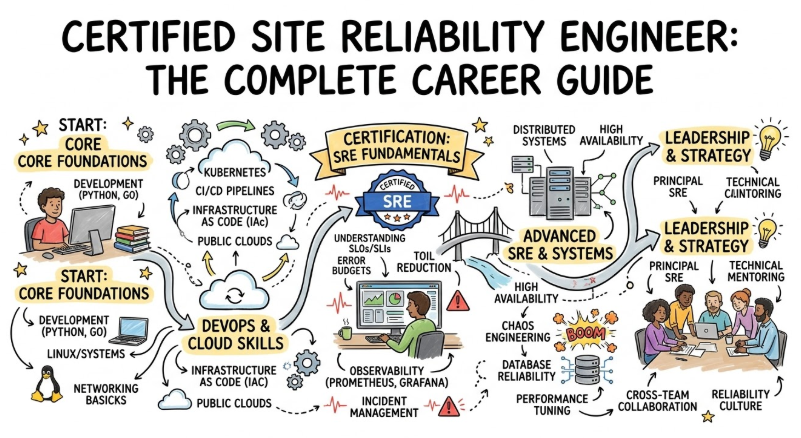
The role of a Site Reliability Engineer has transitioned from a niche Google-inspired experiment to the backbone of modern digital enterprises. As organizations shift toward cloud-native architectures and complex microservices, the need for professionals who can balance feature velocity with system stability has never been higher. This guide is designed for software engineers, platform specialists, and technical leaders who want to master the art of production excellence through the Certified Site Reliability Engineer program. By following this roadmap, professionals can move beyond basic automation and embrace a data-driven approach to reliability. Whether you are looking to pivot your career or solidify your expertise within a DevOpsschool framework, this guide provides the clarity needed to make informed career decisions.
What is the Certified Site Reliability Engineer?
The Certified Site Reliability Engineer designation represents a professional standard for engineers who manage the intersection of software engineering and systems operations. It exists to bridge the gap between traditional IT operations and modern, high-speed software development life cycles. This certification focuses on the practical application of SRE principles such as Service Level Objectives (SLOs), error budgets, and toil reduction.
Unlike theoretical courses, this program emphasizes real-world, production-focused learning. It aligns with modern engineering workflows by teaching participants how to handle high-scale distributed systems and implement automated incident response. In an enterprise environment, this certification proves that an engineer can maintain uptime and performance without sacrificing the speed of innovation.
Who Should Pursue Certified Site Reliability Engineer?
This certification is designed for a broad spectrum of technical professionals, ranging from junior developers to seasoned infrastructure architects. Software engineers looking to understand the operational impact of their code will find the curriculum invaluable. Similarly, DevOps, platform, and cloud engineers can use this track to specialize in high-availability systems.
The program also caters to security and data professionals who need to ensure the reliability of sensitive pipelines and protected environments. In the Indian market and across the global tech landscape, engineering managers and technical leaders pursue this certification to better structure their teams around reliability-first cultures. It provides a common language for both beginners entering the field and experienced engineers looking to validate their years of “on-the-job” knowledge.
Why Certified Site Reliability Engineer is Valuable Now and Beyond
The demand for SREs continues to grow as companies realize that downtime is not just a technical failure but a significant business risk. As enterprise adoption of Kubernetes, multi-cloud, and serverless technologies increases, the complexity of managing these systems requires a specialized skill set. This certification ensures that professionals remain relevant even as specific tools change, by focusing on the underlying principles of reliability engineering.
Investing time in this certification offers a high return on career investment because SRE skills are highly transferable across industries. Whether an organization is in fintech, healthcare, or e-commerce, the need for stable systems is universal. By mastering these concepts, you move from being a “tool operator” to a “reliability architect,” securing your place in the long-term evolution of the software industry.
Certified Site Reliability Engineer Certification Overview
The program is delivered via sreschool and hosted on sreschool.com. It is structured as a comprehensive professional development path that covers the entire SRE lifecycle. The assessment approach is practical, often involving hands-on scenarios that mirror the challenges faced in live production environments.
The ownership and structure of the certification are designed to meet industry standards for technical excellence. It moves beyond simple multiple-choice questions to ensure that candidates truly understand how to implement observability, manage incidents, and automate repetitive tasks. This practical focus ensures that anyone holding the certification is ready to contribute to a production team from day one.
Certified Site Reliability Engineer Certification Tracks & Levels
The certification is divided into distinct levels to accommodate different stages of a professional’s career. The Foundation level introduces the core vocabulary and concepts, making it ideal for those new to the SRE philosophy. The Professional level dives deeper into implementation, focusing on building and maintaining the infrastructure required for reliable services.
For seasoned experts, the Advanced level explores complex topics like chaos engineering and multi-region resilience. Specialization tracks allow professionals to align their SRE knowledge with other disciplines such as DevOps, FinOps, or Security. This tiered approach ensures a logical career progression, allowing an engineer to grow from an individual contributor to a strategic lead within their organization.
Complete Certified Site Reliability Engineer Certification Table
| Track | Level | Who it’s for | Prerequisites | Skills Covered | Recommended Order |
| Core SRE | Foundation | Junior Engineers, Managers | Basic Linux & Coding | SLOs, SLIs, Toil, On-call | 1 |
| Core SRE | Professional | SREs, DevOps Engineers | 2+ years Experience | Observability, Automation | 2 |
| Core SRE | Advanced | Senior SREs, Architects | Professional Level | Chaos Engineering, Scaling | 3 |
| SRE + Security | Specialist | Security Engineers | Core Foundation | DevSecOps, Secure SRE | 4 |
| SRE + FinOps | Specialist | Cloud Architects | Core Foundation | Cost-aware Reliability | 4 |
| SRE + Platform | Specialist | Platform Engineers | Professional Level | Internal Dev Platforms | 5 |
Detailed Guide for Each Certified Site Reliability Engineer Certification
What it is
This certification validates a candidate’s understanding of the core SRE philosophy and vocabulary. It ensures that the individual understands how SRE differs from traditional operations and DevOps.
Who should take it
It is suitable for junior developers, system administrators, and project managers. Anyone looking to build a strong theoretical and practical baseline in reliability should start here.
Skills you’ll gain
- Defining SLIs and SLOs.
- Understanding the concept of Error Budgets.
- Identifying and reducing Toil in operations.
- Basics of Incident Management and Post-mortems.
Real-world projects you should be able to do
- Create a reliability dashboard for a simple web application.
- Conduct a blameless post-mortem for a simulated outage.
- Calculate an error budget for a monthly release cycle.
Preparation plan
- 7–14 days: Review the SRE handbook and practice defining service level indicators.
- 30 days: Complete the foundation coursework and participate in mock incident drills.
- 60 days: Engage in peer discussions and apply the concepts to a small-scale personal project.
Common mistakes
- Confusing SLAs with SLOs during the assessment.
- Focusing too much on specific tools rather than the SRE mindset.
- Underestimating the importance of “blameless” culture in the exam scenarios.
Best next certification after this
- Same-track option: Certified Site Reliability Engineer – Professional
- Cross-track option: Certified DevOps Professional
- Leadership option: Engineering Management Foundation
Choose Your Learning Path
DevOps Path
The DevOps path focuses on the integration of development and operations through automation. Professionals here learn to build robust CI/CD pipelines that incorporate SRE principles as “quality gates.” The goal is to ensure that code moves to production quickly but safely. It is the ideal path for those who enjoy coding and infrastructure-as-code.
DevSecOps Path
In the DevSecOps path, reliability is viewed through the lens of security. Engineers learn how to automate security checks and ensure that the systems are not only available but also hardened against attacks. This path bridges the gap between the SRE’s focus on uptime and the Security Engineer’s focus on integrity. It is essential for professionals in regulated industries.
SRE Path
The pure SRE path is dedicated to the science of reliability and system performance. It focuses heavily on observability, incident response, and the mathematical modeling of system health. Engineers on this path are the “guardians of production,” ensuring that the user experience remains consistent. This is the most direct path for those wanting to specialize in large-scale operations.
AIOps Path
The AIOps path explores the use of machine learning to enhance system reliability. Professionals learn how to use AI to predict outages, automate root cause analysis, and manage massive volumes of telemetry data. This path is perfect for engineers who want to stay at the cutting edge of automated operations. It transforms reactive monitoring into proactive intelligence.
MLOps Path
The MLOps path is designed for those managing the lifecycle of machine learning models in production. SRE principles are applied to ensure that data pipelines and model inference services are reliable and scalable. This path addresses the unique reliability challenges of stateful AI applications. It is critical for data-driven organizations looking to productionize their AI research.
DataOps Path
The DataOps path applies SRE methodologies to data engineering and analytics. It focuses on the reliability of data pipelines, ensuring that data is delivered accurately and on time. Engineers learn to treat data as a product that requires its own set of SLOs and error budgets. This path is vital for companies where data-driven decision-making is core to the business.
FinOps Path
The FinOps path merges SRE principles with cloud financial management. Engineers learn to build systems that are not only reliable but also cost-optimized. This involves understanding how architectural choices impact the cloud bill and ensuring that reliability doesn’t come at an unsustainable price. It is the perfect path for those looking to have a direct impact on the company’s bottom line.
Role → Recommended Certified Site Reliability Engineer Certifications
| Role | Recommended Certifications |
| DevOps Engineer | Certified Site Reliability Engineer – Professional |
| SRE | Certified Site Reliability Engineer – Advanced |
| Platform Engineer | Certified Site Reliability Engineer – Professional + Specialist |
| Cloud Engineer | Certified Site Reliability Engineer – Foundation |
| Security Engineer | Certified Site Reliability Engineer – Specialist (Security) |
| Data Engineer | Certified Site Reliability Engineer – Specialist (DataOps) |
| FinOps Practitioner | Certified Site Reliability Engineer – Specialist (FinOps) |
| Engineering Manager | Certified Site Reliability Engineer – Foundation |
Next Certifications to Take After Certified Site Reliability Engineer
Same Track Progression
Once you have mastered the SRE levels, you should look toward deep specialization. This might involve focusing on specific platforms like Kubernetes or deep-diving into observability tools. The goal is to become the go-to expert for complex reliability challenges within your specific technology stack. Deep specialization often leads to Principal or Staff Engineer roles.
Cross-Track Expansion
Broadening your skills into adjacent areas like security or data can make you an indispensable asset. An SRE with strong security knowledge (DevSecOps) or an SRE who understands data pipelines (DataOps) is highly valued in modern enterprises. This expansion allows you to oversee entire platform ecosystems rather than just individual services.
Leadership & Management Track
For those looking to move away from day-to-day coding, the leadership track is the natural next step. This involves moving into Engineering Management or Technical Program Management. Here, you use your SRE background to build high-performing teams and shape the engineering culture of the entire organization. You shift from managing systems to managing the people who build them.
Training & Certification Support Providers for Certified Site Reliability Engineer
DevOpsSchool provides comprehensive training programs that cover the entire SRE and DevOps spectrum. Their curriculum is designed by industry experts to ensure that students gain practical, job-ready skills. They offer a blend of live sessions and recorded content, making it accessible for working professionals looking to upskill.
Cotocus focuses on high-end technical consulting and specialized training in cloud-native technologies. Their approach to SRE training involves deep dives into infrastructure automation and container orchestration. They are known for their hands-on labs and real-world project scenarios that prepare candidates for high-stakes production environments.
Scmgalaxy is a community-driven platform that offers extensive resources for SRE and configuration management. They provide a wealth of tutorials, blog posts, and practice exams to help engineers stay current with industry trends. Their focus is on continuous learning and providing a supportive environment for technical growth.
BestDevOps offers tailored training solutions for teams and individuals looking to adopt modern engineering practices. They emphasize the cultural shift required for SRE, alongside the technical tools. Their trainers bring years of experience from top-tier tech companies to provide a realistic perspective on system reliability.
devsecopsschool.com specializes in the intersection of security and operations. Their training programs ensure that reliability engineers understand how to integrate security into every stage of the lifecycle. They provide specialized certifications that are highly regarded in sectors where compliance and data protection are paramount.
sreschool.com is the primary host for the Certified Site Reliability Engineer program. They offer a structured learning path that guides candidates from the basics to advanced architectural concepts. Their focus is entirely on the SRE discipline, ensuring a deep and focused educational experience for all students.
aiopsschool.com focuses on the future of operations through artificial intelligence and machine learning. Their courses teach engineers how to build intelligent systems that can self-heal and predict failures. It is the premier destination for those looking to master AIOps and stay ahead of the automation curve.
dataopsschool.com provides training on how to apply SRE and DevOps principles to the world of big data. They address the specific challenges of data pipeline reliability and quality. Their curriculum is essential for data engineers who want to move away from manual intervention and toward automated data operations.
finopsschool.com addresses the growing need for cloud financial management within the engineering community. They teach SREs and architects how to build cost-effective systems without compromising on performance. Their certifications help professionals bridge the gap between technical design and business profitability.
Frequently Asked Questions (General)
How difficult is the Certified Site Reliability Engineer exam?
The exam is designed to be challenging but fair. It tests practical application rather than rote memorization. If you have hands-on experience and have followed the curriculum, you will find it manageable. It is intended to separate practitioners from those who only have theoretical knowledge.
How much time does it take to get certified?
Depending on your experience level, it can take anywhere from 30 to 90 days. Beginners may need more time to grasp the core concepts, while experienced engineers might focus on specific modules they are less familiar with. Consistency in study and practice is key to finishing within a reasonable timeframe.
Are there any prerequisites for the foundation level?
There are no formal prerequisites, but a basic understanding of Linux, networking, and at least one programming language (like Python or Go) is highly recommended. Being comfortable with the command line will make the practical portions of the course much easier to navigate.
What is the ROI of this certification?
The ROI is significant in terms of both salary potential and job security. Certified SREs often command higher salaries than generalist DevOps engineers. Furthermore, the skills you learn help you reduce outages in your current role, which directly impacts your performance reviews and career growth.
Can I take the exam online?
Yes, the certification is designed to be accessible globally through an online proctored format. This allows you to take the exam from the comfort of your home or office. Ensure you have a stable internet connection and a quiet environment for the duration of the test.
Is the certification recognized globally?
Yes, the standards taught in the program are based on global best practices used by companies like Google, Netflix, and Amazon. The certification is recognized by enterprises worldwide as a mark of quality and technical proficiency in the field of reliability engineering.
How often do I need to renew the certification?
To ensure that certified professionals stay current with the rapidly changing tech landscape, a renewal is typically required every two years. This can be achieved by taking a refresher course or by demonstrating continued professional development in the field.
Does the course cover specific tools like Terraform or Kubernetes?
While the certification focuses on principles, it uses industry-standard tools for its practical labs. You will get experience with orchestration, monitoring, and infrastructure-as-code tools as they relate to achieving reliability goals.
What is the difference between SRE and DevOps?
DevOps is a cultural philosophy focused on breaking down silos, while SRE is a specific implementation of that philosophy. As the saying goes, “class SRE implements interface DevOps.” SRE provides the concrete metrics and practices to make the DevOps goals a reality.
Is this certification suitable for managers?
Yes, the foundation level is excellent for managers who need to understand the language and metrics their teams are using. It helps leaders set realistic expectations and build a culture that supports reliability and long-term system health.
What kind of support is available during the learning process?
Students have access to community forums, expert-led webinars, and comprehensive documentation. Many training providers also offer mentorship programs where you can get direct feedback on your progress and technical challenges.
Are there hands-on labs included in the training?
Yes, the program emphasizes “learning by doing.” You will have access to virtual lab environments where you can practice setting up monitoring, simulating outages, and writing automation scripts in a safe, controlled setting.
FAQs on Certified Site Reliability Engineer
What is the core focus of the Certified Site Reliability Engineer program?
The core focus is to teach engineers how to treat operations as a software engineering problem. This includes using code to manage systems, defining clear reliability targets through SLOs, and using data to make informed decisions about when to launch new features versus when to focus on stability.
How does this certification help with incident management?
It provides a structured framework for handling incidents, from the initial alert to the final post-mortem. You will learn how to organize an on-call rotation that doesn’t lead to burnout and how to conduct blameless reviews that focus on improving the system rather than pointing fingers.
Does the program cover Cloud-Native concepts?
Absolutely. The curriculum is built around modern, cloud-native architectures. You will learn how to manage reliability in environments that use containers, microservices, and dynamic scaling. This makes the certification highly relevant for anyone working in AWS, Azure, or Google Cloud.
Why are SLOs emphasized so much in the training?
SLOs are the “heartbeat” of SRE. Without them, you cannot objectively measure if a system is “reliable enough.” The training teaches you how to negotiate these targets with business stakeholders so that everyone is aligned on what constitutes a successful service.
How does the certification address the concept of “Toil”?
The program teaches you how to identify and measure toil—the repetitive, manual work that doesn’t provide long-term value. You will learn strategies for automating these tasks so that engineers can focus on high-value projects that improve the system’s architecture and resilience.
Is Chaos Engineering part of the curriculum?
Yes, particularly at the professional and advanced levels. You will learn the principles of “breaking things on purpose” to uncover hidden weaknesses in your system before they cause real-world outages. This proactive approach is a hallmark of an advanced SRE.
Can I transition from a traditional SysAdmin role to SRE using this?
This is one of the primary use cases for the certification. It provides the software engineering mindset and automation skills that traditional system administrators need to evolve into the SRE role. It acts as a bridge between the old and new ways of managing infrastructure.
What is the value of the “Blameless Culture” module?
Technical skills alone are not enough for reliability. The program teaches the cultural aspects of SRE, emphasizing that human error is usually a symptom of a systemic problem. Learning how to foster a blameless culture is essential for building a team that continuously improves.
Final Thoughts:
As a mentor who has seen the industry evolve over the last two decades, I can say that the shift toward SRE is not a passing trend. It is a fundamental change in how we build and maintain software. If you are looking for a way to future-proof your career, the Certified Site Reliability Engineer program is a sound investment. It moves you away from the “firefighting” mentality of traditional operations and gives you the tools to build systems that are inherently resilient.
There is no hype here—just the reality that reliable systems are built by engineers who understand the balance between risk and reward. This certification doesn’t just give you a title; it gives you a methodology for solving complex problems at scale. Whether you are in India or working for a global firm, these skills will make you a more effective, more valuable, and more confident engineer. If you are willing to put in the work to master the labs and understand the philosophy, the path to becoming a top-tier SRE is open to you.