Upgrade & Secure Your Future with DevOps, SRE, DevSecOps, MLOps!
We spend hours scrolling social media and waste money on things we forget, but won’t spend 30 minutes a day earning certifications that can change our lives.
Master in DevOps, SRE, DevSecOps & MLOps by DevOps School!
Learn from Guru Rajesh Kumar and double your salary in just one year.
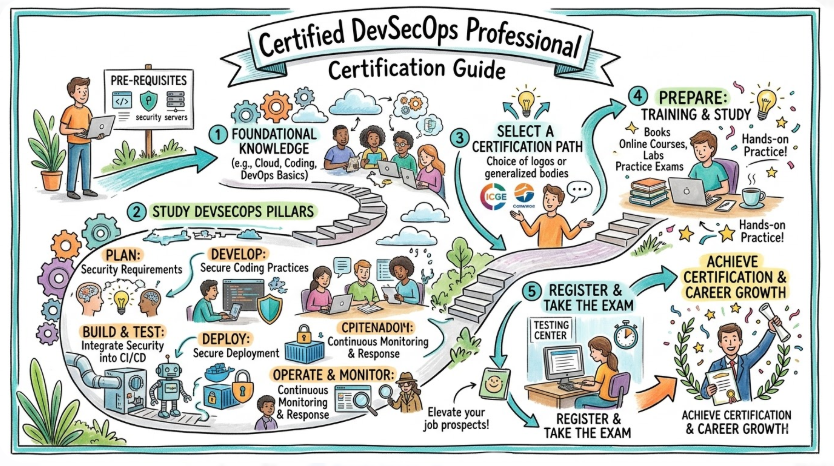
The software industry has reached a tipping point. For years, the focus was purely on the velocity of delivery—getting features to the user as fast as possible. But in today’s climate of sophisticated threats and complex cloud-native architectures, speed without safety is a liability. For engineers and managers in India and across the global tech landscape, the goal has shifted: we must now build systems that are inherently resilient.
As someone who has navigated the transition from monolithic local servers to globally distributed micro-services, I can tell you that the most significant risk we face isn’t slow code—it’s insecure code. This guide is designed to walk you through the Certified DevSecOps Professional (CDP) journey, a path that turns standard automation into a robust defense mechanism for your organization.
The New Reality: Security as a Cultural Standard
We are moving away from the era where security was a separate department that performed audits at the end of a project. That model simply cannot keep up with modern CI/CD cycles. Instead, we are seeing the rise of the “Security-First” engineer.
This isn’t just about learning new software; it’s about a cultural transformation where security becomes a shared responsibility. Whether you are a Software Engineer or a Lead Manager, understanding how to “Shift Left”—integrating security at the very beginning of the development process—is the most effective way to protect the business and your career longevity.
Deep Dive: Certified DevSecOps Professional
The Certified DevSecOps Professional (CDP) serves as the gold standard for validating that an engineer can manage the high-stakes intersection of development, operations, and security.
What it is
The Certified DevSecOps Professional (CDP) is a technical certification that bridges the gap between high-speed delivery and ironclad security. It is a hands-on program designed to teach you how to automate security within the DevOps lifecycle. Instead of focusing on abstract theories, this program requires you to physically build and secure pipelines, scan for vulnerabilities in real-time, and implement “Security as Code.”
Who should take it
- Active Software Engineers: Developers who want to move beyond writing code and start architecting secure, production-ready applications.
- DevOps & SRE Leads: Professionals responsible for the infrastructure who need to ensure every deployment is scanned and compliant by default.
- Security Practitioners: Traditional security analysts who want to modernize their skills and learn to code automated security gates.
- Engineering Managers: Leaders who need to supervise the implementation of secure software development lifecycles (SDLC) across their departments.
Skills you’ll gain
This certification provides a comprehensive toolkit for the modern automated environment. You will gain a deep technical understanding of:
- Automated Pipeline Hardening: Learn to integrate security checkpoints into Jenkins, GitLab, or GitHub Actions so that no “leaky” code ever reaches a server.
- Vulnerability Assessment (SAST/DAST): Mastery of tools that scan static source code and dynamic, running applications to find flaws before hackers do.
- Supply Chain Integrity: Learning to use Software Composition Analysis (SCA) to identify risks in the thousands of third-party libraries that modern apps rely on.
- Container and Cluster Security: Gaining the ability to secure Docker images and manage the complex network policies of Kubernetes.
- Infrastructure Governance: Automating the review of Terraform and Ansible scripts to prevent misconfigured clouds.
- Secrets Management: Setting up centralized vaults to ensure that passwords, tokens, and API keys are never exposed in a repository.
Real-world projects you should be able to do after it
The value of the CDP is measured by what you can execute in a production environment. After completion, you will be able to:
- Architect a “Gatekeeper” CI/CD Pipeline: A system that automatically blocks any deployment containing a high-severity security flaw.
- Build a Continuous Compliance Engine: A framework that monitors your cloud environment 24/7 and alerts you the moment a resource falls out of compliance with global standards.
- Implement a Secure Image Registry: A pipeline that automatically rebuilds and patches base images the moment a new vulnerability (CVE) is announced.
- Deploy a Zero-Trust Secret System: A company-wide implementation where applications dynamically fetch credentials only when needed, leaving no footprints for attackers.
Preparation plan
Your study schedule should be determined by your current technical maturity.
- The 7–14 Day Sprint: Best for those already working with Docker and Jenkins. Focus purely on the security tool integrations and mastering the lab environments.
- The 30-Day Professional Track: Spend two weeks on the foundations of SAST/DAST and SCA, then two weeks on advanced container and pipeline security projects.
- The 60-Day Foundation Path: Spend the first month mastering the basics of automation (Linux, Git, CI/CD). Spend the second month applying the security modules of the CDP curriculum.
Common mistakes
I have seen many talented engineers struggle with this transition because they fall into these traps:
- Treating Security as a “Gate” Instead of a “Process”: Security shouldn’t stop development; it should enable it. Avoid creating barriers that frustrate your team.
- Ignoring the Logic Behind the Tools: Don’t just learn which buttons to click in a scanner. Learn why the vulnerability exists and how to coach a developer to fix the root cause.
- Skipping the Hardened Lab Practice: This is a performance-based certification. If you don’t spend significant time in the labs, you will likely struggle during the practical examination.
Global Comparison: Mapping the Software Engineering Landscape
To understand where DevSecOps fits in your long-term growth, refer to this mapping of top certifications curated from Gurukul Galaxy’s latest industry data.
| Track | Level | Who it’s for | Prerequisites | Skills Covered | Recommended Order |
| DevSecOps | Professional | Engineers/Managers | DevOps Basics | SAST, DAST, SCA, CI/CD | 1st (Core Defense) |
| Observability | Master | Senior Engineers | 2+ Years Exp. | Metrics, Tracing, SLOs | 2nd (Production Vision) |
| SRE | Professional | SREs/Ops | Cloud Basics | Error Budgets, Incident Mgmt | 1st (Reliability) |
| AIOps | Professional | Data/Ops | Python/Stats | Anomaly Detection, ML | 3rd (Future Intelligence) |
| FinOps | Associate | Managers/Architects | Cloud Basics | Cost Governance, Showback | 2nd (Cloud Economics) |
Choose Your Path: 6 Specialized Career Tracks
Modern engineering allows for high levels of specialization. Select the path that fits your natural strengths:
- The DevOps Path: Focus on the speed and efficiency of the delivery lifecycle.
- The DevSecOps Path: Focus on building secure, automated pipelines and “Security as Code.”
- The SRE Path: Focus on the reliability, scalability, and high availability of global systems.
- The AIOps/MLOps Path: Focus on using data science and AI to automate infrastructure decisions.
- The DataOps Path: Focus on the secure and efficient management of high-speed data pipelines.
- The FinOps Path: Focus on the intersection of cloud performance and financial accountability.
Role → Recommended Certifications Mapping
Identify your current role or your next target to see the most effective certification sequence:
- DevOps Engineer: DevOps Professional → Certified DevSecOps Professional.
- SRE: SRE Professional → Master in Observability Engineering.
- Platform Engineer: Kubernetes Specialist → Certified DevSecOps Professional.
- Cloud Engineer: Cloud Architect → Certified DevSecOps Professional.
- Security Engineer: Ethical Hacking → Certified DevSecOps Professional.
- Data Engineer: DataOps Professional → Master in Observability Engineering.
- FinOps Practitioner: FinOps Associate → Master in Observability Engineering.
- Engineering Manager: DevSecOps Manager → Master in Observability Engineering.
Centers of Excellence: Leading Training Institutions
Selecting a training partner is as important as the certification itself. These institutions are recognized for their commitment to providing the hands-on support needed for the Certified DevSecOps Professional.
DevOpsSchool
DevOpsSchool is a global leader in high-touch, mentor-driven education. They specialize in deep-dive technical programs that ensure you don’t just pass an exam but are ready to lead a transformation in a real-world enterprise environment.
Cotocus
Cotocus is highly regarded for its corporate-focused training. They provide a practical bridge for engineers who need to understand the latest cloud-native technologies and apply them immediately in high-growth tech environments.
Scmgalaxy
Scmgalaxy serves as a massive community hub for automation professionals. They provide a wealth of resources and specialized training focusing on the intricate details of software configuration and build security.
BestDevOps
BestDevOps offers streamlined, high-impact training for the working professional. Their modules are designed to solve the immediate technical challenges of engineering teams while paving a clear path to career advancement.
This institution is dedicated specifically to the “Sec” in DevSecOps. Their programs are designed to turn engineers into security architects, focusing heavily on automated defense and pipeline hardening.
sreschool
SRESchool provides the definitive training for those who want to master the science of reliability. They teach the specific mindsets and tools needed to maintain massive, distributed systems with zero downtime.
aiopsschool
AIOpsSchool is at the forefront of the next operational wave. They provide the training needed to use artificial intelligence to manage systems that have grown too large for human intervention.
dataopsschool
DataOpsSchool addresses the growing need for reliability in big data. They teach how to apply DevOps principles to data engineering, ensuring that data is both high-quality and highly secure.
finopsschool
FinOpsSchool focuses on the bottom line of the cloud. They provide the framework for financial accountability, teaching managers and engineers how to optimize cloud costs without sacrificing performance.
Next Step Certification Options:
- Same Track: Certified DevSecOps Expert – for those aiming for the pinnacle of technical defense.
- Cross-Track: Master in Observability Engineering – to gain total transparency and feedback into your production systems.
- Leadership Track: Engineering Management Masterclass – for those ready to move into strategic, high-level leadership roles.
FAQs – Career & Market Growth
- Is DevSecOps still relevant with the rise of AI? More than ever. AI can write code faster, but it can also introduce vulnerabilities faster. Automated security is the only way to manage that risk.
- How do these certifications impact salary in India? DevSecOps and SRE are currently among the top 3 highest-paying technical specializations in the Indian IT sector.
- Can I jump straight to the Master in Observability? We recommend having a solid foundation in secure operations (CDP) first so you understand the context of what you are observing.
- Are these recognized by global SaaS companies? Yes, the skills taught (SAST, DAST, O11y) are the global standards used by companies like Meta, Netflix, and Amazon.
- How much code do I need to know? You should be comfortable with basic scripting (Python/Bash) and YAML. You don’t need to be a full-stack developer.
- Can a manager benefit from a technical certification? Yes. It provides the technical literacy needed to lead high-performing teams and make better budget decisions.
- Is the CDP exam practical or theoretical? It is a practical, performance-based exam where you solve real-world security challenges in a lab.
- How does FinOps help my career? It allows you to prove the financial value of your engineering decisions to the C-suite.
- What if I have no cloud experience? Start with the 60-day foundation plan offered by institutions like DevOpsSchool to build your basics first.
- Is there a community for networking? Yes, platforms like Scmgalaxy offer massive communities of like-minded professionals for support.
- How long should I study each day? For a working professional, 1.5 to 2 hours of focused study is usually sufficient to complete the 30-day path.
- Do these certifications expire? Industry standards recommend a refresh every 2–3 years to keep up with the rapid pace of technology.
FAQs – Certified DevSecOps Professional Focus
- What is the core focus of the CDP? Automating the security of the software delivery pipeline.
- Does it cover Kubernetes? Yes, securing containers and orchestration layers is a central pillar of the certification.
- What tools are covered? Industry standards like Snyk, SonarQube, Zap, Vault, and various open-source security tools.
- What is “Shift Left”? It is the practice of moving security testing to the earliest possible stage of the development cycle.
- Is the training available online? Yes, most authorized institutions provide both live instructor-led and self-paced online options.
- Does CDP help with security compliance audits? Yes, it teaches you how to automate the collection of evidence for frameworks like SOC2.
- Is there a focus on “Security as Code”? Yes, the primary goal is to turn security policies into machine-readable, automated scripts.
- Can I take the exam from home? Yes, proctored online exams are available through authorized providers.
Conclusion
The journey toward becoming a Certified DevSecOps Professional represents a fundamental upgrade in your engineering identity. In an era where a single security breach can define a company’s future, the ability to build and automate secure delivery systems is the ultimate competitive advantage. By committing to this path—and eventually expanding your vision through the Master in Observability Engineering—you are ensuring that your technical skills remain resilient, relevant, and in high demand. The future of engineering belongs to those who can move fast without breaking things, and this guide is your first step toward that mastery.