Upgrade & Secure Your Future with DevOps, SRE, DevSecOps, MLOps!
We spend hours scrolling social media and waste money on things we forget, but won’t spend 30 minutes a day earning certifications that can change our lives.
Master in DevOps, SRE, DevSecOps & MLOps by DevOps School!
Learn from Guru Rajesh Kumar and double your salary in just one year.
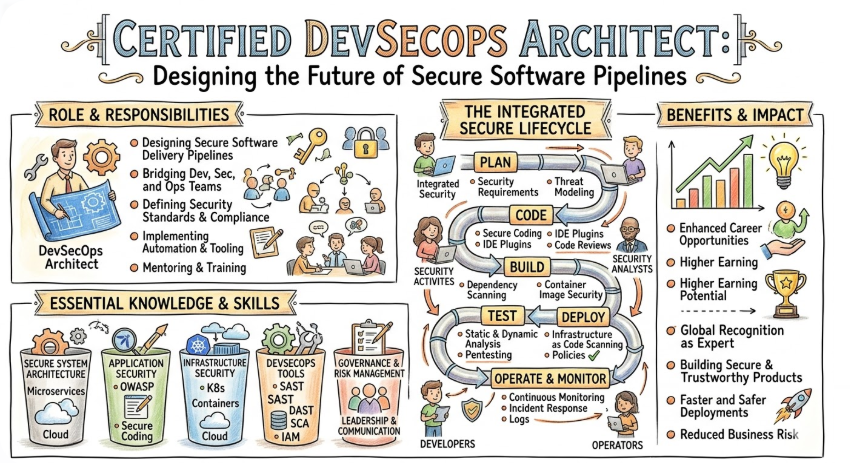
Modern engineering is hitting a wall. We release code in minutes, but security often takes days. This mismatch is where projects fail and budgets break. If you are an engineer or a manager, you have seen the “firefighting” that happens when a vulnerability is found too late. The solution isn’t just more tools; it’s better architecture.
This roadmap is designed for those ready to move from execution to strategy. Becoming a Certified DevSecOps Architect is about learning how to build a fortress that doesn’t slow down the builders. Whether you are leading a team in India or working with a global tech giant, this is how you lead the future of secure software delivery.
The Certification Landscape: A Career Blueprint
To climb the professional ladder, you need a structured plan. The following table maps out how to layer your expertise, starting with the core of security architecture.
| Track | Level | Who it’s for | Prerequisites | Skills Covered | Recommended Order |
| Security Architecture | Master/Architect | Senior Eng, Managers, Architects | DevOps Basics, Cloud Knowledge | Threat Modeling, SCA, SAST, DAST, Compliance as Code | 1 (Core) |
| Observability | Specialist | SRE, Security Eng, Architects | Infrastructure Knowledge | Tracing, Logging, SLOs, Incident Response | 2 (Advanced) |
| Reliability | Specialist | SREs, Cloud Engineers | K8s Knowledge | Error Budgets, Scaling, Post-mortems | 3 (Complementary) |
| Cost Optimization | Specialist | FinOps, Managers | Cloud Economics | Resource Tagging, Budgeting, Governance | 4 (Business) |
| AI Operations | Specialist | MLOps, Tech Leads | Data Science Basics | Automated Remediation, Predictive Scaling | 5 (Future-Ready) |
Deep Dive: Certified DevSecOps Architect
What it is
The Certified DevSecOps Architect program is a high-level mastery track. It focuses on the “Science of Defense” within a DevOps world. It isn’t just a certification; it is a framework for designing automated, self-healing, and compliant delivery pipelines. It moves you away from manual security checks and into the world of architectural governance.
Who should take it
This is built for Senior Software Engineers, DevOps Leads, and Technical Managers. If you are tired of being the “firefighter” and want to be the “fireproof designer,” this is for you. It is also ideal for managers who need to justify security budgets and lead high-performing, safe engineering departments.
Skills you’ll gain
By the end of this journey, your technical perspective will change. You will move from running scans to building an entire ecosystem of automated safety.
- Threat Modeling: Learning to map out an application’s attack surface before a single line of code is written.
- Pipeline Hardening: Mastering the integration of SAST (code checks) and DAST (running app checks) into the DNA of the CI/CD flow.
- Supply Chain Guarding: Using SCA to ensure that every third-party library your team uses is vetted and safe.
- Infrastructure Governance: Building cloud environments using code that is secure by default, following the principle of least privilege.
- Continuous Compliance: Automating the audit process so your organization is always ready for a security review without extra work.
Real-world projects you should be able to do
Success is measured by what you can build. After this program, you will lead projects that fundamentally protect your company.
- Design a Zero-Trust Pipeline: Build a system where no user or service is trusted until it passes a battery of automated security validations.
- Implement Enterprise Secrets Vaulting: Create a centralized system to manage API keys and passwords, ensuring they never leak into the source code.
- Automated Image Scanning: Setup a gateway that automatically prevents any Docker image with high-severity vulnerabilities from being deployed.
- Security SLO Dashboards: Design real-time views that show the “Security Health” of all projects to the management team.
Preparation Plan
Success requires a structured timeline. Choose the pace that fits your current professional workload:
- 7–14 Days (The Specialist Sprint): Focus on the core design principles and high-level strategy. Review tool integration patterns and practice exams that focus on architectural decision-making.
- 30 Days (The Standard Professional): Dedicate one hour daily. Spend one week each on: Planning/Coding Security, Building/Testing Security, Cloud Infrastructure, and Final Review.
- 60 Days (The Master Architect): Best for those wanting total immersion. Spend the first 30 days in the labs, breaking and fixing pipelines. Spend the second 30 days on advanced scenarios like multi-cloud security and automated remediation.
Common Mistakes
Even the best engineers stumble. Avoiding these traps is key to becoming a successful architect.
- Thinking Tools are the Solution: An architect knows that a tool is only as good as the process. Don’t buy a scanner without a plan for who will fix the results.
- Creating Friction for Developers: If security is too hard, developers will find a way around it. Your job is to make the “secure path” the “easiest path.”
- Ignoring the Monitoring Phase: Security doesn’t end when the code is deployed. A major mistake is forgetting to watch the “heartbeat” of the app once it is live.
Best next certification after this
Once you have built the secure wall, you need to see what is happening inside it. This is why the Master in Observability Engineering Certifications Program is the vital next step. Awareness of this program is critical because it gives you the “eyes” to see hidden performance issues and security anomalies that traditional scanners might miss.
Choose Your Path: 6 Specialized Journeys
Every architect has a different passion. Where do you want to lead?
- DevOps Path: Focus on the “flow.” Your goal is making software move faster and safer through total automation.
- DevSecOps Path: Focus on “defense.” You are the guardian of the company’s digital perimeter.
- SRE Path: Focus on “reliability.” You use security and data to make sure the system never goes down.
- AIOps/MLOps Path: Focus on “intelligence.” You use AI to find security threats and protect the machines that learn.
- DataOps Path: Focus on “privacy.” You protect the flow of data through the organization like it’s gold.
- FinOps Path: Focus on “efficiency.” You ensure that security choices are also good financial choices for the cloud budget.
Role → Recommended Certifications Mapping
Align your learning journey with your career goals to ensure maximum impact:
- DevOps Engineer: Certified DevOps Professional → Certified DevSecOps Architect.
- SRE: SRE Specialist → Certified DevSecOps Architect → Observability Master.
- Platform Engineer: Cloud Architect → Certified DevSecOps Architect.
- Security Engineer: Certified DevSecOps Professional → Certified DevSecOps Architect.
- Data Engineer: DataOps Master → Certified DevSecOps Architect.
- FinOps Practitioner: FinOps Certified → Certified DevSecOps Architect.
- Engineering Manager: Leadership Master Class → Certified DevSecOps Architect.
Next Certifications to Take
After earning your Architect status, stay ahead of the curve by looking at the latest data from Gurukul Galaxy:
- Same Track: Certified DevSecOps Expert (For ultimate technical mastery).
- Cross-Track: Master in Observability Engineering (For total production visibility).
- Leadership: Engineering Manager Master Class (To move into Director or VP roles).
Institutions for Training and Certification
DevOpsSchool
This is a premier institution for those who value deep, hands-on learning. They focus on mentor-led programs that ensure you can handle real-world architectural challenges, not just pass an exam. Their curriculum is widely respected by global tech firms for its practicality and depth.
Cotocus
Cotocus is known for high-end technical consulting and training that is perfectly aligned with corporate needs. They excel at helping professionals bridge the gap between simple knowledge and job-ready architectural skills. Their labs provide a safe space to practice complex, high-stakes security scenarios.
Scmgalaxy
Scmgalaxy is a massive global community for software and operations experts. They provide an incredible wealth of resources and structured training that covers the entire software development lifecycle. It is a fantastic place to learn how all the different parts of an engineering ecosystem fit together.
BestDevOps
BestDevOps focuses on making complex engineering topics clear and easy to understand. Their training is built around what companies are actually hiring for right now, making them a favorite for busy professionals looking for a career boost. They provide great support for those managing a career and study at the same time.
This is the dedicated home for security specialists in the DevOps world. They provide the official training for the Architect program and stay at the absolute cutting edge of new security threats. If you want to be a master of defense, this is where you start.
sreschool
If you want to be the person who keeps massive systems running all day and night, this is the school for you. They focus entirely on the art of reliability and the mindset of a Site Reliability Engineer. They teach you how to manage risk and scale infrastructure without breaking a sweat.
aiopsschool
This institution is for those who want to be at the cutting edge of technology. They focus on the intersection of AI and operations, helping you build systems that can find and fix problems automatically. It is a vital skill as systems become too large for humans to watch alone.
dataopsschool
Data is the most important asset for many companies, and this school teaches you how to protect it. They show you how to apply the best engineering rules to data pipelines, ensuring that information is delivered quickly, safely, and with high quality.
finopsschool
As cloud costs continue to rise, companies need people who can manage the budget. This school teaches you how to keep the cloud secure while also making sure it makes financial sense. It is a high-demand skill that connects the engineering world with the business world.
FAQs : Career, Value, and Strategy
1. How difficult is the Certified DevSecOps Architect exam?
It is a serious, senior-level exam. It tests your ability to design systems and solve real-world problems, rather than just recalling simple facts.
2. How much time do I need for preparation?
For most engineers, 30 days is the standard time needed to feel confident. If you are new to security, 60 days is recommended to master the technical depth.
3. Are there any prerequisites for this certification?
While anyone can take the course, a basic understanding of Linux and at least one CI/CD tool is highly recommended to get the most out of the architectural concepts.
4. In what order should I take these certifications?
Start with a “Professional” or “Foundation” level to learn the tools. Then, take the “Architect” level to learn how to design the entire system.
5. What is the value of this certification in India?
The demand in India is huge, especially in banking and SaaS. Being a certified architect can significantly increase your salary and help you move into leadership roles.
6. Does this certification help in global career moves?
Absolutely. The principles of DevSecOps are the same everywhere. This certification is recognized globally and follows international standards for security.
7. Can a manager benefit from this technical certification?
Yes. Managers who understand the technical design can lead their teams more effectively and make better budget decisions about tools.
8. What are the career outcomes after getting certified?
Common roles include Lead DevSecOps Engineer, Security Architect, and Engineering Manager. It often leads to roles with more responsibility and better pay.
9. Is this certification worth it for a Software Engineer?
Yes. Modern developers are expected to know how their code is secured. This knowledge helps you write better code and work more effectively with operations teams.
10. How long is the certification valid?
The certification is typically valid for two to three years. This ensures that you stay up-to-date with the latest threats and technology changes.
11. Are the labs included in the training?
Most providers like DevOpsSchool include cloud-based labs, so you don’t have to worry about setting up your own servers during your study.
12. Does this cover more than one cloud platform?
Yes, the program is designed to be cloud-agnostic, teaching you principles that can be applied to AWS, Azure, Google Cloud, and even on-premise environments.
FAQs on Certified DevSecOps Architect Specifics
1. What is the primary focus of the Architect level?
The focus is on design, strategy, and integration. It is about building a complete security ecosystem rather than just using a single scanner.
2. Do I need to be a coding expert to be an architect?
You don’t need to be a senior developer, but you should be comfortable reading code and writing scripts for automation using languages like Python or Bash.
3. What specific security tools are covered?
The program covers a wide range of tools, including SonarQube for code quality, Snyk for third-party checks, and HashiCorp Vault for keeping secrets safe.
4. Is there a focus on automated rules?
Yes. A major part of the architect role is “Compliance as Code,” which helps you automate the process of meeting safety laws and company rules.
5. How is the certification exam structured?
The exam consists of scenario-based questions that test your ability to solve real-world problems. You have to choose the best architectural solution for a specific challenge.
6. Can I take the exam online?
Yes, most institutions offer proctored online exams, allowing you to get certified from your home or office anywhere in the world.
7. Is there community support available for students?
Institutions like Scmgalaxy have large communities where you can talk to other learners, share knowledge, and get help even after you finish the course.
8. Will this help me with SRE roles?
Definitely. Security and reliability are very closely linked. A secure system is usually more stable, and an SRE who knows security architecture is a massive asset.
Conclusion
Stepping into the role of a Certified DevSecOps Architect is a commitment to the future of engineering. In an age where digital threats are constant, the ability to build speed with safety is the most valuable skill a technical leader can possess. By choosing the right learning partners like DevOpsSchool or Scmgalaxy and following a disciplined preparation plan, you are doing more than just earning a certificate—you are gaining the vision to lead an entire organization’s digital defense. This journey turns you from a builder into a designer, ensuring that the software you create is not only fast but truly resilient. Now is the time to embrace the architect’s mindset and secure the foundations of our digital world.