Upgrade & Secure Your Future with DevOps, SRE, DevSecOps, MLOps!
We spend hours scrolling social media and waste money on things we forget, but won’t spend 30 minutes a day earning certifications that can change our lives.
Master in DevOps, SRE, DevSecOps & MLOps by DevOps School!
Learn from Guru Rajesh Kumar and double your salary in just one year.
Introduction
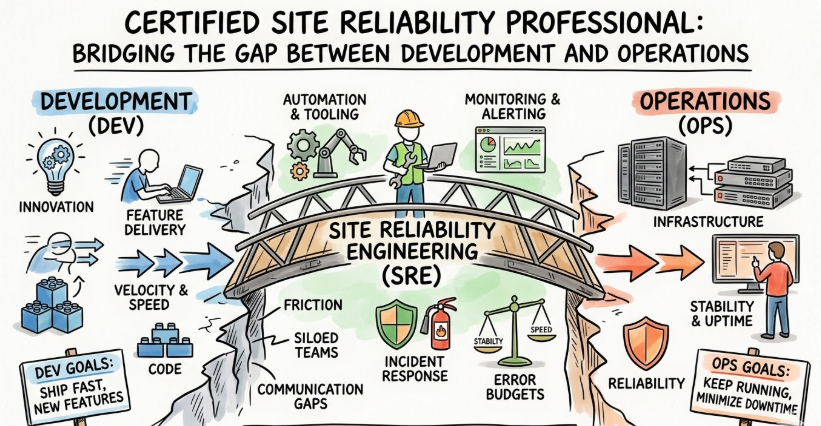
In the current landscape of high-scale digital services, reliability has become the most critical feature of any software product. The Certified Site Reliability Professional designation is designed to bridge the gap between traditional operations and modern software engineering. This guide is crafted for engineers and managers who recognize that uptime is not just a metric but a fundamental requirement for business survival. Whether you are navigating a transition from legacy sysadmin roles or looking to formalize your expertise in cloud-native environments, this certification provides a structured roadmap.
Understanding the principles of SRE is no longer optional for those working in DevOps, platform engineering, or distributed systems. This guide aims to demystify the certification process, helping you evaluate its impact on your career trajectory and technical proficiency. By focusing on practical application rather than just theoretical knowledge, the program ensures that practitioners can handle the complexities of modern production environments. Navigating your career through sreschool allows you to align your skills with global industry standards used by elite engineering teams.
What is the Certified Site Reliability Professional?
The Certified Site Reliability Professional represents a rigorous validation of an engineer’s ability to apply software engineering mindsets to system administration challenges. It exists because the industry moved past the stage where manual intervention could keep up with the velocity of cloud deployments. This certification emphasizes the shift from “running” systems to “engineering” systems that can self-heal, scale, and provide measurable reliability.
Rather than focusing on a single tool or cloud provider, the program prioritizes production-focused learning and sustainable operations. It aligns with modern engineering workflows by teaching participants how to manage risk through error budgets and how to eliminate toil through automation. In an enterprise setting, this means moving away from a culture of blame toward a culture of data-driven post-mortems and continuous improvement.
Who Should Pursue Certified Site Reliability Professional?
This certification is built for a wide spectrum of technical professionals, ranging from backend developers who want to understand the lifecycle of their code to systems engineers looking to adopt automation. Cloud architects, security professionals, and data engineers also benefit immensely, as reliability is a cross-functional concern that impacts every layer of the stack. Even managers and technical leaders find value here, as it provides the vocabulary and framework needed to lead high-performing SRE teams.
In the global market, and specifically within the rapidly evolving Indian tech ecosystem, there is a massive demand for engineers who can manage large-scale distributed systems. Beginners can use this path to build a solid foundation in automation and monitoring, while experienced veterans can use it to formalize years of “on-the-job” learning into a recognized professional credential. It is particularly relevant for those working in fintech, e-commerce, and SaaS where downtime directly correlates to massive revenue loss.
Why Certified Site Reliability Professional is Valuable and Beyond
The demand for SRE expertise is driven by the fact that enterprise adoption of microservices and Kubernetes shows no signs of slowing down. As systems grow more complex, the need for professionals who can maintain “five nines” of availability becomes a non-negotiable requirement for organizations. This certification helps professionals stay relevant by teaching core principles that persist even as specific tools like Jenkins or Terraform are replaced by newer alternatives.
The return on investment for this certification is seen in both salary growth and career longevity, as SRE roles are among the most resilient and high-paying in the tech industry. By mastering the art of balancing feature velocity with system stability, you become an indispensable asset to any engineering organization. It moves you from being a “firefighter” who reacts to incidents to a “fire marshal” who builds systems that prevent incidents from occurring in the first place.
Certified Site Reliability Professional Certification Overview
The program is delivered via the official Certified Site Reliability Professional portal and is hosted on sreschool.com. This certification is structured to cater to different stages of professional growth, utilizing a multi-level assessment approach that tests both conceptual understanding and hands-on application. It is owned and managed by industry experts who ensure the curriculum stays updated with the latest trends in observability, incident management, and capacity planning.
The structure is intentionally practical, avoiding the pitfalls of purely multiple-choice exams by incorporating scenarios that reflect real-world production outages. Candidates are evaluated on their ability to design resilient architectures, implement comprehensive monitoring, and manage the human aspects of on-call rotations. This comprehensive approach ensures that the “Certified” title carries weight with hiring managers and technical peers alike.
Certified Site Reliability Professional Certification Tracks & Levels
The certification is divided into three primary levels: Foundation, Professional, and Advanced. The Foundation level is designed for those new to the discipline, focusing on the core vocabulary and the fundamental “Golden Signals” of monitoring. It provides the base layer of knowledge required to participate in an SRE culture without feeling overwhelmed by technical debt or complex tooling.
As professionals move to the Professional and Advanced levels, the tracks become more specialized. You can choose to focus on specific domains such as SRE for DevOps, FinOps for SRE, or even specialized reliability for AI and Data platforms. This tiered progression allows an engineer to map their learning directly to their current job responsibilities while preparing for senior or principal-level roles in the future.
Complete Certified Site Reliability Professional Certification Table
| Track | Level | Who it’s for | Prerequisites | Skills Covered | Recommended Order |
| Core SRE | Foundation | Junior Engineers | Basic Linux/Cloud | SLIs, SLOs, Error Budgets | 1st |
| Core SRE | Professional | Mid-level SREs | 2+ Years Experience | Observability, Automation | 2nd |
| Core SRE | Advanced | Senior/Principal | 5+ Years Experience | Architecture, Resilience | 3rd |
| Operations | Specialist | DevOps Engineers | CI/CD Knowledge | Incident Response, Toil | Concurrent |
| Financial | Specialist | FinOps Leads | Cloud Billing Basics | Cloud Cost Reliability | Optional |
| Security | Specialist | DevSecOps | Security Basics | Secure Reliability | Optional |
Detailed Guide for Each Certified Site Reliability Professional Certification
Certified Site Reliability Professional – Foundation
What it is
This entry-level certification validates a candidate’s understanding of basic SRE terminology and the philosophy behind site reliability. It ensures the practitioner understands the difference between traditional IT operations and the SRE model.
Who should take it
It is ideal for graduating students, junior developers, or sysadmins who are looking to pivot into modern cloud-native operations roles.
Skills you’ll gain
- Understanding Service Level Indicators (SLIs) and Service Level Objectives (SLOs).
- Calculating and managing Error Budgets.
- Identifying and reducing operational Toil.
- Basic principles of incident post-mortems and blameless culture.
Real-world projects you should be able to do
- Define reliability metrics for a simple web application.
- Draft a basic incident response plan for a small team.
- Create a dashboard showcasing the four golden signals of monitoring.
Preparation plan
- 7-14 Days: Focus on the core SRE handbook principles and terminology.
- 30 Days: Complete foundational labs on monitoring and logging basics.
- 60 Days: Deep dive into case studies of major outages and how SRE principles could have mitigated them.
Common mistakes
- Confusing SLAs (legal) with SLOs (technical).
- Thinking SRE is just another name for DevOps.
- Ignoring the cultural and human aspects of the role.
Best next certification after this
- Same-track option: Certified Site Reliability Professional – Professional.
- Cross-track option: DevOps Foundation.
- Leadership option: Team Lead Essentials.
Certified Site Reliability Professional – Professional
What it is
This certification validates the ability to implement SRE practices using modern toolchains and automation. It focuses on the “how” of reliability, moving from theory to implementation.
Who should take it
Mid-level engineers who have some experience in production environments and want to master the technical execution of SRE tasks.
Skills you’ll gain
- Advanced observability using Prometheus, Grafana, or ELK stacks.
- Automated incident response and self-healing systems.
- Capacity planning and performance tuning for distributed systems.
- Managing complex CI/CD pipelines with integrated reliability gates.
Real-world projects you should be able to do
- Implement an automated alerting system that reduces “alert fatigue.”
- Build a self-healing script for a Kubernetes-based microservice.
- Conduct a full, blameless post-mortem for a simulated production failure.
Preparation plan
- 7-14 Days: Review advanced networking and distributed systems architecture.
- 30 Days: Hands-on practice with observability tools and automation scripts.
- 60 Days: Conduct mock incident drills and practice drafting technical post-mortems.
Common mistakes
- Over-automating processes without understanding the underlying logic.
- Setting SLOs that are too strict and impossible to achieve.
- Focusing too much on tools rather than the processes they support.
Best next certification after this
- Same-track option: Certified Site Reliability Professional – Advanced.
- Cross-track option: Certified DevSecOps Professional.
- Leadership option: SRE Manager Track.
Certified Site Reliability Professional – Advanced
What it is
This is the pinnacle of the SRE track, focusing on systemic architecture, organizational reliability, and long-term strategic planning. It validates the ability to lead reliability efforts across multiple teams or entire organizations.
Who should take it
Senior Engineers, Staff SREs, and Architects who are responsible for the high-level design and reliability of complex, global infrastructures.
Skills you’ll gain
- Designing for high availability across multi-cloud and hybrid environments.
- Establishing organizational standards for reliability and engineering excellence.
- Advanced Chaos Engineering and Resilience Testing techniques.
- Leading cultural shifts toward reliability-centered engineering.
Real-world projects you should be able to do
- Design a multi-region failover strategy for a mission-critical application.
- Implement a company-wide Chaos Engineering program.
- Develop a framework for evaluating the reliability of third-party vendors.
Preparation plan
- 7-14 Days: Study complex architectural patterns like “cell-based architecture.”
- 30 Days: Analyze large-scale system designs from top-tier tech companies.
- 60 Days: Develop a comprehensive reliability strategy for a hypothetical enterprise.
Common mistakes
- Losing touch with the day-to-day technical challenges of the engineering team.
- Prioritizing architecture “purity” over practical business needs.
- Failing to communicate the business value of reliability to non-technical stakeholders.
Best next certification after this
- Same-track option: Principal SRE Fellowship.
- Cross-track option: MLOps Architect.
- Leadership option: Director of Engineering / CTO track.
Choose Your Learning Path
DevOps Path
The DevOps path focuses on the integration of development and operations through continuous delivery. For an SRE, this means ensuring that the deployment pipeline itself is reliable and that code can be promoted to production with high confidence. You will learn how to build automated gates that check for reliability metrics before a release is finalized. This path is perfect for those who enjoy building the “highways” that code travels on.
DevSecOps Path
The DevSecOps path emphasizes that a system cannot be reliable if it is not secure. This learning path integrates security scanning and compliance checks into the SRE workflow, treating security vulnerabilities as a form of technical debt that impacts uptime. It focuses on automated threat detection and the rapid remediation of security incidents. This is a critical path for engineers working in highly regulated industries like banking or healthcare.
SRE Path
The pure SRE path is the core journey focused on maintaining the balance between innovation and stability. It dives deep into the mathematical models of reliability, advanced monitoring, and the elimination of manual work through sophisticated software solutions. You will spend time perfecting your incident management skills and learning how to build resilient systems at scale. This path is the most direct route to becoming a specialist in production operations.
AIOps Path
The AIOps path explores the intersection of artificial intelligence and IT operations to handle massive volumes of telemetry data. It focuses on using machine learning models to predict potential outages before they happen and to automate root cause analysis. As systems become too large for humans to monitor manually, AIOps provides the tools to manage “noise” and identify real signals. This is an emerging and highly specialized field within the broader SRE discipline.
MLOps Path
The MLOps path is tailored for those who manage the lifecycle of machine learning models in production environments. Unlike traditional software, ML models require specific reliability checks regarding data drift, model decay, and resource-intensive training pipelines. This path teaches SREs how to apply reliability principles to the unique challenges of data science workflows. It is essential for organizations that rely on real-time AI predictions for their business logic.
DataOps Path
The DataOps path applies SRE and DevOps principles to data pipelines and big data infrastructure. Reliability in this context means ensuring data integrity, low latency in data processing, and the high availability of data lakes and warehouses. You will learn how to monitor data quality as a service level indicator and how to build automated recovery for failed data jobs. This path is ideal for engineers supporting large-scale data analytics and business intelligence platforms.
FinOps Path
The FinOps path focuses on the financial reliability and cost-efficiency of cloud operations. In a modern SRE role, performance is often tied to cost, and an inefficient system is a form of operational failure. This path teaches you how to monitor cloud spend in real-time, optimize resource allocation, and ensure that the cost of reliability does not exceed the value of the service. It is increasingly important as companies look to maximize their return on cloud investments.
Role → Recommended Certified Site Reliability Professional Certifications
| Role | Recommended Certifications |
| DevOps Engineer | Certified Site Reliability Professional (Professional) |
| SRE | Certified Site Reliability Professional (Full Track) |
| Platform Engineer | Certified Site Reliability Professional (Advanced) |
| Cloud Engineer | Certified Site Reliability Professional (Foundation) |
| Security Engineer | Certified Site Reliability Professional + DevSecOps |
| Data Engineer | Certified Site Reliability Professional + DataOps |
| FinOps Practitioner | Certified Site Reliability Professional + FinOps |
| Engineering Manager | Certified Site Reliability Professional (Foundation) |
Next Certifications to Take After Certified Site Reliability Professional
Same Track Progression
After completing the advanced level of the Certified Site Reliability Professional, engineers should look toward deep specialization. This might include vendor-specific expert certifications for cloud platforms like AWS or Azure, focusing specifically on their “Well-Architected” frameworks. Continuous learning in advanced systems programming, such as mastering Go or Rust, is also recommended to build more performant and reliable system tools.
Cross-Track Expansion
Reliability does not exist in a vacuum, so expanding into adjacent fields is a smart career move. Taking certifications in DevSecOps or MLOps allows an SRE to apply their reliability mindset to different types of workloads. Understanding the nuances of security or data science makes an SRE more versatile and capable of supporting complex, multi-functional engineering departments.
Leadership & Management Track
For those looking to move into management, the next step involves certifications focused on engineering leadership and organizational psychology. Leading an SRE team requires a different set of skills than being a high-level individual contributor. You will need to understand how to manage budget, hire top talent, and advocate for reliability at the executive level, making leadership-specific training a natural progression.
Training & Certification Support Providers for Certified Site Reliability Professional
DevOpsSchool
DevOpsSchool has established itself as a premier destination for professionals seeking in-depth knowledge in the DevOps and SRE domains. They provide a comprehensive suite of resources, including instructor-led training and self-paced modules that align perfectly with the Certified Site Reliability Professional curriculum. Their approach focuses on bridging the gap between theoretical concepts and practical industry requirements. Students benefit from their extensive library of tutorials and real-world project simulations, which are essential for mastering the complexities of modern site reliability engineering. With a strong presence in the global training market, they offer a supportive community and expert guidance for anyone looking to advance their career in this field.
Cotocus
Cotocus is recognized for its specialized focus on high-end technology training and consulting, making it an excellent support provider for SRE candidates. They offer tailored learning paths that help engineers grasp the intricate details of cloud-native architectures and reliability principles. Their training methodology is highly interactive, ensuring that participants can apply what they learn in real-time production scenarios. Cotocus emphasizes the importance of hands-on experience, providing labs and environments that mirror the challenges faced by top-tier engineering teams. This focus on practical skill acquisition makes them a valuable partner for those aiming to achieve the Certified Site Reliability Professional designation and excel in their roles.
Scmgalaxy
Scmgalaxy serves as a massive knowledge hub and community for software configuration management, DevOps, and SRE professionals. They provide a wealth of free and premium content, including blogs, videos, and detailed guides that support the learning objectives of the Certified Site Reliability Professional. Their platform is particularly useful for staying updated on the latest tools and trends in the industry, which is crucial for any SRE. By offering a blend of community-driven insights and professional training, Scmgalaxy helps engineers navigate the evolving landscape of site reliability. Their resources are designed to be accessible and practical, making them a go-to source for troubleshooting and skill enhancement.
BestDevOps
BestDevOps focuses on providing streamlined and efficient training programs that help professionals quickly gain the skills they need to succeed. They offer specialized courses that cover the core pillars of the Certified Site Reliability Professional program, ensuring that students are well-prepared for their assessments. Their curriculum is designed by industry veterans who understand the day-to-day realities of managing distributed systems. By focusing on the most relevant tools and practices, BestDevOps ensures that learners do not waste time on outdated or purely theoretical information. This direct and results-oriented approach makes them a popular choice for busy professionals looking to upskill without sacrificing their productivity.
devsecopsschool.com
DevSecOpsSchool is a dedicated platform for engineers who want to integrate security into their reliability and DevOps workflows. As security is a fundamental component of site reliability, their courses provide essential knowledge for anyone pursuing the Certified Site Reliability Professional. They offer detailed training on automated security testing, compliance as code, and secure infrastructure management. Their curriculum ensures that an SRE can not only keep a system running but also keep it safe from modern cyber threats. For professionals looking to add a security dimension to their reliability expertise, this provider offers the perfect blend of technical depth and practical application.
sreschool.com
Sreschool.com is the primary authority and hosting site for the Certified Site Reliability Professional program itself. It provides the most direct and comprehensive support for candidates, offering the official curriculum, assessment guidelines, and certification tracks. The site is a treasure trove of information specifically curated for the SRE discipline, ranging from foundational concepts to advanced architectural patterns. By utilizing the resources directly from the source, candidates ensure that their learning is perfectly aligned with the certification standards. The platform also fosters a community of SRE practitioners, providing a space for networking and sharing best practices in the field of reliability engineering.
aiopsschool.com
Aiopsschool.com caters to the growing need for intelligent automation in the world of IT operations and reliability. As systems become more complex, the AI-driven insights provided by their training become invaluable for an SRE. They offer courses that teach how to implement machine learning for anomaly detection, predictive maintenance, and automated incident resolution. Their curriculum is essential for those looking to specialize in the AIOps track of the Certified Site Reliability Professional. By mastering these cutting-edge technologies, engineers can significantly reduce MTTR (Mean Time To Repair) and improve the overall resilience of their systems through data-driven decision-making.
dataopsschool.com
Dataopsschool.com is the leading provider of training for the intersection of data engineering and operational excellence. For SREs who are responsible for data-heavy environments, their courses offer critical insights into managing data pipelines with the same rigor as software services. They focus on data quality, pipeline reliability, and the orchestration of complex data workflows. Their training supports the DataOps specialization within the Certified Site Reliability Professional program, helping engineers ensure that data remains a reliable asset for the business. Their practical approach to data infrastructure makes them an essential resource for engineers working in big data, analytics, and business intelligence.
finopsschool.com
Finopsschool.com addresses the critical need for financial accountability in cloud-native environments, a key area of concern for modern SREs. They provide specialized training on cloud cost management, resource optimization, and the cultural shift required for effective FinOps. Their curriculum is a perfect match for the FinOps track of the Certified Site Reliability Professional, teaching engineers how to balance performance with cost-efficiency. By learning how to monitor and control cloud spend, SREs become more valuable to their organizations by directly contributing to the bottom line. Finopsschool.com offers the tools and frameworks needed to turn cloud costs into a manageable and reliable metric.
Frequently Asked Questions (General)
- What is the primary focus of this certification?
The focus is on applying software engineering principles to operations to build and maintain highly reliable, scalable distributed systems. - How much experience do I need to start?
The Foundation level requires basic knowledge of Linux and cloud concepts, while the Professional and Advanced levels require more hands-on production experience. - What is the typical timeframe to complete the certification?
Depending on your background, it can take anywhere from 30 days for the Foundation level to 6 months for the Advanced level. - Is this certification recognized globally?
Yes, the principles taught are based on industry-standard SRE practices used by major tech companies worldwide. - Does the certification focus on a specific cloud provider?
No, it is designed to be cloud-agnostic, focusing on principles that apply to AWS, Azure, Google Cloud, and on-premises environments. - What is the format of the assessment?
The assessment includes a mix of conceptual questions and practical, scenario-based evaluations to test real-world problem-solving skills. - Are there any prerequisites for the Professional level?
While not strictly mandatory, having the Foundation certification or equivalent industry experience is highly recommended. - How does this certification help my salary prospects?
SREs are among the highest-paid professionals in tech, and this certification validates the high-demand skills required for those roles. - Can I skip the Foundation level?
If you have significant industry experience, you may move directly to the Professional level, but the Foundation level ensures no gaps in core terminology. - Is there a renewal requirement for the certification?
Yes, to keep up with the fast-moving industry, practitioners are usually required to renew or upgrade their certification every two to three years. - Does the course cover specific tools like Kubernetes or Terraform?
The course covers the implementation of these tools within the context of reliability, though the focus remains on the principles rather than the tools themselves. - What kind of support is available during the learning process?
Candidates have access to official documentation, community forums, and support from various training providers listed in this guide.
FAQs on Certified Site Reliability Professional
- How does this certification differ from a standard DevOps course?
This program specifically focuses on reliability and the engineering tasks required to maintain uptime, whereas DevOps is broader and covers the entire development lifecycle. - What are the “Golden Signals” covered in the curriculum?
The curriculum dives deep into Latency, Traffic, Errors, and Saturation as the primary metrics for system health. - Is Chaos Engineering a part of the Advanced track?
Yes, the Advanced level includes significant content on resilience testing and injecting failures to strengthen systems. - How are Error Budgets handled in the professional level?
You will learn how to define budgets, track them, and use them to make data-driven decisions about feature releases versus stability fixes. - Does the certification address on-call rotations?
Yes, it covers the human and process aspects of managing sustainable, healthy on-call shifts to prevent engineer burnout. - Are post-mortems a major focus?
The program emphasizes the creation of “blameless” post-mortems to ensure organizations learn from failures without discouraging risk-taking. - Is there a focus on automation?
Automation is central to the program, specifically aimed at reducing “toil”—repetitive, manual tasks that do not provide long-term value. - Can this certification help me transition from a developer role?
Absolutely, it provides the operational context that developers need to take full ownership of their code in a production environment.
Final Thoughts: Is Certified Site Reliability Professional Worth It?
When you reach a certain point in your engineering career, you realize that writing code is only half the battle; the other half is keeping that code running when millions of users are hitting it simultaneously. The Certified Site Reliability Professional is more than just a piece of paper; it is a commitment to a specific way of thinking about systems. It forces you to stop guessing and start measuring, to stop reacting and start engineering.
If you are looking for a way to stand out in a crowded job market or if you want to lead your current organization toward a more stable future, this certification is a solid investment. It provides a structured path through the often-chaotic world of cloud-native operations. My advice as a mentor is simple: don’t just chase the badge—embrace the mindset. The technical skills you gain will serve you well, but the ability to build reliable, human-centric systems will define your career.