Upgrade & Secure Your Future with DevOps, SRE, DevSecOps, MLOps!
We spend hours scrolling social media and waste money on things we forget, but won’t spend 30 minutes a day earning certifications that can change our lives.
Master in DevOps, SRE, DevSecOps & MLOps by DevOps School!
Learn from Guru Rajesh Kumar and double your salary in just one year.
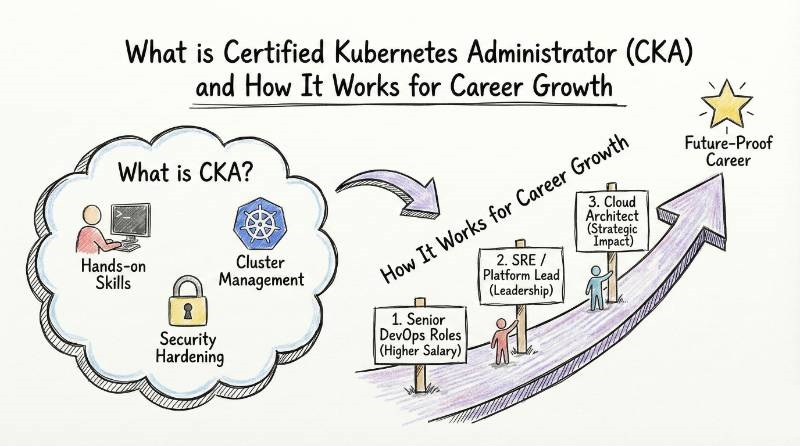
Managing containerized applications is no longer an optional skill for modern engineers. As someone who has navigated the shifts from bare-metal servers to virtual machines, and now to distributed cloud-native ecosystems, I have seen how Kubernetes has become the definitive operating system of the cloud.
The Certified Kubernetes Administrator (CKA) certification is not just a badge; it is a validation of your ability to keep the “engine room” of modern software running. This guide provides a comprehensive roadmap for engineers and managers in India and globally to master this domain.
Complete Master Certification Table
This table outlines the primary certification tracks available through DevOpsSchool and their partners to help you plan your career progression.
| Track | Level | Who it’s For | Prerequisites | Skills Covered | Recommended Order |
| Kubernetes | Administrator | DevOps & Cloud Engineers | Docker, Linux Basics | Cluster Setup, Networking, Storage, Troubleshooting | 1st (Core) |
| DevOps | Professional | Software Engineers | Coding, Git | CI/CD, IaC, Automation | 2nd |
| DevSecOps | Specialist | Security Engineers | DevOps Basics | Security Auditing, Policy, Compliance | 3rd |
| SRE | Reliability | Operations Leads | DevOps Professional | SLOs/SLIs, Error Budgets, Monitoring | 4th |
| AIOps | Advanced | Data & Ops Leads | Python, Statistics | AI/ML in Ops, Predictive Maintenance | 5th |
| FinOps | Management | Managers & Architects | Cloud Fundamentals | Cloud Cost Optimization, Budgeting | 6th |
Detailed Guide: Certified Kubernetes Administrator (CKA)
What it is
The Certified Kubernetes Administrator (CKA) is a performance-based certification that ensures you can design, install, and manage production-grade Kubernetes clusters. Unlike multiple-choice exams, this is a hands-on test where you solve real-world problems in a live command-line environment.
Who should take it
- System Administrators moving into cloud-native roles.
- DevOps Engineers responsible for infrastructure automation.
- Software Engineers who want to understand the underlying platform of their apps.
- Engineering Managers who need to lead teams using containerized stacks.
Skills you’ll gain
- Cluster Architecture: Understanding how the control plane and worker nodes interact.
- Installation & Configuration: Bootstrapping a cluster from scratch using
kubeadm. - Troubleshooting: Identifying why pods fail or networking breaks.
- Storage Management: Implementing persistent volumes and storage classes.
- Security: Managing RBAC (Role-Based Access Control) and TLS certificates.
Real-world projects you can do after it
- Build a high-availability Kubernetes cluster for a microservices application.
- Automate cluster upgrades with zero downtime.
- Implement complex networking policies to isolate sensitive database workloads.
- Debug production issues like “CrashLoopBackOff” or node pressure in minutes.
Preparation Plan
7–14 Days (The Fast Track)
- Days 1-3: Focus on Core Concepts and Architecture. Memorize the control plane components.
- Days 4-7: Intensive
kubectlimperative command practice. Learn to generate YAML files quickly. - Days 8-14: Practice Troubleshooting and Cluster Maintenance. Take mock exams like Killer.sh.
30 Days (Standard Plan)
- Week 1: Linux Fundamentals and Networking. Master the CLI.
- Week 2: Application Lifecycle & Services. Deploying and exposing apps.
- Week 3: Storage and Security. Practice PVCs and RBAC.
- Week 4: Mock exams and speed drills. Ensure you can navigate official documentation quickly.
60 Days (Deep Dive)
- Month 1: Theory plus local labs using Minikube or Kind. Read the documentation end-to-end.
- Month 2: Build a cluster “The Hard Way” to understand the plumbing. Focus on the 30% weighted Troubleshooting domain.
Common Mistakes
- Ignoring the Context: Failing to switch
kubectl config set-contextbefore answering a question. - Over-relying on YAML: Trying to write YAML from scratch instead of using
kubectl run --dry-run=client. - Poor Time Management: Getting stuck on a 2% question for 20 minutes.
- Documentation Speed: Not knowing where the example YAML files are in the official Kubernetes docs.
Best next certification after this
The Certified Kubernetes Security Specialist (CKS) is the natural progression, as it builds directly on the administrative foundations you’ve just mastered.
Choose Your Learning Path
Success in modern engineering requires a specialized focus. Here are six paths you can take:
- DevOps Path: Focus on the “flow” of software. Master CI/CD pipelines, GitOps, and Infrastructure as Code.
- DevSecOps Path: Integrate security into the pipeline. Focus on vulnerability scanning, secret management, and compliance-as-code.
- SRE Path: Apply software engineering to operations. Focus on high availability, incident response, and performance tuning.
- AIOps/MLOps Path: Use AI to manage IT operations. Learn how to monitor and deploy machine learning models at scale.
- DataOps Path: Focus on the lifecycle of data. Streamline data pipelines and ensure data quality in distributed systems.
- FinOps Path: Manage the economics of the cloud. Learn how to balance performance with cost and drive financial accountability.
Role → Recommended Certifications Mapping
- DevOps Engineer: CKA + Certified DevOps Professional.
- SRE: CKA + SRE Certified Professional.
- Platform Engineer: CKA + Certified DevOps Architect.
- Cloud Engineer: CKA + Master in Azure/AWS DevOps.
- Security Engineer: CKA + DevSecOps Certified Professional + CKS.
- Data Engineer: CKA + DataOps Certified Professional.
- FinOps Practitioner: CKA + FinOps Certified Professional.
- Engineering Manager: CKA + Certified DevOps Manager.
Top Training Institutions for CKA
These institutions offer hands-on, mentor-led training to ensure you don’t just pass the exam, but actually learn the job.
DevOpsSchool
As a primary leader in technical upskilling, DevOpsSchool is highly regarded for its intensive, mentor-led programs. Their CKA curriculum is heavily focused on hands-on labs (roughly 70% of the course), ensuring you master the command line and real-world troubleshooting scenarios. Under the guidance of industry experts like Rajesh Kumar, it offers lifelong technical support and a robust LMS.
Cotocus
Cotocus stands out by bridging the gap between training and enterprise consulting. They focus on high-level architecture and production-grade deployments, making them an excellent choice for senior engineers and managers who need to understand how Kubernetes fits into a large-scale business strategy. Their training often reflects the complex, multi-cloud challenges faced by modern organizations.
Scmgalaxy
This institution is widely recognized as a community-centric platform that provides extensive technical resources and troubleshooting guides. Scmgalaxy excels at providing deep-dive tutorials that go beyond the exam syllabus, helping professionals understand the “why” behind cluster components. It is a fantastic hub for those who value community support and peer-to-peer learning.
BestDevOps
BestDevOps is known for its curated career paths and simplified learning modules tailored specifically for working professionals. They strip away the unnecessary fluff to focus on the core competencies required for the CKA exam and daily operations. Their approach is highly effective for those who need a structured, time-efficient way to gain mastery.
devsecopsschool
For engineers who want to view Kubernetes through a security lens, devsecopsschool is the premier choice. While covering the standard CKA requirements, they emphasize security-first engineering, vulnerability scanning, and hardening clusters. This specialization is vital for anyone aiming for roles where compliance and security are non-negotiable.
sreschool
Sreschool focuses on the reliability and observability aspects of Kubernetes. Their training is designed for professionals who need to maintain high availability and manage incident responses in containerized environments. It is an ideal institution if your goal is to transition into a dedicated Site Reliability Engineering role after your CKA.
aiopsschool
Aiopsschool is at the forefront of the next wave of operations, focusing on integrating AI and automated intelligence into Kubernetes management. Their programs teach you how to use predictive analytics and machine learning to optimize cluster performance. This is perfect for forward-thinking engineers looking to future-proof their skills in the AIOps domain.
dataopsschool
Specializing in the data lifecycle, dataopsschool provides unique insights into running data-heavy workloads on Kubernetes. They cover the complexities of persistent storage, stateful sets, and data pipeline orchestration at scale. This institution is a top pick for Data Engineers and Architects who need to manage large-scale data environments.
finopsschool
Finopsschool addresses the critical need for cloud cost optimization and financial accountability within Kubernetes. Their training helps engineers and managers understand the economic impact of architectural choices, teaching them how to balance high performance with budget constraints. It is an essential stop for anyone moving into a FinOps Practitioner role.
Next Certifications to Take
After completing the CKA, you have three primary directions to grow, as recommended by industry experts:
- Same Track (Advanced Specialization): Certified Kubernetes Security Specialist (CKS). This hardens your knowledge of cluster security.
- Cross-Track (Technical Breadth): Hashicorp Certified Terraform Associate. Mastering IaC alongside K8s makes you a complete platform engineer.
- Leadership (Career Growth): Certified DevOps Manager (CDM). Focuses on the strategy, culture, and governance required to lead digital transformations.
FAQs focused on Career and Strategy
1. How difficult is the CKA exam compared to others?
It is considered a 7/10 in difficulty. Because it is hands-on rather than multiple choice, you cannot guess your way through it. You must know the commands.
2. How much time do I need to prepare if I am a working professional?
Most engineers find 60–90 minutes a day for 4 to 6 weeks is the “sweet spot” to gain enough muscle memory for the CLI.
3. What are the prerequisites?
There are no formal prerequisites, but you should be very comfortable with Linux command-line tools (grep, cat, nano/vim) and basic networking concepts.
4. Should I take CKAD or CKA first?
If you manage infrastructure, start with CKA. If you are a developer purely focused on deploying apps, CKAD is a better entry point.
5. Is the CKA certification worth it in 2026?
Absolutely. Kubernetes is the industry standard. Most high-paying DevOps roles now list CKA as a preferred or mandatory qualification.
6. Does the certification expire?
Yes, it is valid for 2 years. This ensures that certified professionals stay up-to-date with the fast-moving Kubernetes ecosystem.
7. Can I use the Kubernetes documentation during the exam?
Yes. You are allowed to have one tab open with official documentation. Knowing how to search this documentation is a key part of the exam.
8. What is the passing score?
Typically, you need a score of 66% or higher to pass.
9. How does this impact my salary?
In India and globally, CKA holders often see a 20-30% salary bump when transitioning into specialized cloud-native roles.
10. What if I fail on my first attempt?
Most exam vouchers from the Linux Foundation (and through DevOpsSchool) include one free retake.
11. Is CKA enough to become a Senior DevOps Engineer?
It is a foundational “hard skill,” but you will also need experience with CI/CD, Monitoring, and IaC (Terraform/Ansible) to be considered a senior.
12. Can a manager benefit from CKA?
Yes. Understanding the technical constraints and capabilities of Kubernetes allows managers to set realistic timelines and make better architectural decisions.
FAQs: Certified Kubernetes Administrator (CKA) Training
1. What is the primary focus of the CKA training at DevOpsSchool?
The training focuses on hands-on labs. You will spend 70% of your time in the terminal, building and breaking clusters to learn how to fix them.
2. Do I get help with the exam registration?
Yes, our mentors guide you through the registration process and provide tips for setting up your home exam environment.
3. Are the projects covered in the course real-world based?
Yes, we use scenarios like “Migrating a legacy app to K8s” and “Setting up a secure RBAC system” which are directly taken from enterprise environments.
4. Can I attend the training if I am a complete beginner?
We recommend taking a basic Linux and Docker course first. If you are new, our “Foundation” modules will help bridge that gap before diving into CKA.
5. What tools will I master in this training?
Beyond Kubernetes, you will learn kubeadm, kubectl, etcd management, and various CNI (Container Network Interface) plugins.
6. Is there a community for post-training support?
Yes, learners get access to a massive community of alumni and experts through Scmgalaxy and DevOpsSchool forums.
7. How do I practice at home?
We provide access to lab environments, but we also teach you how to set up your own cluster using virtual machines or cloud-free tiers.
8. Is this training recognized by global employers?
Yes, DevOpsSchool is a globally recognized provider, and our training is designed to align with international industry standards.
Conclusion
The path to becoming a Certified Kubernetes Administrator is a journey from understanding basic containers to mastering complex, self-healing distributed systems. In my years of observing the industry, I have found that those who invest in this hands-on knowledge are the ones who lead the most successful projects.
Whether you are an engineer looking to level up or a manager aiming to modernize your team, the CKA is the most reliable yardstick for excellence in the cloud-native world. Start your journey today, pick a path that fits your goals, and join the elite group of professionals shaping the future of IT.