Upgrade & Secure Your Future with DevOps, SRE, DevSecOps, MLOps!
We spend hours scrolling social media and waste money on things we forget, but won’t spend 30 minutes a day earning certifications that can change our lives.
Master in DevOps, SRE, DevSecOps & MLOps by DevOps School!
Learn from Guru Rajesh Kumar and double your salary in just one year.
Introduction
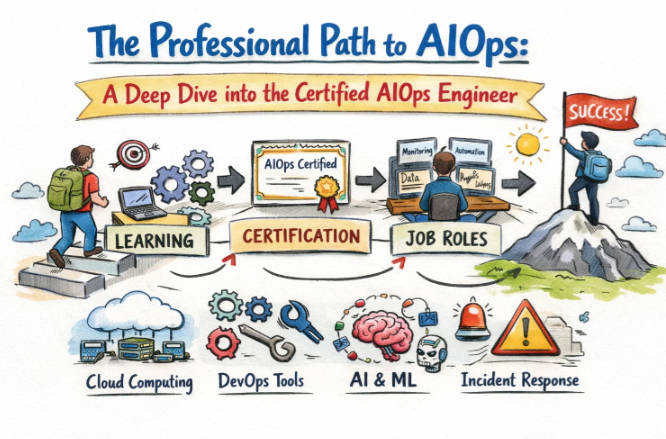
The Certified AIOps Engineer is a comprehensive professional program designed to bridge the gap between traditional IT operations and modern artificial intelligence capabilities. This guide is crafted for engineers who realize that manual monitoring and reactive troubleshooting are no longer sustainable in the era of microservices and hyperscale clouds. As systems become increasingly complex, the role of a Certified AIOps Engineer becomes pivotal in maintaining system reliability through automated insights and predictive analytics. By following this guide, professionals can understand how to transition from legacy operational mindsets to a proactive, data-driven approach supported by AIOps School.
What is the Certified AIOps Engineer?
The Certified AIOps Engineer program represents a shift in how enterprise environments are managed and optimized using machine learning and big data. It exists to provide engineers with a structured framework for implementing automated event correlation, anomaly detection, and root cause analysis in production environments. Unlike theoretical data science courses, this certification focuses on the practical application of AI technologies within the existing DevOps and SRE ecosystems. It aligns with modern engineering workflows by emphasizing the use of telemetry data to drive autonomous operations and reduce the cognitive load on human operators.
Who Should Pursue Certified AIOps Engineer?
This certification is ideally suited for SREs, DevOps engineers, and Cloud Architects who are responsible for maintaining high-availability systems and want to reduce Mean Time to Repair (MTTR). Experienced engineers looking to specialize in the intersection of data science and systems engineering will find the curriculum highly relevant to enterprise-scale challenges. Managers and technical leaders should also pursue this path to understand how to build and lead teams that leverage autonomous operational tools. Whether you are working in the growing tech hubs of India or within global distributed teams, this certification provides the technical depth required to manage complex digital infrastructures.
Why Certified AIOps Engineer is Valuable in the Future and Beyond
The demand for AIOps expertise is surging as organizations move away from simple threshold-based alerting toward sophisticated, self-healing infrastructures. Earning the Certified AIOps Engineer credential ensures that a professional remains relevant as the industry moves toward “NoOps” and highly automated platform engineering. Enterprise adoption of AI-driven operations is no longer optional for companies handling massive datasets, making this certification a high-return investment for career longevity. By mastering these skills, engineers can demonstrate their ability to handle the scale and speed of modern business requirements while minimizing operational noise.
Certified AIOps Engineer Certification Overview
The program is delivered via the official Certified AIOps Engineer portal and hosted on the AIOps School platform. It is structured to provide a multi-tiered learning experience, moving from foundational concepts to advanced architectural implementation strategies. The assessment approach is performance-based, ensuring that candidates can actually apply algorithms to real-world datasets rather than just memorizing definitions. This ownership of the learning path allows professionals to master the full lifecycle of an AIOps project, from data collection to autonomous remediation.
Certified AIOps Engineer Certification Tracks & Levels
The certification is divided into three primary levels: Foundation, Professional, and Advanced, ensuring a logical progression for learners. The Foundation level introduces the core concepts of telemetry and basic machine learning models, while the Professional level dives deep into implementation and tool integration. Advanced levels focus on architecting end-to-end autonomous systems and leading enterprise-wide AIOps transformations. These levels are designed to align with career progression, helping a junior engineer move into a senior or principal role by demonstrating specialized operational intelligence.
Complete Certified AIOps Engineer Certification Table
| Track | Level | Who it’s for | Prerequisites | Skills Covered | Recommended Order |
| Core Operations | Foundation | Junior DevOps/SREs | Basic Linux & Python | Telemetry, Event Noise Reduction | 1 |
| Implementation | Professional | Senior Engineers | Foundation Level | ML Models for Ops, Anomaly Detection | 2 |
| Architecture | Advanced | Principal Engineers | Professional Level | Predictive Scaling, Auto-remediation | 3 |
| Management | Executive | IT Managers | General Tech Knowledge | ROI of AIOps, Team Structuring | Optional |
Detailed Guide for Each Certified AIOps Engineer Certification
Certified AIOps Engineer – Foundation
What it is
This certification validates a candidate’s understanding of basic AIOps terminology, the evolution from DevOps to AIOps, and the fundamental principles of data-driven operations. It focuses on the ability to distinguish between traditional monitoring and modern observability.
Who should take it
Aspiring DevOps engineers, system administrators, and recent graduates who want to build a career in modern IT operations should start here. It is also suitable for traditional operators looking to modernize their skill set.
Skills you’ll gain
- Understanding telemetry data types (Metrics, Logs, Traces).
- Basic concepts of algorithmic noise reduction.
- Identification of AIOps use cases in the enterprise.
- Fundamentals of event correlation.
Real-world projects you should be able to do
- Setting up a centralized logging dashboard with basic filtering.
- Implementing simple threshold alerts across a small cluster.
- Visualizing system performance metrics using standard observability tools.
Preparation plan
- 7-14 Days: Focus on the official glossary and core concepts of observability.
- 30 Days: Complete the foundational labs on data ingestion.
- 60 Days: Not required for this level if the candidate has a systems background.
Common mistakes
- Overcomplicating the math behind the models early on.
- Neglecting the importance of high-quality data ingestion.
Best next certification after this
- Same-track option: Certified AIOps Engineer – Professional.
- Cross-track option: Certified SRE Professional.
- Leadership option: ITIL Strategic Leader.
Certified AIOps Engineer – Professional
What it is
This level confirms the engineer’s ability to implement machine learning models specifically tailored for operational data. It bridges the gap between raw data and actionable operational insights.
Who should take it
SREs and DevOps professionals with at least 2 years of experience who are responsible for maintaining production environments. It is for those who need to automate incident management.
Skills you’ll gain
- Deploying anomaly detection algorithms on time-series data.
- Automating root cause analysis (RCA) using dependency mapping.
- Integrating AIOps tools with CI/CD pipelines and ITSM platforms.
- Advanced log patterns and clustering.
Real-world projects you should be able to do
- Building an automated incident suppression system.
- Creating a predictive alerting system for disk space or memory leaks.
- Integrating a machine learning model to categorize incoming support tickets.
Preparation plan
- 7-14 Days: Review Python for data science and basic statistical models.
- 30 Days: Work through hands-on labs involving historical data analysis.
- 60 Days: Perform end-to-end implementation in a sandbox environment.
Common mistakes
- Ignoring the “black box” problem where engineers don’t understand why a model fired an alert.
- Poor integration with existing communication tools like Slack or PagerDuty.
Best next certification after this
- Same-track option: Certified AIOps Engineer – Advanced.
- Cross-track option: MLOps Professional Certification.
- Leadership option: Technical Program Manager (TPM) tracks.
Certified AIOps Engineer – Advanced
What it is
This certification is the pinnacle of the AIOps path, validating the ability to design and govern autonomous “self-healing” systems. It focuses on high-level strategy, ethics in AI operations, and architectural resilience.
Who should take it
Architects, Principal Engineers, and Technical Leads who are tasked with designing the operational future of a large-scale organization. Candidates must have deep technical and organizational knowledge.
Skills you’ll gain
- Designing closed-loop automation and self-healing workflows.
- Governance and ethics in automated operational decision-making.
- Financial modeling for AIOps (Cloud cost optimization via AI).
- Scaling AIOps across multi-cloud and hybrid environments.
Real-world projects you should be able to do
- Designing a global traffic management system that reacts to latency anomalies automatically.
- Building an enterprise-wide AIOps roadmap and data lake strategy.
- Implementing automated cost-optimization triggers based on usage patterns.
Preparation plan
- 7-14 Days: Deep dive into enterprise architecture patterns.
- 30 Days: Case study analysis of large-scale AIOps failures and successes.
- 60 Days: Design a comprehensive autonomous operations framework.
Common mistakes
- Failing to account for “automation anxiety” within the workforce.
- Over-reliance on automation without sufficient manual overrides for edge cases.
Best next certification after this
- Same-track option: None (Highest Level).
- Cross-track option: Chief Technology Officer (CTO) training.
- Leadership option: Digital Transformation Strategy certifications.
Choose Your Learning Path
DevOps Path
In the DevOps path, the focus is on integrating AIOps into the continuous integration and continuous deployment cycle. Engineers learn to use AI to predict if a build will fail or if a deployment will cause performance regressions in production. This path emphasizes the speed of delivery without sacrificing stability. It is perfect for those who want to automate the feedback loop between developers and operations.
DevSecOps Path
The DevSecOps path integrates AIOps into the security posture of the organization. Here, AI is used to detect anomalous user behavior and identify potential security breaches in real-time. Engineers learn to automate the response to common vulnerabilities and use machine learning to filter out false positives in security scans. This path is vital for maintaining compliance and security at high velocity.
SRE Path
The Site Reliability Engineering (SRE) path is perhaps the most natural fit for AIOps. It focuses on using data to maintain Service Level Objectives (SLOs) and Service Level Indicators (SLIs). AIOps tools help SREs manage error budgets more effectively by predicting outages before they occur. This path teaches how to balance the need for new features with the absolute necessity of system uptime.
AIOps Path
The dedicated AIOps path focuses purely on the mastery of the operational data lifecycle. It covers everything from data collection and normalization to the deployment of advanced heuristics and neural networks for system health. Professionals in this path become the resident experts on the internal tooling that keeps the entire engineering organization running smoothly. It is a deep dive into the “intelligence” of IT operations.
MLOps Path
The MLOps path focuses on the operationalization of machine learning models themselves. While AIOps uses ML to run IT, MLOps provides the framework to deploy and monitor those ML models reliably. This path is critical for ensuring that the algorithms used in AIOps (and other business areas) remain accurate and do not suffer from model drift. It bridges the gap between data science and traditional software engineering.
DataOps Path
The DataOps path emphasizes the quality and flow of data that feeds the AIOps engines. Without clean, reliable data, the AI models used in operations will fail. This path teaches engineers how to build robust data pipelines and ensure that telemetry data is always available and accurate. It is the foundation upon which all other automated operation tracks are built.
FinOps Path
The FinOps path leverages AIOps to manage and optimize cloud spending. By using predictive analytics, engineers can forecast future cloud usage and automatically adjust resources to save money. This path teaches how to correlate operational performance with financial impact, making it a favorite for management and executive leadership. It turns operational efficiency into direct bottom-line savings.
Role → Recommended Certified AIOps Engineer Certifications
| Role | Recommended Certifications |
| DevOps Engineer | Certified AIOps Engineer – Foundation & Professional |
| SRE | Certified AIOps Engineer – Professional & Advanced |
| Platform Engineer | Certified AIOps Engineer – Professional |
| Cloud Engineer | Certified AIOps Engineer – Foundation |
| Security Engineer | Certified AIOps Engineer – Professional (Focus on Security) |
| Data Engineer | Certified AIOps Engineer – Foundation |
| FinOps Practitioner | Certified AIOps Engineer – Foundation |
| Engineering Manager | Certified AIOps Engineer – Foundation & Executive Track |
Next Certifications to Take After Certified AIOps Engineer
Same Track Progression
Once you have mastered the Certified AIOps Engineer levels, the logical step is to dive deeper into specific AI disciplines. You might pursue advanced certifications in Deep Learning or Natural Language Processing to better understand how to analyze unstructured log data. The goal is to move from being a consumer of AIOps tools to a creator of custom operational algorithms. This specialization makes you an invaluable asset to large-scale tech companies.
Cross-Track Expansion
After gaining AIOps expertise, expanding into SRE or FinOps is a highly effective way to broaden your career impact. Understanding how AIOps impacts the cost of operations (FinOps) or the reliability of services (SRE) creates a multi-dimensional professional profile. This “T-shaped” skill set allows you to collaborate effectively across different departments and solve complex, cross-functional problems. It ensures you are not just a tool expert, but a business-aligned engineer.
Leadership & Management Track
For those looking to move into leadership, the next step involves certifications in IT Strategy and Digital Transformation. The transition from a Certified AIOps Engineer to a Director of Operations or CTO requires a shift from technical implementation to organizational strategy. You will use your AIOps background to justify budget allocations and lead the cultural shift toward automation. This track focuses on people, process, and the long-term vision of an automated enterprise.
Training & Certification Support Providers for Certified AIOps Engineer
DevOpsSchool
DevOpsSchool is a leading provider of technical training that offers a deep bench of instructors with real-world experience in automation. They provide comprehensive modules that cover the prerequisites needed for the Certified AIOps Engineer, including Python scripting and cloud fundamentals. Their approach is heavily focused on hands-on labs, ensuring that students do not just learn the theory but can actually execute the tasks required in a production environment. With a strong presence in India and a growing global footprint, they are a reliable choice for those looking for structured, instructor-led training.
Cotocus
Cotocus specializes in boutique technical training for high-end engineering roles, including specialized AIOps tracks. They are known for their small batch sizes and personalized mentorship, which is ideal for senior engineers looking to master the complexities of the Certified AIOps Engineer curriculum. Their curriculum is constantly updated to reflect the latest shifts in the industry, focusing on the integration of AI with modern cloud-native architectures. Cotocus provides a bridge between general cloud knowledge and the specific, data-driven skills required for modern autonomous operations.
Scmgalaxy
Scmgalaxy has built a massive community around software configuration management and DevOps, making it an excellent resource for AIOps candidates. They offer a wealth of free tutorials, blogs, and community forums that supplement the formal Certified AIOps Engineer training. Their paid programs are designed for working professionals who need flexible schedules and practical, project-based learning. For those who want to understand the history of operations and how we arrived at the AIOps era, Scmgalaxy provides the context and technical depth necessary for success.
BestDevOps
BestDevOps focuses on providing high-quality, streamlined training for the most in-demand certifications in the industry. Their Certified AIOps Engineer prep courses are designed to be efficient, focusing on the core competencies that candidates need to pass the exam and perform on the job. They use a blend of video lectures and practice exams to build candidate confidence and ensure a high success rate. BestDevOps is particularly well-regarded for its focus on the current tools and technologies that are most prevalent in the global enterprise market today.
devsecopsschool.com
DevSecOpsSchool is the primary destination for engineers who want to blend security with their AIOps journey. They provide specialized training that shows how the Certified AIOps Engineer principles can be applied to threat detection and automated security response. Their courses emphasize the importance of “Intelligence-Driven Security,” teaching students how to use AI to secure the entire software development lifecycle. By training here, professionals can ensure that their move toward AIOps does not create new security vulnerabilities, but rather strengthens the organization’s overall security posture.
sreschool.com
SRE School is dedicated to the art and science of Site Reliability Engineering, which is the foundational discipline for AIOps. They provide the context that many engineers lack, showing exactly where AI fits into the SRE framework of error budgets and toil reduction. Their training for the Certified AIOps Engineer focuses on the reliability aspects, such as predictive capacity planning and automated incident management. For an engineer who wants to be a top-tier SRE, the curriculum at SRE School provides the essential data-driven skills needed for the next generation of reliability engineering.
aiopsschool.com
AIOps School is the primary authority and hosting site for the Certified AIOps Engineer program. They offer the most direct and comprehensive path to certification, with a curriculum that is designed by industry experts who are currently implementing these systems in the field. Their platform provides a complete ecosystem for learning, including theoretical modules, interactive labs, and a certification engine. By training directly with the source, candidates ensure that they are getting the most accurate and up-to-date information available in the rapidly evolving field of AI-driven operations.
dataopsschool.com
DataOps School recognizes that AIOps is only as good as the data feeding it, which is why they focus on the data engineering side of the house. Their training programs support the Certified AIOps Engineer by teaching candidates how to build the high-performance data pipelines required for real-time AI. They cover topics like data quality, observability of data flows, and the integration of diverse telemetry sources. This is an essential stop for any engineer who wants to ensure their AIOps implementation is built on a solid, reliable, and scalable data foundation.
finopsschool.com
FinOps School provides the financial context for technical operations, teaching engineers how to prove the ROI of their AIOps initiatives. Their support for the Certified AIOps Engineer involves modules on cloud cost management and the use of AI to drive financial efficiency. They teach how to speak the language of the business, helping engineers translate “reduced noise” into “reduced cloud spend.” For those looking to move into management or simply want to show their value to the C-suite, FinOps School offers the necessary financial literacy and analytical tools.
Frequently Asked Questions (General)
- What is the primary goal of the Certified AIOps Engineer program?
The goal is to equip engineers with the skills to apply machine learning and data science to IT operations, enabling more efficient and automated system management. - How long does it typically take to complete the certification?
Depending on your starting point, it can take anywhere from 30 days for the Foundation level to 6 months for the Advanced certification. - Are there any prerequisites for the Foundation level?
A basic understanding of Linux, networking, and a general knowledge of at least one programming language like Python is recommended. - Is this certification recognized globally?
Yes, the skills taught are based on industry-standard practices used by major enterprises and cloud providers worldwide. - Do I need to be a data scientist to take this course?
No, the course is designed for engineers. It teaches you the specific parts of data science and ML that are relevant to IT operations. - What is the format of the certification exam?
The exam is a combination of multiple-choice questions and hands-on laboratory tasks that test your practical implementation skills. - How does AIOps differ from standard DevOps?
DevOps focuses on the process and culture of collaboration, while AIOps provides the intelligent tools and automation to handle scale and complexity. - Can I skip the Foundation level and go straight to Professional?
While not recommended, experienced professionals with a strong background in both SRE and ML may apply for a waiver to start at the Professional level. - Does the certification expire?
Like most technical certifications, it is recommended to renew or upgrade every two to three years to stay current with the latest AI models and tools. - What kind of salary increase can I expect?
While results vary, AIOps specialists often command a 20-30% premium over standard DevOps roles due to the specialized nature of the skill set. - Is the training available online or in-person?
Training is primarily delivered through the digital platform at AIOps School, offering flexibility for working professionals globally. - Which industries value this certification the most?
FinTech, E-commerce, Healthcare, and any organization managing large-scale distributed systems or high-traffic cloud environments.
FAQs on Certified AIOps Engineer
- How does this certification help with “Alert Fatigue”?
It teaches you how to implement algorithmic noise reduction, which filters out duplicate and irrelevant alerts so you can focus on real issues. - Will I learn about specific tools like ELK, Splunk, or Datadog?
Yes, the program covers how to integrate AI capabilities into these popular observability stacks to enhance their native functionality. - Does the program cover open-source AIOps frameworks?
Absolutely, it emphasizes a tool-agnostic approach while providing hands-on experience with leading open-source and proprietary frameworks. - How much coding is involved in the Professional level?
You will need to write Python scripts to interact with APIs and manipulate data, though you don’t need to be a full-stack developer. - Is there a focus on “Self-Healing” systems?
Yes, particularly at the Advanced level, where you learn to design closed-loop systems that can resolve common issues without human intervention. - How does AIOps impact the role of a traditional SRE?
It evolves the role from manual troubleshooting to managing the systems that troubleshoot, allowing SREs to focus on higher-value architectural work. - What is the focus of the Executive track?
It focuses on the business case for AIOps, including team structure, vendor selection, and measuring the ROI of automation initiatives. - Is cloud-native architecture a big part of the curriculum?
Yes, the certification is heavily focused on managing environments built on Kubernetes, microservices, and multi-cloud strategies.
Final Thoughts: Is Certified AIOps Engineer Worth It?
As a mentor who has seen the evolution of operations from manual rack-and-stack to the current era of cloud-native complexity, I believe the Certified AIOps Engineer is one of the most practical investments you can make today. We have reached a point where human cognitive limits are being tested by the sheer volume of data our systems generate. AIOps is not a luxury; it is a necessity for anyone who wants to remain a top-tier engineer in a high-scale environment. This certification provides a structured, no-nonsense path to mastering those skills. If you are tired of being woken up by false alarms and want to build systems that are truly intelligent, this is the right path for you.