Upgrade & Secure Your Future with DevOps, SRE, DevSecOps, MLOps!
We spend hours scrolling social media and waste money on things we forget, but won’t spend 30 minutes a day earning certifications that can change our lives.
Master in DevOps, SRE, DevSecOps & MLOps by DevOps School!
Learn from Guru Rajesh Kumar and double your salary in just one year.
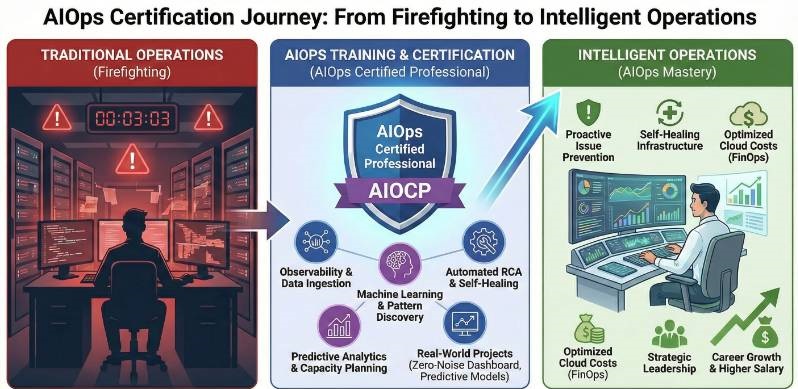
The way we manage technology is changing faster than ever. Over the years, I have watched teams move from managing simple physical servers to complex, global cloud networks. Today, the sheer amount of data, logs, and alerts can feel overwhelming. It is no longer possible for a person to manually check every single error.
This is why AIOps (Artificial Intelligence for IT Operations) is so important. it is the bridge between human expertise and machine intelligence. By learning how to use AI to find patterns and automate fixes, you move from being a “firefighter” to a strategic architect. This guide is here to help you navigate the AIOps Certification Training Course | AIOps and take your career to the next level.
Why AIOps is the Future of Operations
Traditional monitoring tells you what is happening. AIOps tells you why it is happening and what will happen next. By using machine learning (ML) and big data, AIOps platforms can spot patterns that humans might miss.
For engineers, this means fewer middle-of-the-night pages. For managers, it means better system uptime and lower operational costs. Whether you are in India or working for a global firm, the demand for AIOps expertise is skyrocketing.
Deep Dive: AIOps Certification Training Course | AIOps
The core of this journey is the AIOps Certified Professional (AIOCP) program. This isn’t just a theoretical course; it is a practical blueprint for building the “brain” of your infrastructure.
What it is
The AIOps Certification Training Course | AIOps is a specialized training program that bridges the gap between traditional operations and data science. It teaches you how to implement AI-driven event correlation, predictive analytics, and self-healing systems using modern toolchains.
Who should take it
- DevOps Engineers who want to automate root cause analysis and reduce alert fatigue.
- Site Reliability Engineers (SREs) looking to use predictive models for error budgets and capacity planning.
- Software Engineers wanting to build smarter, more resilient backend systems.
- Engineering Managers who need to lead their teams through digital and AI transformations.
- Cloud & Platform Engineers aiming to integrate intelligence into their infrastructure-as-code (IaC) workflows.
Skills you’ll gain
- Intelligent Observability: Moving beyond dashboards to understand complex system behaviors.
- Data Ingestion & Big Data: Handling massive streams of logs, metrics, and traces.
- Pattern Recognition: Using ML to identify “normal” vs. “anomalous” behavior.
- Automated Root Cause Analysis (RCA): Reducing the time spent finding the source of a problem.
- Predictive Scaling: Forecasting traffic and resource needs before they peak.
- AIOps Tooling: Mastery of platforms like Prometheus, ELK, and specialized AI-ops engines.
Real-world projects you should be able to do
- The Zero-Noise Dashboard: Build a system that filters out thousands of “flapping” alerts and only notifies the team for critical issues.
- Predictive Outage Detector: Create a model that identifies hardware or software failure patterns 30 minutes before they occur.
- Self-Healing Kubernetes: Develop a pipeline that detects memory leaks and automatically restarts pods or adjusts limits without human intervention.
- Log Sentiment Analysis: Use Natural Language Processing (NLP) to categorize and group millions of lines of error logs into actionable insights.
Preparation plan
- 7–14 Days (The Fast Track): Focus on core AIOps terminology. Understand the difference between supervised and unsupervised learning in an operations context. Learn the architecture of an AIOps platform.
- 30 Days (The Professional Path): Spend time on Python scripting and data manipulation. Set up a local monitoring stack and practice feeding it custom data to see how it handles basic anomalies.
- 60 Days (The Expert Path): This is the hands-on phase. Build end-to-end projects. Focus on integrating ML models with automation tools like Ansible or Terraform to trigger infrastructure changes.
Common mistakes
- Thinking “AI Fixes Everything”: AI is a tool, not a magic wand. You still need solid DevOps foundations.
- Ignoring Data Quality: If your logs are messy, your AI results will be poor. Always clean your data first.
- Setting and Forgetting: AIOps models need constant “tuning” to stay accurate as your infrastructure grows.
- Over-Complication: Start with simple statistical rules before moving to deep learning models.
Best next certification after this
The MLOps Certified Professional is the ideal next step. While AIOps uses AI to manage operations, MLOps helps you manage the lifecycle of the models you are now building.
Master Certification Overview
| Track | Level | Who it’s for | Prerequisites | Skills Covered | Recommended Order |
| AIOps | Professional | Engineers/Managers | Basic Ops + Python | ML, RCA, Predictive Ops | 1 |
| DevOps | Foundation | All Tech Roles | None | CI/CD, Git, Docker | 1 |
| SRE | Expert | SREs/SysAdmins | DevOps Basics | Reliability, SLOs | 2 |
| DataOps | Professional | Data Engineers | SQL/Big Data | Data Pipelines | 2 |
| FinOps | Associate | Finance/Ops | Cloud Basics | Cost Optimization | 1 |
| DevSecOps | Professional | Security/DevOps | DevOps Basics | Security Automation | 2 |
Choose Your Path: 6 Learning Journeys
- The DevOps Path: Focus on speed and delivery. Master the CI/CD pipeline and automate the bridge between dev and ops.
- The DevSecOps Path: Focus on safety at speed. Shift security to the left and automate compliance and vulnerability scanning.
- The SRE Path: Focus on system reliability. Use software engineering to solve infrastructure problems and protect the user experience.
- The AIOps/MLOps Path: Focus on intelligence. Build systems that can learn, predict, and repair themselves using data science.
- The DataOps Path: Focus on the data lifecycle. Ensure that data flows seamlessly and accurately from the source to the AI engines.
- The FinOps Path: Focus on the cloud economy. Master the art of managing variable cloud spend and maximizing business value.
Role → Recommended Certifications Mapping
- DevOps Engineer: DevOps Foundation → Certified Jenkins Engineer → AIOps Certified Professional.
- SRE: SRE Foundation → Prometheus & Grafana Specialist → AIOps Certified Professional.
- Platform Engineer: Kubernetes (CKA) → Terraform Associate → AIOps Certified Professional.
- Cloud Engineer: AWS/Azure Solutions Architect → AIOps Certified Professional.
- Security Engineer: DevSecOps Certified Professional → AIOps Certified Professional.
- Data Engineer: DataOps Certified Professional → MLOps Certified Professional.
- FinOps Practitioner: FinOps Certified Practitioner → AIOps Certified Professional.
- Engineering Manager: DevOps Leader → AIOps Foundation → FinOps for Managers.
Top Training Institutions for AIOps
Selecting the right partner for your education is critical. These institutions are recognized for their excellence in AIOps training:
- DevOpsSchool: This is the global leader in AIOps and DevOps education. They offer a project-centric curriculum with lifetime access to their LMS. Their training is designed for working professionals who need practical, job-ready skills rather than just theory.
- Cotocus: Known for high-impact corporate training and technical bootcamps. They focus heavily on the hands-on implementation of AIOps tools, making them a top choice for engineering teams look to upskill quickly.
- Scmgalaxy: A massive knowledge hub and community platform. They provide a unique mix of structured certification paths and deep technical resources like blogs, videos, and community forums.
- BestDevOps: This institution focuses on career mentoring and helping engineers bridge the gap to high-paying roles. Their AIOps path is highly rated for its focus on modern industry requirements.
- DevSecOpsSchool: The best place to go if you want to combine your AIOps knowledge with a heavy focus on security and automated compliance.
- Sreschool: Dedicated entirely to the world of Site Reliability Engineering. They help you use AI to make your systems more stable and reliable.
- Aiopsschool: A specialized institution that lives and breathes Artificial Intelligence for IT Operations. They offer the most focused content in this specific field.
- Dataopsschool: If your work involves a lot of big data and analytics, this institution will help you understand how to manage the data that your AI tools need.
- Finopsschool: A great choice for managers who want to learn how AI can be used to forecast cloud costs and keep the company’s budget under control.
Next Certifications to Take
Once you have completed the AIOps track, you should consider these three directions to further your career:
- Same Track (Deep Dive): MLOps Certified Professional. Learn how to deploy and monitor the very models that power your intelligent infrastructure.
- Cross-Track (Broaden): DevSecOps Certified Professional. As infrastructure becomes smarter, it must also be secure. This combo makes you an “Elite” architect.
- Leadership Track: DevOps Leader (DOL). If you want to move into Director or VP levels, this certification focuses on the culture, strategy, and business of these technologies.
General FAQs
1. Is AIOps certification difficult for beginners? It is moderately challenging. You should have a basic understanding of IT operations and some scripting knowledge before starting.
2. How long does the training take? Most professionals can complete the certification within 4 to 8 weeks of part-time study.
3. What are the prerequisites? A basic comfort level with Linux, Python, and cloud environments like AWS or Azure is recommended.
4. Is there a specific sequence for these certifications? Starting with a DevOps or SRE foundation is helpful but not mandatory if you already have 2-3 years of work experience.
5. What is the value of this certification for my career? AIOps is one of the fastest-growing and highest-paying niches in the tech market today.
6. Does the course cover specific tools? Yes, it covers the most popular open-source and commercial AIOps toolchains.
7. Can I take this course online? Yes, most top providers like DevOpsSchool offer live, instructor-led online sessions.
8. What are the common career outcomes? Common roles include AIOps Engineer, Senior SRE, Automation Lead, and Platform Architect.
9. Is the exam practical or theoretical? It is usually a mix of both, with a strong focus on project-based assessments.
10. How long is the certification valid? It is generally valid for 2 to 3 years, keeping you up-to-date with the latest tech shifts.
11. Is this recognized globally? Yes, these certifications are recognized by major tech firms across India, Europe, and North America.
12. Does AIOps help with cloud cost management? Yes, it can predict resource waste and help automate the “right-sizing” of your cloud environment.
FAQs: AIOps Certification Training Course | AIOps
1. What makes the DevOpsSchool program different? They focus on “Project-Based Learning.” You build real AIOps systems during the course, not just watch slides.
2. Do I need to be a Data Scientist? No. You need to be an engineer who understands how to apply Data Science to operations.
3. Will I get help with the labs? Yes, top-tier schools provide 24/7 technical support for their lab environments.
4. Is there a certificate of completion? Yes, you receive a professional certification after passing the evaluation.
5. Can this be done alongside a full-time job? Yes, the schedules are designed for working professionals with weekend and evening batches.
6. What kind of salary hike can I expect? AIOps specialists often see a 20-40% increase in compensation compared to traditional DevOps roles.
7. Is Python mandatory? While not mandatory to start, you will learn the Python necessary for AIOps during the training.
8. How do I enroll? Visit the Official Provider website to find the next available batch and registration details.
Conclusion
The transition from manual operations to intelligent, self-healing systems is the defining shift of our era. By pursuing the AIOps Certification Training Course | AIOps, you are doing more than just adding a line to your resume; you are future-proofing your career. You are learning to build systems that think, learn, and scale beyond human limits. Whether you are an engineer or a manager, the time to start this journey is now. The future of operations is smart, and it is waiting for you to lead the way.