Upgrade & Secure Your Future with DevOps, SRE, DevSecOps, MLOps!
We spend hours scrolling social media and waste money on things we forget, but won’t spend 30 minutes a day earning certifications that can change our lives.
Master in DevOps, SRE, DevSecOps & MLOps by DevOps School!
Learn from Guru Rajesh Kumar and double your salary in just one year.
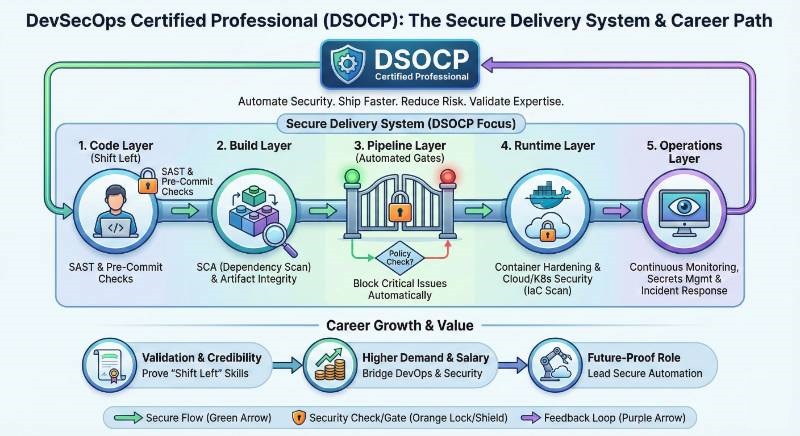
In the past, security was a “gate” at the end of the software process. It was slow, manual, and often painful. Today, if you cannot automate security, you cannot ship software. This shift has created one of the most urgent career opportunities in the tech industry: DevSecOps.
The DevSecOps Certified Professional (DSOCP) is not just another certificate. It is a validation that you can build the “immune system” of a software company. You learn to make security checks happen automatically—inside the pipeline—so that developers can move fast without breaking things.
This guide is for working engineers, managers, and software professionals (in India and globally) who want to master the art of secure software delivery.
Master Certification Table
Here is the quick snapshot of the certification.
| Feature | Details |
| Certification Name | DevSecOps Certified Professional (DSOCP) |
| Track | Security & Automation |
| Level | Professional / Advanced |
| Who it’s for | DevOps Engineers, Security Engineers, SREs, Developers, QA Leads |
| Prerequisites | Basic Linux, Git, and understanding of CI/CD pipelines (Jenkins/GitLab) |
| Skills Covered | SAST/DAST, Container Security, IaC Security, Secret Management, Compliance as Code |
| Recommended Order | Take after a foundational DevOps course (optional but helpful) |
Deep Dive: DevSecOps Certified Professional (DSOCP)
What it is
The DevSecOps Certified Professional (DSOCP) is a hands-on training program that teaches you how to design a “Secure Delivery System.” It moves beyond theory and focuses on the five layers of modern security:
- Code Layer: Safe coding habits and pre-commit checks.
- Build Layer: Dependency scanning and artifact integrity.
- Pipeline Layer: Automated security gates that block bad builds.
- Runtime Layer: Container and Kubernetes security.
- Operations Layer: Continuous monitoring and incident response.
Who should take it
- DevOps & Platform Engineers: If you build pipelines, you must know how to secure them.
- Security Engineers: If you are tired of manual audits and want to automate your work.
- Software Engineers: If you want to write secure code and understand how to fix vulnerabilities before they reach production.
- Engineering Managers: If you need to lead teams to ship faster without “security drama” at the release deadline.
Skills you’ll gain
- Secure CI/CD Design: Building pipelines that test, scan, and validate every change automatically.
- Software Composition Analysis (SCA): Managing open-source risks and licensing issues.
- Container Hardening: Reducing the attack surface of Docker images and Kubernetes pods.
- Secrets Management: Stopping passwords and API keys from leaking into code repositories.
- Infrastructure as Code (IaC) Security: Scanning Terraform and Ansible for misconfigurations.
- Vulnerability Management: Triaging alerts and prioritizing fixes based on real risk.
Real-world projects you should be able to do after it
The true value of this training is what you can build. After completing the DSOCP, you should be able to deliver these five specific projects:
Project 1: The “Zero-Trust” CI/CD Pipeline
- Goal: Build a pipeline that assumes all code is risky until proven safe.
- Tasks: Integrate SAST tools (like SonarQube) and SCA tools (like Trivy) into Jenkins or GitLab CI.
- Outcome: A pipeline that automatically fails the build if critical vulnerabilities are found, preventing bad code from ever reaching the staging environment.
Project 2: Container Security Workflow
- Goal: Secure the software supply chain for microservices.
- Tasks: Implement image signing, base image scanning, and registry policing.
- Outcome: A system where only “trusted” and “scanned” images are allowed to run in your cluster.
Project 3: Kubernetes Security Baseline
- Goal: Harden a Kubernetes cluster against common attacks.
- Tasks: Configure Role-Based Access Control (RBAC), set up Network Policies to isolate namespaces, and enforce Pod Security Standards.
- Outcome: A cluster where a compromised container cannot easily attack other services.
Project 4: Automated Secrets Management System
- Goal: Eliminate hardcoded credentials.
- Tasks: Deploy a tool like HashiCorp Vault and integrate it with your applications so they fetch secrets dynamically at runtime.
- Outcome: No more API keys stored in plain text in GitHub or configuration files.
Project 5: Vulnerability Dashboard & Triage Process
- Goal: Make security visible.
- Tasks: Aggregate alerts from all your tools into a single dashboard (like DefectDojo) and define an SLA for fixing them.
- Outcome: A clear view of your security posture that managers can understand.
Preparation plan
Depending on your current experience, choose the plan that fits you.
7–14 Days Plan (Fast Track)
- Best for: Experienced DevOps engineers.
- Day 1-3: Refresh on CI/CD stages and Linux basics.
- Day 4-6: Focus deeply on Dependency Scanning and SAST tools.
- Day 7-10: Practice Container Security (Docker/K8s) and specific tool configurations.
- Day 11-14: Build one “Capstone Pipeline” that integrates all tools.
30 Days Plan (Recommended for Professionals)
- Best for: Working professionals studying part-time.
- Week 1: Master the foundations of Secure SDLC and Threat Modeling.
- Week 2: Deep dive into Code Security (SAST) and Supply Chain Security (SCA).
- Week 3: Focus on Runtime Security (Containers, Kubernetes, and Cloud IAM).
- Week 4: Capstone project and mock exams. Dedicate time to setting up a home lab.
60 Days Plan (Career Transition)
- Best for: Developers or Ops admins moving into Security.
- Weeks 1-2: Build strong foundations in Linux, Git, and Docker.
- Weeks 3-4: Learn CI/CD concepts by building simple pipelines without security first.
- Weeks 5-6: Layer in security tools one by one (Scan first, then block).
- Weeks 7-8: Focus on “Culture” aspects—how to handle false positives and work with developers.
Common mistakes
- Buying tools before fixing culture: Installing a scanner doesn’t make you secure if no one fixes the bugs.
- Alert Fatigue: Turning on every rule in the scanner immediately. This floods developers with 1,000 alerts, causing them to ignore everything. Start small.
- Blocking everything day one: Breaking the build for minor issues will make developers hate the security process. Start with “Warning” mode.
- Ignoring the “Supply Chain”: Focusing only on your code but ignoring the 500 open-source libraries you import.
- Forgetting Runtime: Securing the pipeline is great, but you also need to monitor the application after it is deployed.
Best next certification after this
- Certified Kubernetes Security Specialist (CKS): To master deep technical security in Kubernetes.
- Certified Cloud Security Professional (CCSP): To broaden your knowledge across cloud platforms.
Choose Your Path: 6 Specialized Learning Paths
The DSOCP is the core of the DevSecOps path, but it is valuable for all modern IT roles.
- DevOps Path:
- Focus: Flow, Speed, Automation.
- Goal: Release features to customers as fast as possible.
- DevSecOps Path (The DSOCP Track):
- Focus: Risk, Compliance, Safety.
- Goal: Release features safely without slowing down the flow.
- SRE (Site Reliability Engineering) Path:
- Focus: Uptime, Latency, Scalability.
- Goal: Ensure the system is reliable and can handle massive traffic.
- AIOps / MLOps Path:
- Focus: AI-driven operations and Model delivery.
- Goal: Automate complex decision-making and manage AI models in production.
- DataOps Path:
- Focus: Data integrity and pipeline efficiency.
- Goal: Deliver accurate data to business teams instantly and securely.
- FinOps Path:
- Focus: Cost, Value, Cloud Spend.
- Goal: Maximize the business value of every dollar spent on cloud.
Role → Recommended Certifications Mapping
Use this map to plan your next 18 months of career growth.
| Current Role | Recommended Certification Path |
| DevOps Engineer | DevOps Master → DevSecOps (DSOCP) → SRE Professional |
| SRE | Linux Expert → DSOCP → Chaos Engineering Specialist |
| Platform Engineer | Kubernetes Administrator (CKA) → DSOCP → Cloud Architect |
| Cloud Engineer | AWS/Azure Admin → DSOCP → Terraform Certified Associate |
| Security Engineer | Ethical Hacking → DSOCP → Cloud Security Specialist |
| Data Engineer | Big Data Master → DataOps Certified → DSOCP (for data security) |
| FinOps Practitioner | Cloud Practitioner → FinOps Certified → DSOCP (for compliance costs) |
| Engineering Manager | Scrum Master → DevOps Master → DSOCP (for oversight) |
Top Institutions for DevSecOps Training
When choosing a training partner, you want one that helps you build a career, not just pass an exam. Here are the top institutions.
DevOpsSchool
DevOpsSchool is the premier destination for this specific certification. They are known for a “Community-First” approach, offering live instructor-led sessions, lifetime access to materials, and strong internship support. Their focus is on getting you job-ready with real-world scenarios.
Cotocus
Cotocus is built on a consulting foundation. This means their training is derived from real projects they have delivered for clients. It is highly practical and suited for experienced engineers who want to solve specific, complex architectural challenges.
Scmgalaxy
Scmgalaxy is excellent for structured, step-by-step learning. They are perfect for learners who want a clear progression path with plenty of tutorials and community backing. It is a great place to build your foundational knowledge before tackling advanced topics.
BestDevOps
BestDevOps focuses on career guidance and skill mapping. They align their training closely with current job market descriptions, ensuring that what you learn is exactly what hiring managers are asking for right now.
devsecopsschool
As the name suggests, this is a niche portal dedicated entirely to the intersection of Development, Security, and Operations. If you want a curriculum that goes deep into tools like Vault, Aqua Security, and Sysdig, this is the specialist choice.
sreschool
While focused on Site Reliability Engineering, sreschool is the right choice if your goal is to move from Security to Reliability. They teach how security impacts uptime and how to build systems that are both safe and stable.
aiopsschool
This institute focuses on the cutting edge of IT Operations. They are ideal for learning how to use Artificial Intelligence to detect security threats automatically and reduce “alert fatigue” for your team.
dataopsschool
Security is critical for data pipelines. DataOpsSchool is the best place for data engineers to learn how to secure ETL processes, protect PII data, and manage governance in a big data environment.
finopsschool
Security incidents cost money. FinOpsSchool teaches the financial side of the cloud, helping you understand how to govern cloud spending securely and how compliance impacts the bottom line.
FAQs: General & DSOCP Specific
General Questions (1-12)
- Is the DSOCP difficult for beginners?If you are new to Linux and CI/CD, it will be challenging. However, if you follow the “Preparation Plan” and build the projects step-by-step, it is very achievable.
- How long does it take to complete?For most working professionals, it takes about 4 to 6 weeks of consistent weekend study and practice.
- Do I need to be a coder?No. You need to be able to read code and understand scripts (YAML/JSON), but you do not need to be a software developer.
- Is the training live or recorded?Top providers like DevOpsSchool offer live, interactive training which is highly recommended for asking questions.
- What is the market value of this certification?High. Companies are desperate for engineers who can “shift left.” It validates you are a modern engineer, not a legacy one.
- Will this help me get a job abroad?Yes. The tools (Kubernetes, Docker, Jenkins) and concepts are global standards used in the US, Europe, and India.
- Can a fresher take this course?Yes, but be prepared to work harder. You will need to learn the basics of SDLC and Linux alongside the security concepts.
- How does this differ from standard DevOps training?DevOps focuses on speed. DevSecOps focuses on safety. This course adds the critical security layer to the DevOps loop.
- What tools will I learn?You will typically learn SonarQube, Trivy, OPA, HashiCorp Vault, Prometheus, and CI/CD tools like Jenkins.
- Is the exam theoretical or practical?The best certifications (like DSOCP) involve practical assessments or projects, proving you can actually do the work.
- Do I need a powerful laptop?A standard laptop (16GB RAM recommended) is fine, as most labs can be done in the cloud or with lightweight containers.
- What happens if I fail?Reputable providers usually offer mentorship and a re-take option to ensure you eventually succeed.
DSOCP Specific Questions
- What is the core outcome of DSOCP?The ability to design a secure delivery workflow where builds, tests, and scans happen automatically without manual intervention.
- Does DSOCP focus more on DevOps or Security?It connects both. It teaches security inside the delivery process, making it a hybrid skill set.
- How do I demonstrate DSOCP skills in my job?Start by adding visibility: set up a scanner, create a report, and show your manager the “hidden” risks in your current pipeline.
- What should I master first: dependency scanning or container scanning?If you are a developer-heavy team, start with dependency scanning. If you are ops-heavy, start with containers.
- What if my company culture resists security gates?Start with “Warning” mode. Do not block builds immediately. Show the data first, then slowly introduce blocking rules for critical issues.
- Does DSOCP help with compliance (GDPR/HIPAA)?Yes. Automated pipelines provide a “paper trail” (audit log) that proves exactly who deployed what and when, which is essential for compliance.
- Is DSOCP relevant for cloud-first companies?Extremely. Cloud permissions and misconfigurations are major risks. DSOCP teaches you how to catch these early using Infrastructure as Code scanning.
- What is the best next step for platform teams?After DSOCP, focus on “Golden Pipelines”—creating secure templates that other teams can use to inherit security by default.
Next certifications to take
Once you have mastered the DSOCP, continue your journey:
- Same Track (Deepen Expertise):
- Certified Kubernetes Security Specialist (CKS): The gold standard for K8s security.
- Cross-Track (Broaden Skills):
- AWS Certified Security – Specialty: Apply your skills deep within the AWS cloud.
- Leadership Track (Move Up):
- Certified Information Systems Security Professional (CISSP): For those aiming for CISO or upper management roles.
Conclusion
The DevSecOps Certified Professional (DSOCP) is a practical, career-changing certification for those who want to ship software quickly without increasing risk. It moves you from being a “tool user” to a “system designer.”
By earning this certification, you prove that you can handle dependencies safely, protect secrets, and secure containers—skills that every modern company needs desperately.