Upgrade & Secure Your Future with DevOps, SRE, DevSecOps, MLOps!
We spend hours scrolling social media and waste money on things we forget, but won’t spend 30 minutes a day earning certifications that can change our lives.
Master in DevOps, SRE, DevSecOps & MLOps by DevOps School!
Learn from Guru Rajesh Kumar and double your salary in just one year.
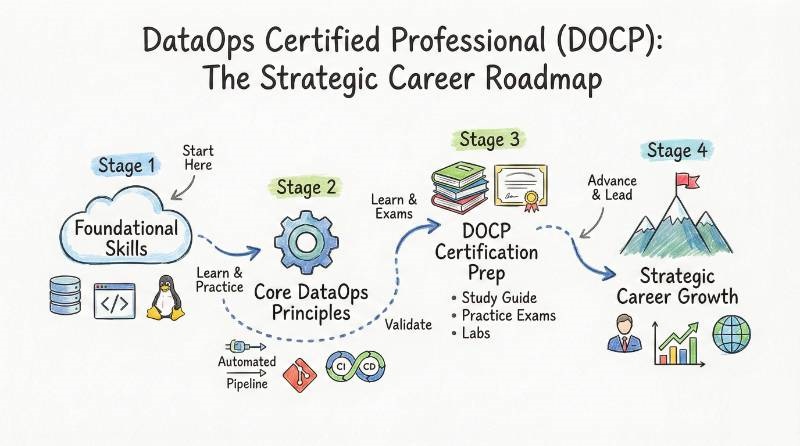
Managing data used to be a straightforward task involving a few databases and weekly reports. However, in the modern era, data flows like a rushing river that can easily overwhelm an unprepared team. Because of this complexity, organizations are rapidly shifting toward DataOps to ensure their data pipelines are as fast and reliable as their software deployments.
DataOps is not merely a buzzword; rather, it is a critical methodology that brings the speed and discipline of DevOps to the world of data science and engineering. If you are a software engineer or a technical manager, obtaining the DataOps Certified Professional (DOCP) credential is the most effective way to prove you can handle this data-driven future. This guide provides everything you need to know to master this domain.
Why DataOps Matters Now
The primary bottleneck in modern business is rarely a lack of information. Instead, the real challenge lies in the inability to process and use that information quickly enough to make decisions. Traditional data management is often slow and manual. Furthermore, these legacy processes are highly prone to human error, which leads to “dirty data” and broken trust.
To solve these issues, DataOps applies Agile development, DevOps automation, and Lean manufacturing principles to data workflows. Consequently, by becoming a DataOps Certified Professional, you learn to treat data as a living product. You will move away from a reactive state—where you spend your day fixing broken pipelines—and transition into a proactive role where you build resilient, self-healing systems.
Choose Your Path: 6 Career Tracks for Modern Engineers
Before diving deep into DataOps, it is important to understand where it sits in the broader ecosystem. Here are the six primary paths you can take to level up your career:
1. The DevOps Path
This is the foundation. It focuses on breaking down silos between developers and operations. It’s all about CI/CD, automation, and speed.
2. The DevSecOps Path
Security cannot be an afterthought. This path integrates security checks into every stage of the pipeline, ensuring that speed doesn’t come at the cost of safety.
3. The SRE (Site Reliability Engineering) Path
SREs are the guardians of uptime. They use software engineering to solve operations problems, focusing on scalability and reliability.
4. The AIOps / MLOps Path
This is where automation meets intelligence. MLOps focuses on the lifecycle of machine learning models, while AIOps uses AI to automate IT operations.
5. The DataOps Path
Our focus today. This track is for those who want to master the automation and quality of data pipelines. It bridges the gap between data engineers and data consumers.
6. The FinOps Path
Cloud costs can spiral out of control. FinOps practitioners bring financial accountability to the variable spend model of the cloud, ensuring every dollar spent drives value.
Role → Recommended Certifications Mapping
Not sure where you fit? Use this mapping to align your current role with the right certification journey.
| Current Role | Recommended Certification |
| DevOps Engineer | Certified DevOps Professional (CDP) |
| SRE / Systems Engineer | SRE Certified Professional (SREC) |
| Platform Engineer | Certified DevOps Architect (CDA) |
| Cloud Engineer | Azure/AWS DevOps Engineer Expert |
| Security Engineer | DevSecOps Certified Professional (DSOCP) |
| Data Engineer | DataOps Certified Professional (DOCP) |
| FinOps Practitioner | Certified FinOps Professional |
| Engineering Manager | Certified DevOps Manager (CDM) |
Complete Certification Master Table
Here is a comprehensive look at the leading certifications provided by DevOpsSchool and its partners.
| Track | Level | Who it’s for | Prerequisites | Skills Covered | Recommended Order |
| DevOps | Foundation | Beginners | Basic Linux | Git, Docker, CI/CD | 1st |
| DevOps | Professional | Engineers | 2+ yrs exp | Kubernetes, Terraform | 2nd |
| DataOps | Professional | Data Pros | SQL/Python | Airflow, Kafka, dbt | Specialist |
| SRE | Professional | Ops Experts | DevOps basics | Observability, SLAs | Advanced |
| DevSecOps | Professional | Security Pros | CI/CD knowledge | Vault, SonarQube | Advanced |
| MLOps | Professional | Data Scientists | Python, ML | Model CI/CD, MLFlow | Specialist |
| AIOps | Professional | SREs/Managers | Ops basics | ELK, Prometheus, AI | Specialist |
DataOps Certified Professional (DOCP)
What it is
The DataOps Certified Professional (DOCP) is a practitioner-level program focused on technical mastery. Specifically, it validates your ability to design, build, and maintain automated data pipelines that are reliable, scalable, and secure.
Who should take it
- Data Engineers wanting to automate their manual workflows.
- Software Engineers transitioning into data-heavy roles.
- Data Scientists tired of “dirty” data and broken pipelines.
- Managers overseeing data and analytics teams.
Skills you’ll gain
- Orchestration: Mastering tools like Apache Airflow to schedule complex workflows.
- Streaming: Handling real-time data with Apache Kafka.
- Data Quality: Implementing automated testing for data integrity.
- Infrastructure as Code: Deploying data stacks using Terraform and Kubernetes.
- Governance: Understanding data lineage and compliance (GDPR/HIPAA).
Real-world projects you should be able to do
- Design and deploy an end-to-end automated ETL pipeline from scratch.
- Create a comprehensive real-time dashboard for monitoring the health of all data flows.
- Implement a “Data-as-Code” workflow that utilizes version control for all data configurations.
- Set up automated validation gates to block poor-quality data before it reaches production databases.
The DOCP Preparation Plan
Depending on your experience, you can choose a timeline that fits your schedule:
The Fast Track (7–14 days)
This path is ideal for those already working in DevOps or Data Engineering. First, focus on mastering the specific terminology and core tool syntax found in the syllabus. Next, spend roughly four hours a day reviewing the DataOps Manifesto and basic Airflow configurations. Ultimately, your goal is to understand the “What” and “How” of basic pipeline construction.
The Deep Dive (30 days)
If you are new to automation, this 30-day plan is the best choice. Start by dedicating one week to each major tool, such as Kafka or dbt. Moreover, ensure you build one hands-on project per week to reinforce your learning. By the end of the month, you should be fluent in both troubleshooting and performance tuning.
The Mastery Path (60 days)
This is the recommended path for those aiming for leadership or architect roles. In addition to the technical tools, you must study enterprise-scale case studies and data governance strategies. Furthermore, focus on implementing security-as-code for sensitive data access. Consequently, you will be prepared to lead a full DataOps transformation for a large organization.
Common Mistakes to Avoid
- Ignoring the “Ops” in DataOps: Many focus only on the data tools and forget about CI/CD and monitoring.
- Over-Engineering: Don’t build a complex real-time streaming system if a simple batch process works.
- Manual Fixes: Avoid “cowboy coding” in production. If it’s not in the code/Git, it doesn’t exist.
- Siloed Testing: Testing only the code and not the data quality itself is a recipe for disaster.
What’s Next? Expanding Your Horizons
Once you have your DOCP, you shouldn’t stop there. Here are three directions you can take:
Same Track (Specialization): Pursue the Certified DataOps Architect to move into high-level strategy and system design.
Cross-Track (Broadening): Enroll in the MLOps Certified Professional program to bridge the gap between raw data and machine learning models.
Leadership (Growth): Consider the Certified DevOps Manager (CDM) to learn how to lead high-performing technical teams and manage budgets effectively.
Top Institutions for DataOps Training
If you are looking for guided training and certification support, these institutions are the leaders in the space:
- DevOpsSchool: As a global leader in technical training, they offer deep, tool-centric courses with lifetime access to learning materials. Their curriculum is heavily focused on real-world projects and hands-on labs.
- Cotocus: This institution is widely known for its boutique training style and high-quality lab environments. They specialize in simulating complex enterprise challenges to prepare students for real-world scenarios.
- Scmgalaxy: This is a massive community-driven platform that provides extensive resources and tutorials. In addition to training, they offer significant support for SCM and DevOps professionals worldwide.
- BestDevOps: They specialize in intensive bootcamps designed to take an engineer from a beginner to an expert in a short timeframe. Their focus is on practical, job-ready skills that can be applied immediately.
- DataOpsSchool: This is a specialized branch that focuses exclusively on the data lifecycle. They offer niche courses in data governance and advanced pipeline automation that are hard to find elsewhere.
- dataopsschool: A niche platform focusing exclusively on the DataOps lifecycle, providing the deepest possible technical dive into data orchestration tools.
- finopsschool: Provides the financial and cloud-economic training necessary to ensure that your DataOps pipelines are cost-effective as they scale.
Frequently Asked Questions (General)
- Is DataOps just DevOps for data? While the two share many principles, DataOps specifically addresses the unique challenges of data quality and state management.
- Do I need to be an expert coder? You don’t need to be a software architect, but a solid grasp of SQL and Python is definitely required for success.
- How long does the certification last? Typically, professional certifications in this fast-moving field are valid for 2–3 years before a refresh is recommended.
- Is this course suitable for managers? Absolutely, because it helps managers understand the technical hurdles and resource needs of their data teams.
- Will this help me get a salary hike? Yes, because DataOps is a high-demand niche; certified professionals often see significant increases in their market value.
- Are there any prerequisites for DOCP? A basic understanding of databases and Linux command-line basics will help you progress through the material much faster.
- Is the final exam mostly theory? No, the DOCP emphasizes practical application, meaning you will likely be tested on your ability to configure and troubleshoot tools.
- Does it cover cloud-native tools? Yes, the program covers how to implement these strategies across major cloud providers like AWS, Azure, and Google Cloud.
- What is the DataOps Manifesto? It is a set of 18 guiding principles that prioritize things like “Value Data over Tools” and “Continuous Improvement.”
- Can I pass by self-studying? It is possible, but structured training from an institution provides the lab environments that are difficult to set up on your own.
- How does this relate to AI? AI models are only as good as the data they consume. Therefore, DataOps is the foundation that makes reliable AI possible.
- What is the difference between DataOps and Data Engineering? Data Engineering is the act of building the pipeline, while DataOps is the methodology of making that process automated and reliable.
FAQs: DataOps Certified Professional (DOCP)
- What is the primary objective of the DOCP? The goal is to produce experts who can significantly reduce the time it takes to deliver high-quality data to the business.
- Which specific tools are covered in the curriculum? You will primarily work with industry standards such as Apache Airflow, Kafka, Docker, Kubernetes, and dbt.
- Is the DOCP certification recognized globally? Yes, it is highly respected in major tech hubs across India, North America, and Europe.
- How difficult is the certification process? It is considered moderately difficult because it requires a mix of theoretical knowledge and hands-on technical skill.
- Does the DOCP include Data Governance? Yes, a significant portion of the course is dedicated to data lineage, security, and maintaining compliance.
- Should I take DevOps before DataOps? While not strictly required, having a “DevOps Foundation” will make the transition into DataOps much smoother.
- What specific job roles can I apply for? Common roles include DataOps Engineer, Senior Data Pipeline Engineer, and Data Platform Architect.
- Does it cover legacy systems? While the focus is on modern cloud-native stacks, the principles are applicable to any data environment, including legacy databases.
Conclusion
The era of manual, error-prone data management is officially coming to a close. As organizations race to become truly “AI-first,” the demand for professionals who can build reliable data foundations is reaching an all-time high. The DataOps Certified Professional (DOCP) is more than just a credential; it is a commitment to a modern, automated, and high-quality way of managing information.
Whether you are an engineer looking to future-proof your career or a manager trying to bring order to your team’s data chaos, mastering DataOps is the single most strategic move you can make today.