Upgrade & Secure Your Future with DevOps, SRE, DevSecOps, MLOps!
We spend hours scrolling social media and waste money on things we forget, but won’t spend 30 minutes a day earning certifications that can change our lives.
Master in DevOps, SRE, DevSecOps & MLOps by DevOps School!
Learn from Guru Rajesh Kumar and double your salary in just one year.
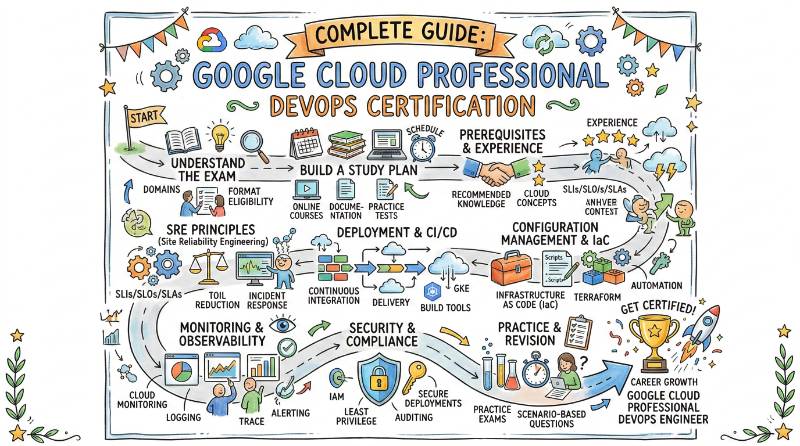
In the world of technology, things move fast. For many years, I have seen how the role of the engineer has changed. It is no longer just about writing code that works on your own computer. It is about making sure that code works for thousands of people at the same time, without any breaks or slow-downs. Google Cloud Platform (GCP) has become a top choice for big companies because it uses the same tools Google uses to stay online.
Whether you are an engineer in India or a manager leading a global team, getting the right certification is a smart move. It shows you have the skills to handle big projects. This guide will help you understand the Google Cloud Professional Cloud DevOps Engineer path and how it can help your career grow.
The Big Picture: Google Cloud Certifications
Before we look at the DevOps track, it is good to see how Google organizes all its certificates. This table shows you which path might be right for you.
Master Certification Overview
| Track | Level | Who it’s for | Prerequisites | Skills Covered | Recommended Order |
| Cloud DevOps | Professional | SREs, DevOps Engineers | 3+ years in tech | CI/CD, SRE, Monitoring | 2nd or 3rd |
| Cloud Architect | Professional | Solutions Architects | 3+ years in tech | Design, Security, Planning | 1st or 2nd |
| Cloud Security | Professional | Security Engineers | 3+ years in tech | Identity, Network Safety | 3rd or 4th |
| Data Engineer | Professional | Data Scientists | 3+ years in tech | Big Data, ML, Pipelines | 2nd or 3rd |
| Cloud Developer | Professional | App Developers | 3+ years in tech | APIs, Testing, Debugging | 2nd |
Deep Dive: Google Cloud Professional Cloud DevOps Engineer
This certification is special because it is not just about tools. It is about a way of working that makes systems reliable and fast.
What it is
The Google Cloud Professional Cloud DevOps Engineer certification proves you can build and run stable software. It is based on Site Reliability Engineering (SRE). This means you learn how to balance making new things quickly while keeping the system from crashing. You will learn how to automate daily tasks and keep a close eye on how the system is performing.
Who should take it
This is the right choice for Software Engineers who want to understand the “operations” side of things. It is also perfect for current DevOps Engineers or SREs who want to show they are experts in Google Cloud. Managers also find this useful because it teaches them how to lead teams that build stable products.
Skills you’ll gain
Studying for this certificate will give you a new set of tools to solve problems. You will learn how to treat infrastructure like code.
- SRE Basics: You will learn about SLIs (indicators) and SLOs (objectives). You will understand the “Error Budget,” which helps you decide if it is safe to release new code or if you need to focus on fixing bugs.
- Automation Pipelines: You will master Cloud Build and Artifact Registry. This helps you move code from your computer to the cloud automatically and safely.
- Monitoring and Logging: You will learn to use the Cloud Operations suite to see what is happening inside your apps. This helps you find and fix issues before users even notice them.
- Incident Management: You will learn the right way to act when things go wrong. This includes how to fix the problem fast and how to write a report so the same mistake doesn’t happen again.
Real-world projects you should be able to do
After you learn these skills, you will be able to handle complex tasks that companies really need.
- Safe Code Releases: You can set up “Canary” releases where only a few people see a new feature at first. If it works well, you show it to everyone.
- Self-Healing Systems: You can use Google Kubernetes Engine (GKE) to build systems that fix themselves if a part of them breaks.
- Monitoring Dashboards: You can build screens that show exactly how healthy your app is in real-time.
- Auto-Scaling: You can make your system grow when many people are using it and shrink when things are quiet to save money.
Preparation Plan: Choose Your Speed
Depending on how much time you have, you can follow one of these three plans.
7–14 Days: The Quick Review
- For: People who already use Google Cloud every day.
- Plan: Focus on the official exam guide and take many practice tests. Learn the specific names Google uses for their tools.
- Goal: Make sure you know the “Google way” of answering questions.
30 Days: The Balanced Study
- For: Engineers who know other clouds (like AWS) but are new to Google.
- Plan: Spend two weeks doing hands-on labs. Spend the next two weeks reading about SRE and CI/CD tools.
- Goal: Get comfortable with the Google Cloud console and tools.
60 Days: The Master Path
- For: New engineers or managers who want to learn everything properly.
- Plan: Spend one hour every day. Read the SRE books and build small projects on the cloud. Take a course from a school like DevOpsSchool.
- Goal: Gain a deep understanding that will help you in your daily job, not just the exam.
Common Mistakes (And How to Avoid Them)
Even smart people can fail if they don’t prepare the right way.
- Only learning the tools: The exam asks a lot about culture and SRE rules. If you only know the tools but not the “why” behind them, you might struggle.
- Not practicing: You must use the cloud console. Reading a book is not enough. You need to see how the menus look and how the tools work together.
- Ignoring Google’s Best Practices: Google has a specific way they want you to solve problems. Always choose the answer that follows their official recommendations.
Choose Your Path: 6 Learning Tracks
After the basic DevOps certificate, you can specialize in one of these areas:
- DevOps: Focusing on making the software delivery process as fast and smooth as possible.
- DevSecOps: Adding security to every step of the process so the code is safe from the start.
- SRE: The highest level of reliability. You focus on keeping massive systems running without any downtime.
- AIOps/MLOps: Using AI to help run your systems and learning how to manage machine learning models.
- DataOps: Making sure data moves through the cloud safely and quickly for the data teams.
- FinOps: Learning how to manage the cost of the cloud so your company doesn’t spend too much money.
Role → Recommended Certifications
Here is a simple way to know what to take next based on your job:
- DevOps Engineer: Professional Cloud DevOps Engineer + Professional Cloud Architect.
- SRE: Professional Cloud DevOps Engineer + Professional Cloud Security Engineer.
- Platform Engineer: Professional Cloud Architect + Professional Cloud Developer.
- Cloud Engineer: Associate Cloud Engineer + Professional Cloud DevOps Engineer.
- Security Engineer: Professional Cloud Security Engineer + Professional Cloud DevOps Engineer.
- Data Engineer: Professional Data Engineer + Professional Cloud DevOps Engineer.
- FinOps Practitioner: Cloud Digital Leader + Professional Cloud Architect.
- Engineering Manager: Cloud Digital Leader + Professional Cloud DevOps Engineer.
Next Certifications to Take
Once you have finished the DevOps guide, you should think about your next step. Based on data from GurukulGalaxy, here are three great choices:
- Same Track (Security): The Professional Cloud Security Engineer is perfect because security is very important for DevOps.
- Cross-Track (Data): The Professional Data Engineer helps you understand how to manage big data systems.
- Leadership (Architect): The Professional Cloud Architect is the best choice if you want to move into a high-level design or management role.
Top Institutions for Training and Certification
If you need help learning, these schools provide great training and help with certifications:
- DevOpsSchool: This school is famous for its very practical workshops. They teach you the real skills you need for the job, not just how to pass the test.
- Cotocus: They provide very high-level training for professionals who want to master modern cloud technologies quickly.
- Scmgalaxy: A great place for community learning. They have many blogs and tutorials that help you learn by doing.
- BestDevOps: They focus on teaching the latest industry standards, making sure you are ready for the current job market.
- devsecopsschool: The best choice if you want to focus on the security side of the cloud.
- sreschool: This school focuses purely on Site Reliability Engineering, which is a big part of the Google exam.
- aiopsschool: Learn how to use artificial intelligence to make your infrastructure smarter.
- dataopsschool: Perfect for those who want to work with data pipelines and cloud infrastructure.
- finopsschool: A must for managers who need to learn how to keep cloud costs under control.
FAQs: General DevOps Career Advice
1. Is the DevOps exam difficult?
Yes, it is one of the tougher exams. It requires you to know the tools and the SRE way of thinking very well.
2. How long should I study?
Most people spend about 1 to 2 months preparing if they are working a full-time job.
3. Do I need to be a programmer?
You don’t need to be a master, but you should be able to read code and write simple scripts to automate tasks.
4. What is the best order to take these?
Starting with the Associate Cloud Engineer is usually a good idea before trying the Professional DevOps exam.
5. Is the pay good for this role?
Yes, DevOps and SRE roles are some of the best-paying jobs in the tech industry today, both in India and globally.
6. Does the certificate last forever?
No, it is valid for two years. You will need to take it again to stay up to date with new technology.
7. Can I take the exam online?
Yes, Google allows you to take the exam from your home with a remote proctor.
8. Is Google Cloud as good as AWS?
Both are very good. Google Cloud is often preferred for things like Kubernetes and data analytics.
9. Are there any requirements to take the test?
Google suggests having some experience, but there are no formal rules that say you must have other certificates first.
10. What happens if I don’t pass?
You can take it again after a short waiting period. Use the time to study the areas where you struggled.
11. Is this good for people in management?
Yes. It helps managers speak the same language as their engineers and understand the risks in the cloud.
12. Will this help me find a job in other countries?
Yes, these certifications are recognized all over the world and are very helpful for international careers.
FAQs: Google Cloud Professional Engineer Specifics
1. What is the main goal of this certificate?
The goal is to show you can manage reliable systems and delivery pipelines on Google Cloud.
2. Is it different from the Architect exam?
Yes. The Architect exam is about designing the whole system, while the DevOps exam is about running and deploying it.
3. How much Kubernetes is on the test?
Quite a lot. You should know how GKE works and how to manage clusters.
4. Why is the SRE book important?
Google created SRE, and the exam uses many concepts directly from their official SRE books.
5. Which tools are most important?
Focus on GKE, Cloud Build, Monitoring, and Logging.
6. Is networking important?
You need to know the basics of how traffic moves, like load balancing and how services talk to each other.
7. Are the questions just about facts?
No, they are “scenario” questions. They describe a problem and ask you for the best way to fix it.
8. Can I get my money back if I fail?
No, the fee is for the exam attempt, so it is important to be ready before you book your seat.
Conclusion
Choosing to become a Google Cloud Professional Cloud DevOps Engineer is a major step forward for any technical professional. It is about more than just a piece of paper; it is about learning a way of working that the biggest tech companies in the world use every day. By understanding the principles of reliability and the power of automation, you make yourself a very valuable person in any company. The road to getting certified will teach you how to handle pressure, how to build systems that don’t break, and how to help your team succeed. Whether you are looking for a better job, a higher salary, or just want to be better at what you do, this path is a great investment in your future. It takes time and effort, but the skills you learn will stay with you for your entire career.