Upgrade & Secure Your Future with DevOps, SRE, DevSecOps, MLOps!
We spend hours scrolling social media and waste money on things we forget, but won’t spend 30 minutes a day earning certifications that can change our lives.
Master in DevOps, SRE, DevSecOps & MLOps by DevOps School!
Learn from Guru Rajesh Kumar and double your salary in just one year.
The software world is moving at a breakneck speed. I’ve seen the industry transition from manual “throw-it-over-the-wall” deployments to the highly automated, cloud-native ecosystems of today. However, technical expertise alone is no longer enough to lead a transformation.
Organizations now need Certified DevOps Managers—leaders who can bridge the gap between engineering excellence and business strategy. If you are a Software Engineer or an aspiring Lead in India or globally, this guide is designed to help you navigate the path to leadership.
What is the Certified DevOps Manager Certification?
The Certified DevOps Manager (CDM) is a leadership-focused program designed for professionals who want to lead DevOps teams and drive organizational change. Unlike entry-level certifications that focus solely on tools, the CDM validates your ability to oversee the entire DevOps lifecycle, manage cross-functional teams, and align technical delivery with business objectives.
It is provided by DevOpsSchool, a pioneer in the DevOps training space, focusing on practical application, governance, and the cultural shifts necessary for a successful transformation.
Detailed Certification Breakdown
To help you understand the landscape, I have broken down the primary tracks you will encounter in your journey toward becoming a Master DevOps leader.
Certified DevOps Manager (The Core)
What it is
A leadership-focused certification that validates your ability to oversee DevOps teams, manage CI/CD transformations at scale, and handle the governance, culture, and metrics of a high-performing IT organization.
Who should take it
This is for Senior Engineers, Team Leads, and Project Managers who want to transition into an Engineering Manager or DevOps Lead role. It is provided by DevOpsSchool, a global leader in technical upskilling with a focus on practical, mentor-led training.
Skills you’ll gain
- Strategic DevOps planning and roadmap creation.
- Building and managing cross-functional teams.
- Mastering ROI and performance metrics (DORA metrics).
- Scaling DevOps across large enterprises.
Real-world projects you should be able to do
- Design a 12-month DevOps transformation roadmap for a mid-sized company.
- Implement a standardized CI/CD governance policy across 10+ engineering teams.
- Lead a blameless post-mortem for a major production outage.
Preparation plan
- 7-14 Days: Focus on the DevOps Manifesto, Lean principles, and leadership theory.
- 30 Days: Recommended for most. Includes reviewing case studies and DORA metric implementation.
- 60 Days: Ideal if you are moving from a purely non-technical management role into DevOps leadership.
Common Mistakes to Avoid
In my two decades of mentoring, I’ve noticed a few recurring traps that candidates fall into during their management transition:
- Focusing Only on Tools: Many engineers assume that knowing more tools makes them a better manager. Leadership is about processes and people, not just Jenkins or Kubernetes.
- Neglecting Culture: DevOps is 80% culture and 20% technology. Ignoring team dynamics and psychological safety will lead to failed transformations.
- Ignoring DORA Metrics: Failing to measure success through metrics like Deployment Frequency and Lead Time for Changes makes it impossible to prove the value of your team.
- Underestimating Documentation: As a manager, clear documentation and “Infrastructure as Code” are your best friends. Poor documentation leads to team burnout and “hero culture.”
Best next certification after this
- Certified DevOps Architect (CDA) to deepen the technical design aspect.
Master Certification Comparison Table
| Track | Level | Who it’s for | Prerequisites | Skills Covered | Recommended Order |
| DevOps | Manager | Senior Engineers/TLs | Basic DevOps knowledge | Leadership, Metrics, Governance | 3rd |
| DevOps | Engineer | Software Engineers | Coding/SysAdmin basics | CI/CD, Docker, Git, Jenkins | 1st |
| DevOps | Architect | Principal Engineers | Professional DevOps exp. | System Design, K8s, Scalability | 2nd |
| SRE | Professional | Reliability Engineers | Cloud/DevOps basics | SLOs, SLIs, Error Budgets | 2nd (Specialization) |
| DevSecOps | Professional | Security/DevOps Eng. | CI/CD knowledge | Vulnerability scanning, Compliance | 2nd (Specialization) |
Choose Your Path
I’ve realized that no two careers are the same. You need to pick the path that aligns with your passion.
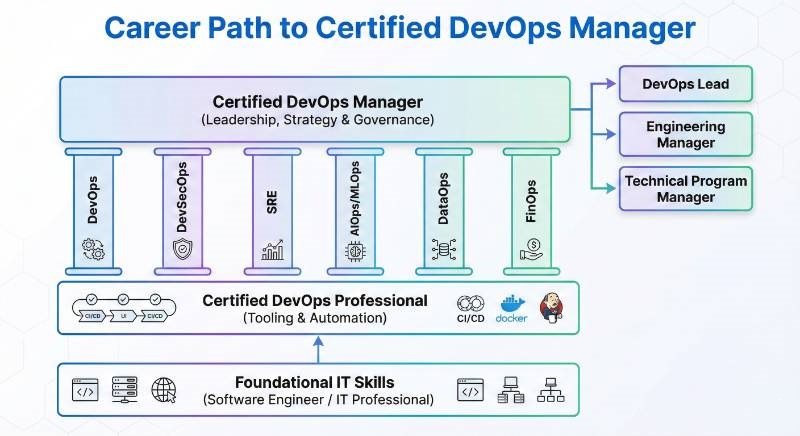
- The DevOps Path: The most versatile. Focuses on the “full stack” of delivery, from code to production.
- The DevSecOps Path: For those who believe security shouldn’t be an afterthought. You’ll learn to “shift left” and automate compliance.
- The SRE Path: Focused on reliability and scale. This is for the “firefighters” who want to build systems that never break.
- The AIOps/MLOps Path: The future of operations. You will manage the lifecycle of AI models and use AI to predict system failures.
- The DataOps Path: Streamlining the flow of data. Crucial for organizations that rely on Big Data and real-time analytics.
- The FinOps Path: The “Cloud Economist” role. You’ll learn how to optimize cloud costs and make engineering teams financially accountable.
Role → Recommended Certifications Mapping
Are you wondering where you fit? Use this quick reference guide:
- DevOps Engineer: Certified DevOps Professional → Certified DevOps Architect.
- SRE: Certified SRE Professional → Certified DevOps Manager.
- Platform Engineer: Certified DevOps Architect → Kubernetes Certified.
- Cloud Engineer: AWS/Azure/GCP Associate → Certified DevOps Professional.
- Security Engineer: DevSecOps Certified Professional → Certified DevSecOps Architect.
- Data Engineer: Certified DataOps Professional → DataOps Manager.
- FinOps Practitioner: Certified FinOps Professional → FinOps Manager.
- Engineering Manager: Certified DevOps Manager → DevOps Leadership Track.
Top Institutions for Training and Certification
If you are looking for help passing the Certified DevOps Manager (CDM) or other specialized exams, these institutions are the best in the business. They offer hands-on labs, real-world projects, and mentorship from experts.
- DevOpsSchool: The premier choice for comprehensive DevOps and Cloud training. They provide lifetime access to course materials and direct mentorship from industry veterans like Rajesh Kumar.
- Cotocus: Known for their deep-dive technical workshops and “Learning by Doing” philosophy. They focus heavily on the practical application of tools.
- Scmgalaxy: A massive resource hub and training provider that focuses on Software Configuration Management and enterprise-grade DevOps practices.
- BestDevOps: Specializes in tailored certification programs for professionals looking to make a quick but high-impact career pivot.
- Specialized Schools: For niche tracks, you should look at devsecopsschool, sreschool, aiopsschool, dataopsschool, and finopsschool. These schools offer laser-focused curricula for their respective domains.
Frequently Asked Questions (FAQs)
General DevOps & Career FAQs
Q1: How difficult is the Certified DevOps Manager exam?
It is moderately difficult because it requires a shift in mindset from “how do I fix this?” to “how do I manage the team that fixes this?”. It tests your situational judgment and strategic thinking.
Q2: How much time is needed for preparation?
For an experienced engineer, 30 days of focused study is usually the sweet spot. If you are new to management, give yourself 60 days to absorb the leadership concepts.
Q3: Are there any hard prerequisites?
There are no strict “papers” required, but it is highly recommended that you have 3-5 years of experience in IT, preferably with some exposure to DevOps tools.
Q4: In what sequence should I take these certifications?
Start with the Certified DevOps Professional to master the tools, then move to Certified DevOps Manager when you are ready to lead.
Q5: What is the real-world value of this certification?
It acts as a “stamp of approval” for recruiters and HR managers, proving you can handle the complexities of modern engineering management.
Q6: Will this help me get a job in India or globally?
Yes. Global firms (and major Indian MNCs) are looking for managers who understand the DevOps lifecycle. This certification is recognized worldwide.
Q7: Is there a lot of coding on the Manager exam?
Not as much as the Engineer exam. The focus is more on architecture, workflow design, and governance.
Q8: What are the career outcomes?
Most graduates move into roles like DevOps Lead, Engineering Manager, or Technical Program Manager (TPM).
Certified DevOps Manager (CDM) Specific FAQs
1. What is the difficulty level of the CDM exam?
The exam is moderately challenging. It requires not just theoretical knowledge but also a mindset shift toward strategy, leadership, and governance.
2. How much time should I dedicate to study?
For most working professionals, 30 to 60 days of consistent study is recommended. If you already have leadership experience, you might be ready in 14 days.
3. Are there any prerequisites for the CDM?
While there are no mandatory certificates required, we highly recommend having 3+ years of experience in an IT role (Dev or Ops) and a baseline understanding of CI/CD concepts.
4. What is the exam format?
The exam typically consists of 50 Multiple Choice Questions (MCQs) with a duration of 90 minutes. It is an online-proctored exam.
5. Is the certification recognized globally?
Yes. DevOpsSchool certifications are recognized by Fortune 500 companies globally, from India to the USA and Europe.
6. What skills will I gain?
You will master DevOps governance, risk management, cost optimization (FinOps), and the ability to lead multi-disciplinary teams.
7. Does the CDM cover specific tools?
While it focuses on management, you will learn the strategic use of tools like Docker, Kubernetes, Jenkins, Terraform, and Prometheus within a team context.
8. What are the career outcomes?
Graduates typically move into roles such as DevOps Lead, Engineering Manager, Technical Program Manager, or Release Manager.
9. Can I take the training and exam online?
Yes, both the training and the certification exam are delivered 100% online, allowing you to learn at your own pace.
10. How long is the certification valid?
The certification is valid for life, though we recommend regular upskilling as the technology landscape evolves.
11. Is there a “Leadership” path after CDM?
Absolutely. After CDM, you can pursue the DevOps Architect or Master in DevOps Engineering (MDE) for a deeper technical-leadership combo.
12. Why choose CDM over a standard Engineer certificate?
The CDM proves you can manage budgets, people, and roadmaps—skills that are essential for the higher salary brackets of Engineering Management.
Conclusion
Becoming a Certified DevOps Manager is a significant milestone in your career journey. It signals to the world that you are no longer just a “doer,” but a strategist capable of driving high-performance cultures.
The industry is hungry for leaders who understand that software delivery is a team sport. With the right training from institutions like DevOpsSchool, you can bridge the gap and lead the next generation of engineering teams.
Good luck on your journey! I’ll see you in the field.