Upgrade & Secure Your Future with DevOps, SRE, DevSecOps, MLOps!
We spend hours scrolling social media and waste money on things we forget, but won’t spend 30 minutes a day earning certifications that can change our lives.
Master in DevOps, SRE, DevSecOps & MLOps by DevOps School!
Learn from Guru Rajesh Kumar and double your salary in just one year.
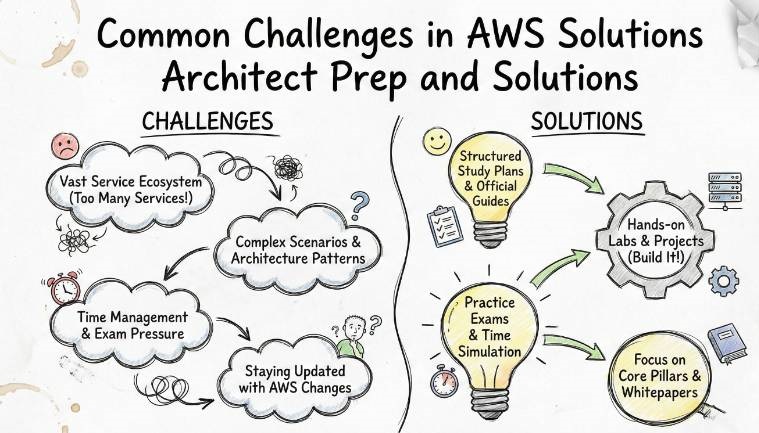
In today’s tech world, being a good coder is just the beginning. The real test comes when your application needs to handle millions of users without crashing or costing the company a fortune. Over the years, I have seen many teams treat the cloud like a simple remote hard drive. But Amazon Web Services (AWS) is a massive, living ecosystem. To truly master it, you need to stop thinking about “servers” and start thinking about “architecture.”
Whether you are a software engineer, a DevOps lead, or an engineering manager, the AWS Certified Solutions Architect path is the best way to prove you can build systems that are stable, secure, and ready for anything.
Navigating the AWS Certification Roadmap
Before we focus on the Solutions Architect role, it helps to see the bigger picture. AWS has organized its certifications into levels that match your career growth, from foundational basics to deep expert specialties.
Master AWS Certification Table
| Track | Level | Who it’s for | Prerequisites | Skills Covered | Recommended Order |
| Cloud | Foundational | Newcomers, Sales, Managers | None | Basics of cloud, billing, and global infra | 1st |
| Architect | Associate | Engineers, Solutions Architects | 1+ year cloud experience | Compute, VPC, S3, IAM, and Databases | 2nd |
| Architect | Professional | Senior Architects, Tech Leads | Associate cert | Complex migrations and org strategy | 4th |
| Operations | Associate | SREs, SysOps Engineers | 1+ year ops experience | Monitoring, automation, and logging | 2nd (Alt) |
| Developer | Associate | Software Engineers | 1+ year dev experience | SDKs, CI/CD, and Serverless tools | 2nd (Alt) |
| Data | Associate | Data Engineers, DBAs | Data background | ETL, Data Lakes, Glue, and Redshift | 3rd |
| AI/ML | Associate | ML Engineers, Data Scientists | Python/ML basics | SageMaker and AI service logic | 3rd |
| Security | Specialty | Security Engineers | 2+ years security exp | Encryption, WAF, and Compliance | 5th |
Deep Dive: AWS Certified Solutions Architect – Associate (SAA-C03)
The Associate level is where most engineers truly find their footing. It moves past simple definitions and asks you to solve problems like a seasoned professional.
What it is
The AWS Certified Solutions Architect – Associate (SAA-C03) is a badge of honor that proves you can design and deploy systems the “right way.” It follows the AWS Well-Architected Framework, which is basically a set of gold standards for building software. It tests if you can look at a business problem and decide which AWS services will make the system fast, safe, and affordable.
Who should take it
This certification is perfect for anyone who builds or manages cloud applications.
- Software Engineers: To understand the environment where your code lives.
- System Admins: To bridge the gap from old-school servers to modern cloud networking.
- DevOps/SREs: To build the foundation for automated, self-healing pipelines.
- Managers: To understand technical trade-offs and control the monthly AWS bill.
Skills you’ll gain
Preparing for this exam will change how you view technology. You will learn to design systems that are “highly available,” meaning even if a whole data center fails, your users won’t notice a thing.
- Security Architecture: You will master IAM (Identity and Access Management) to control who sees what. You will also learn to build VPCs (Virtual Private Clouds) that keep your data hidden from the open web.
- Scaling and Performance: You will learn to use Load Balancers and Auto Scaling. This means your app can grow when traffic hits and shrink when things get quiet.
- Resiliency: You will design systems across multiple “Availability Zones” so that one small failure doesn’t take down the whole company.
- Cost Management: You will learn to pick the right storage (S3) and compute power (EC2) to get the job done without overspending.
Real-world projects you should be able to do
Once you pass this exam, you shouldn’t just have a certificate; you should be able to build production-grade systems.
- The 3-Tier Web App: Build a system with a public load balancer, web servers in a private network, and a database that automatically backs itself up.
- Serverless Data Pipeline: Create a system where a user uploads a photo, a Lambda function automatically resizes it, and the info is saved in a database—all without managing a single server.
- Global Content Delivery: Use CloudFront and Route 53 to make sure your website loads instantly for someone in New York as well as someone in Mumbai.
- Hybrid Connectivity: Connect a company’s physical office to their AWS cloud using a secure VPN tunnel or Direct Connect.
Preparation Plan
| Timeline | Focus Area |
| 7–14 Days | The Reviewer: For those with daily hands-on experience. Focus on 5-10 mock exams and read the FAQs for S3, EC2, and VPC. |
| 30 Days | The Professional: For daily users who only know a few services. Spend 1 hour on labs and 1 hour on theory every day. |
| 60 Days | The Newcomer: For those moving from other fields. Month 1: Use the AWS Free Tier to build projects. Month 2: Study the exam patterns and scenarios. |
Common Mistakes
I have seen many brilliant engineers fail because they didn’t take the exam’s logic seriously.
- Ignoring Cost: Many people choose the fastest service even when the question asks for the “cheapest” one.
- Networking Confusion: Getting Security Groups (server-level) and Network ACLs (network-level) mixed up is a classic trap.
- Relying on Dumps: Questions change. If you don’t understand why an answer is correct, you will struggle with the actual test.
- Skipping Labs: Reading about a VPC isn’t the same as building one. You need to get your hands dirty in the AWS Console.
Choose Your Path: 6 Specialized Learning Journeys
Cloud architecture is just the start. Once you have the mindset, you can specialize in a specific field.
- The DevOps Path: Focus on automation. Use Infrastructure as Code (Terraform) to build systems in minutes.
- The DevSecOps Path: Focus on safety. Learn to put security checks into every step of the coding process.
- The SRE Path: Focus on reliability. Build systems that are so stable they almost never go down.
- The AIOps/MLOps Path: Focus on the future. Use AI to manage your servers and help data scientists deploy their models.
- The DataOps Path: Focus on big data. Learn to manage massive data pipelines so they are always ready for analysis.
- The FinOps Path: Focus on the budget. Help companies save millions by making their cloud usage more efficient.
Role → Recommended Certifications Mapping
| If your role is… | You should take… |
| DevOps Engineer | AWS Solutions Architect + Certified DevOps Engineer |
| SRE | AWS Solutions Architect + SRE Certified Professional |
| Platform Engineer | AWS Solutions Architect + Kubernetes (CKA) |
| Cloud Engineer | AWS Solutions Architect + AWS SysOps Associate |
| Security Engineer | AWS Solutions Architect + AWS Security Specialty |
| Data Engineer | AWS Solutions Architect + AWS Data Engineer Associate |
| FinOps Practitioner | AWS Solutions Architect + Certified FinOps Architect |
| Engineering Manager | AWS Solutions Architect + Certified DevOps Manager |
Next Steps for Your Career
After the Associate level, you have three great ways to keep growing:
- Expert Level: Go for the AWS Solutions Architect – Professional. This is for high-level strategy and complex enterprise designs.
- Security First: Take the AWS Security Specialty. Companies value security more than almost anything else right now.
- Leadership: Look into the Certified DevOps Manager (CDM) if you want to lead teams and manage culture.
Top Institutions for Training and Certification
If you need structured help to clear these exams, these institutions are the best in the business:
- DevOpsSchool: A major leader in the industry that offers deep technical training. They focus on real-world practice and have a huge library of resources for all types of engineers.
- Cotocus: Known for their small, focused bootcamps. They provide a lot of personal mentorship, which is great if you need someone to guide you through the tough labs.
- Scmgalaxy: A massive community platform. They offer thousands of free blogs and tutorials on tools like Git and Jenkins that work perfectly with AWS.
- BestDevOps: They specialize in making complex topics easy to understand. Their courses are perfect for busy professionals who need to learn the most important stuff quickly.
- DevSecOpsSchool: The go-to place for security-focused engineering. They teach you how to bake security into every part of the cloud lifecycle.
- Sreschool: Dedicated to the world of reliability. They teach you how to build systems that never crash, using the same methods as major tech giants.
- Aiopsschool: A forward-looking school that teaches you how to use Machine Learning to automate IT operations.
- Dataopsschool: Perfect for those who want to manage data at scale. They focus on the reliability and speed of data flow in the cloud.
- Finopsschool: The leading provider for cloud financial management. They teach you how to treat the cloud bill like an engineering metric.
FAQs: AWS Certified Solutions Architect (Career & Value)
- Is the exam hard? It is a challenge. It doesn’t just test your memory; it tests your ability to think through a business problem.
- How much time do I need? Most people who work full-time need about 2 to 3 months of consistent study.
- Do I need an IT degree? No. While it helps, many people pass by using hands-on labs and good study guides.
- Should I do Cloud Practitioner first? If you are totally new to the cloud, yes. If you already have some experience, jump straight to the Architect exam.
- Does it expire? Yes, it is valid for 3 years. You renew it by taking the exam again or by passing the Professional level.
- Will this help my salary? Generally, yes. It is consistently ranked as one of the highest-paying certifications in tech globally.
- Can I get a job with just the cert? The certificate gets you the interview. Your ability to build things and explain them gets you the job.
- Do I need to be a coder? You don’t need to be a developer, but you should be able to read simple configuration files (YAML/JSON).
- What if I fail the first time? You can try again after 14 days. Many great architects didn’t pass on their first try.
- Is AWS better than Azure? AWS has the most users, which means there are more jobs available for AWS experts in the market.
- Can I take the test at home? Yes, you can take the exam online from your own computer with a supervisor watching via webcam.
- Are there any free ways to practice? AWS offers a “Free Tier” account that lets you use most services for free for one year to practice.
FAQs: AWS Certified Solutions Architect (Technical Details)
- What is the passing score? You need 720 out of 1000 to pass the exam.
- How many questions? There are 65 questions, and they are all multiple-choice or multiple-response.
- How much time? You have 130 minutes. That is about 2 minutes per question.
- How much does it cost? The exam fee is $150 USD plus taxes.
- What is the most important topic? Networking (VPC) and Identity (IAM) are the two most critical sections to master.
- Are there labs in the exam? Currently, the Associate level is all multiple-choice, but the questions describe lab-like scenarios.
- Is there math? Only very basic math, usually related to comparing the cost of different storage options.
- Which version is current? The SAA-C03 is the current version. Make sure your study materials match this code.
Conclusion
Passing the AWS Certified Solutions Architect – Associate is more than just a line on your resume; it is a turning point in your career. It forces you to stop thinking like a builder and start thinking like an architect. You learn to see the big picture—from how a user logs in to how data is stored safely in a different country. In my experience, the engineers who truly stand out are the ones who understand these deep principles. This certification gives you the foundation to grow into any role, whether it is DevOps, SRE, or even a CTO. It is hard work, but the results are worth it. Start by setting up a free account, building a small project, and taking that first step into the world of cloud architecture.