Upgrade & Secure Your Future with DevOps, SRE, DevSecOps, MLOps!
We spend hours scrolling social media and waste money on things we forget, but won’t spend 30 minutes a day earning certifications that can change our lives.
Master in DevOps, SRE, DevSecOps & MLOps by DevOps School!
Learn from Guru Rajesh Kumar and double your salary in just one year.
Having watched the technology landscape transform from physical server rooms to the vast, serverless cloud environments we use today, I have seen a fundamental change in what companies value. In the past, the struggle was simply finding a place to store data. Today, the challenge is building the systems that make that data useful. We generate massive amounts of information every second, and the industry is looking for experts who can build the reliable, secure pipelines that turn raw data into business intelligence.
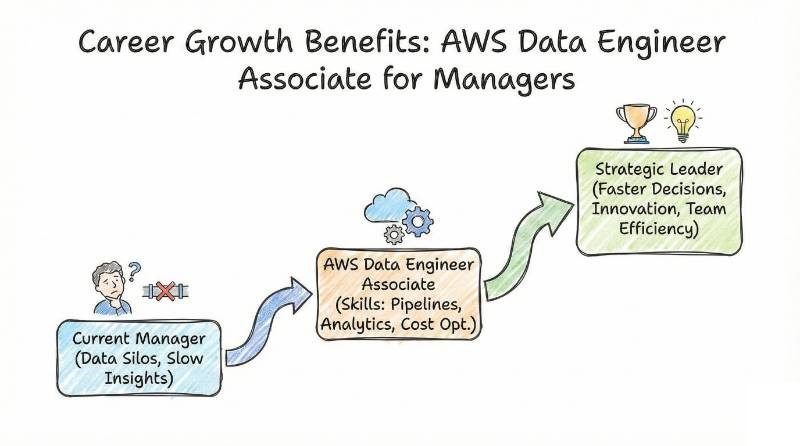
For software engineers and managers, whether you are in India or working globally, standing out in the job market is no longer just about knowing how to code. It is about specializing. The AWS Certified Data Engineer – Associate has quickly become a vital benchmark for any professional who wants to lead in the data space. This guide is designed to help you understand this certification path and provide a clear, expert-level strategy to achieve it.
AWS Certified Data Engineer Associate Training: Master Overview
The following table summarizes the key details of the certification to help you see where it fits in your professional journey.
| Track | Level | Who it’s for | Prerequisites | Skills Covered | Recommended Order |
| Data Engineering | Associate | Software Engineers, Data Engineers, Managers | 1-2 years cloud data experience | Ingestion, ETL, Security, Data Lakes | After Solutions Architect Associate |
Deep Dive: AWS Certified Data Engineer – Associate
What it is
The AWS Certified Data Engineer – Associate (DEA-C01) is a credential that proves your technical ability to build and manage data systems on the AWS platform. It goes beyond basic cloud concepts and focuses specifically on how to move data, where to store it, and how to keep it safe. It validates that you can look at a business problem and choose the right tools—whether that means using AWS Glue for batch processing or Amazon Kinesis for real-time data streams.
Who should take it
This program is perfect for Software Engineers looking to move into high-paying data roles, ETL Developers who are moving their workflows to the cloud, and Data Architects who want an official stamp of approval on their AWS skills. Additionally, Engineering Managers find great value here because it gives them the technical grounding needed to lead data teams and make smart budget decisions regarding cloud infrastructure.
Skills you’ll gain
Preparing for this certification forces you to think like a data architect. You will move away from seeing data as static files and start seeing it as a moving, living asset.
- Ingestion & Transformation: You will master the art of bringing data in from various sources—like IoT devices or web logs—and transforming it into a format that is ready for analysis.
- Storage Management: Learning how to use S3, Amazon Redshift, and DynamoDB effectively. You will understand how to balance performance with cost, ensuring your data is available but not expensive to keep.
- Orchestration: Using tools like AWS Step Functions or Managed Workflows for Apache Airflow (MWAA) to automate complex tasks so they run without manual intervention.
- Governance & Security: This is a major focus. You will learn to use AWS Lake Formation and KMS to ensure that your data is encrypted and that only authorized users can access it.
- Monitoring & Reliability: Setting up alerts and logs using CloudWatch to ensure that if a pipeline breaks, you know about it immediately and can fix it before it impacts the business.
Real-world projects you should be able to do
After finishing this training, you will have the practical skills to handle complex engineering tasks in a production environment.
- Live Data Analytics: Building a system that takes in streaming website data, processes it instantly via AWS Lambda, and displays it on a live dashboard.
- Serverless Data Lake: Designing a system on S3 that automatically cleans and organizes data into different layers (Raw, Cleaned, and Analysis-ready) using AWS Glue.
- Centralized Security Hub: Setting up a system where you can manage data permissions across multiple departments or even different AWS accounts from one place.
- Large-Scale Migration: Planning and executing the move of an old on-premise database into a modern Amazon Redshift cluster with minimal downtime for the company.
Preparation Plan
| Timeline | Action Plan |
| 7–14 Days (The Sprint) | Ideal for those already working in AWS. Focus on “gap-filling.” Review Glue, Redshift, and Lake Formation specifically. Take 3-5 mock exams to identify and fix weak points. |
| 30 Days (The Standard) | Week 1-2: Master data movement and storage (Kinesis, S3, Redshift). Week 3: Focus on ETL and Automation (Glue, Step Functions). Week 4: Deep dive into Security and practice tests. |
| 60 Days (The Deep Dive) | Recommended for software engineers new to data. Spend the first month doing daily hands-on labs. Spend the second month mastering the theoretical concepts and high-level architecture scenarios. |
Common Mistakes
I have seen many talented engineers fail this exam because they underestimated certain areas.
- Ignoring the Cost Factor: AWS doesn’t just want you to build a system; they want you to build an efficient one. Using an expensive service when a cheaper one works will lead to wrong answers.
- Weak Security Knowledge: Many candidates focus only on the “data” part and skip the “security” part. If you don’t understand IAM roles, bucket policies, and encryption keys, you will struggle.
- Relying Only on the Console: The exam often asks about CLI commands or API calls. If you only know how to click buttons in the web browser, you won’t be fully prepared.
- Overlooking Open Standards: While it is an AWS exam, understanding the basics of Apache Spark, SQL, and Python is essential because the AWS services are built on these foundations.
Choose Your Path: 6 Learning Tracks
This certification is a versatile asset that can help you succeed in several specialized career paths.
- DevOps: Learn how to build the infrastructure that allows data teams to deploy their code faster and more reliably.
- DevSecOps: Focus on building security into the data pipeline from day one, ensuring that data is protected at every stage of its journey.
- SRE (Site Reliability Engineering): Use your knowledge to ensure that massive data platforms stay online and perform well under heavy loads.
- AIOps/MLOps: Prepare the high-quality data that artificial intelligence models need. This is the foundation for any successful AI project.
- DataOps: Focus on the “operations” of data—ensuring that data is accurate, delivered on time, and easily accessible to the people who need it.
- FinOps: Become the expert who understands how to manage the cloud bill, ensuring that the company isn’t overspending on storage and compute.
Role → Recommended Certifications Mapping
| Role | Primary Certification | Secondary/Support Certs |
| Data Engineer | AWS Data Engineer Assoc. | AWS Solutions Architect Assoc. |
| DevOps Engineer | AWS DevOps Engineer Prof. | AWS Developer Assoc. |
| SRE | AWS SysOps Admin Assoc. | AWS DevOps Engineer Prof. |
| Platform Engineer | AWS Solutions Architect Prof. | CKA (Kubernetes) |
| Security Engineer | AWS Security Specialty | AWS Solutions Architect Assoc. |
| Cloud Engineer | AWS Solutions Architect Assoc. | AWS SysOps Admin Assoc. |
| FinOps Practitioner | AWS Cloud Practitioner | FinOps Certified Practitioner |
| Engineering Manager | AWS Cloud Practitioner | AWS Solutions Architect Assoc. |
Next Certifications to Take (Top 3 Options)
Once you have mastered the Data Engineer Associate, consider these paths for further growth:
- Option 1 (Same Track): AWS Certified Machine Learning – Associate. This allows you to bridge the gap between preparing data and actually using it to train AI models.
- Option 2 (Cross-Track): AWS Certified Solutions Architect – Associate. This gives you a broader understanding of networking, compute, and general cloud design.
- Option 3 (Leadership): PMP (Project Management Professional). For those looking to move into high-level management, this certification teaches you how to lead complex technical projects.
Top Institutions for AWS Data Engineer Training
If you are looking for professional help to pass your certification, these institutions are highly recommended:
- DevOpsSchool: A leading provider that offers detailed, instructor-led bootcamps. They focus heavily on real-world projects and provide the hands-on labs you need to truly understand the AWS data ecosystem.
- Cotocus: They are well-known for their deep technical training, helping corporate teams and individuals bridge the gap between classroom theory and actual industry work.
- Scmgalaxy: This institution offers training that covers the entire software lifecycle, helping data engineers understand how their work fits into the bigger picture of DevOps and supply chain management.
- BestDevOps: A great choice for those who want focused, fast-paced modules that help them upskill quickly in specific areas like AWS data services and automation.
- devsecopsschool: If your interest lies in protecting data, this school specializes in the intersection of security and engineering, teaching you how to build secure-by-default pipelines.
- sreschool: Their curriculum is designed around reliability and scalability, helping you build data systems that can handle massive traffic without failing.
- aiopsschool: This school focuses on the future of operations, teaching data engineers how their pipelines support modern AI and machine learning workflows.
- dataopsschool: A specialized institution dedicated to the DataOps domain, providing training on every aspect of the data lifecycle from ingestion to final delivery.
- finopsschool: This school teaches the essential skill of cloud financial management, ensuring you can build powerful data systems that remain profitable and cost-effective.
FAQs : Career, Difficulty, and Strategy
1. How difficult is this exam compared to others?
It is more technical than the Solutions Architect Associate. You need a deeper understanding of specific services like Glue and Redshift rather than a general knowledge of everything in AWS.
2. How much time should I set aside for studying?
Most working professionals find that 50 to 70 hours of study is the “sweet spot” for passing, provided they have some hands-on experience.
3. Are there any prerequisites I must complete first?
No. You can jump straight into the Associate level. However, having a basic understanding of cloud concepts (Cloud Practitioner level) is very helpful.
4. What is the recommended order for AWS certifications?
I suggest: Cloud Practitioner -> Solutions Architect Associate -> Data Engineer Associate. This builds a strong foundation before you get into the technical details of data.
5. Is this certification useful for people in management roles?
Yes. It gives managers the technical “vocabulary” they need to lead their teams, hire the right talent, and verify technical decisions.
6. What kind of salary or career boost can I expect?
Specialized data roles often pay significantly more than general cloud roles. It opens doors to titles like Senior Data Engineer or Analytics Architect in global markets.
7. How long will my certification remain valid?
It is valid for three years. To keep it active, you can either retake the exam or earn a higher-level Professional certification.
8. Is this better than the old Data Analytics specialty?
This is a more modern certification. It focuses on the engineering—the actual building of systems—which is currently in much higher demand than just data analysis.
9. Can a standard Software Engineer switch to Data Engineering with this?
Absolutely. The certification is designed to teach developers how to apply their coding skills to manage data at a cloud scale.
10. How does this help with remote or international job opportunities?
AWS certifications are a global standard. Having this on your resume makes it much easier to pass the initial screening for roles in the US, Europe, or the Middle East.
11. What is the minimum passing score?
You need a score of 720 out of 1,000. The questions are weighted, so some are worth more than others.
12. Does the exam include a live lab portion?
Currently, the exam is all multiple-choice or multiple-response. However, the questions are scenario-based, so you really need hands-on experience to solve them.
FAQs : Technical Training & Exam Content
1. Which service should I study the most?
AWS Glue is the most important. You need to understand how to use it for ETL, the Data Catalog, and how to manage Spark jobs within it.
2. Do I need to be a Python expert?
No, but you should be comfortable reading Python or Spark code. You will likely see code snippets in the exam and need to identify what they are doing.
3. How much focus is there on real-time data?
Quite a bit. You must know the difference between Kinesis Data Streams and Kinesis Data Firehose and when to use each one.
4. Will there be SQL questions?
Yes. You should know how to write basic SQL queries and how to optimize them for tools like Amazon Athena and Redshift.
5. What is the importance of “Data Lakes”?
It is the heart of the exam. You must understand how to store data in S3 and use Lake Formation to manage permissions and security.
6. Is cost management a big part of the test?
Yes. Expect questions on choosing the right storage class (like S3 Intelligent-Tiering) or the right type of Redshift node to save money.
7. How does the exam cover security?
It focuses on encryption (KMS) and access control (IAM). You need to know how to keep data safe while it’s being stored and while it’s moving.
8. What is orchestration in the context of this exam?
It refers to using AWS Step Functions to connect different tasks together so they run automatically in a specific sequence.
Conclusion
The transition toward data-centric business is not a passing trend; it is the new standard for the global economy. By earning the AWS Certified Data Engineer – Associate, you are doing more than just passing a test—you are proving that you can architect the systems that power modern decision-making. Whether you are an engineer looking to specialize or a manager wanting to better understand your team’s technical hurdles, this training provides the depth needed to build secure, scalable, and efficient data platforms. The cloud is built on data, and there has never been a better time to become one of its architects.