Upgrade & Secure Your Future with DevOps, SRE, DevSecOps, MLOps!
We spend hours scrolling social media and waste money on things we forget, but won’t spend 30 minutes a day earning certifications that can change our lives.
Master in DevOps, SRE, DevSecOps & MLOps by DevOps School!
Learn from Guru Rajesh Kumar and double your salary in just one year.
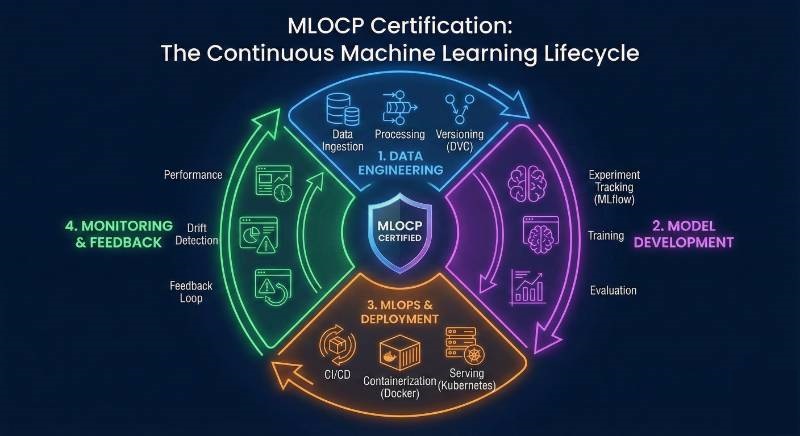
The transition from traditional software development to Artificial Intelligence has created a massive gap in the industry. While data scientists are great at building models, many organizations struggle to get those models into production. This is exactly where MLOps (Machine Learning Operations) steps in. It isn’t just a buzzword; it is a critical engineering discipline that ensures AI is scalable, reliable, and secure.
As someone who has navigated the shift from manual deployments to fully automated, self-healing cloud infrastructures, I can tell you that the complexity of ML systems is unlike anything we’ve seen in standard DevOps. In MLOps, you aren’t just managing code; you are managing data, models, and infrastructure—all of which change at different speeds. The MLOps Certified Professional (MLOCP) program is designed to provide you with the framework to master this “triple-threat” of challenges.
Master Certification Overview
Before diving deep into MLOps, it is helpful to see where it sits within the broader ecosystem of professional certifications provided by DevOpsSchool.
| Track | Level | Who it’s for | Prerequisites | Skills Covered | Recommended Order |
| MLOps | Professional | Engineers, Data Scientists, Managers | Python & DevOps Basics | Pipelines, CI/CD/CT, Monitoring | 1 |
| DevOps | Professional | Software Engineers, SysAdmins | Linux Basics | Jenkins, Ansible, Docker | 1 |
| SRE | Professional | Operations, Reliability Eng. | DevOps Knowledge | SLOs, Error Budgets, Incidents | 2 |
| DevSecOps | Professional | Security Engineers, Devs | DevOps Knowledge | Security Scanning, Compliance | 2 |
| DataOps | Professional | Data Engineers, DBAs | SQL & Data Basics | Data Quality, ETL Pipelines | 2 |
| FinOps | Professional | Managers, Architects | Cloud Knowledge | Cost Optimization, Cloud Bills | 3 |
Deep Dive: MLOps Certified Professional (MLOCP)
What it is
The MLOps Certified Professional (MLOCP) is a specialized certification that validates an engineer’s ability to automate and productionize Machine Learning workflows. It goes beyond simple “coding” and focuses on Continuous Integration (CI), Continuous Deployment (CD), and a new concept: Continuous Training (CT). It ensures that when your data changes, your model updates automatically without breaking the system.
Who should take it
- Software Engineers: If you want to move into the high-paying world of AI infrastructure.
- Data Scientists: If you are tired of your models living on a laptop and want to see them in production.
- Engineering Managers: To understand the lifecycle, costs, and risks associated with AI products.
- DevOps Engineers: To add specialized ML pipeline skills to your existing automation toolkit.
Skills you’ll gain
- Automated ML Pipelines: Designing workflows that handle data ingestion, cleaning, and training.
- Model Versioning: Learning how to version data and models (DVC) just like you version code.
- Infrastructure for ML: Using Kubernetes and Kubeflow to manage heavy compute workloads.
- Observability: Setting up dashboards to detect “Model Drift”—when your AI starts giving wrong answers because the world changed.
- Scalable Serving: Deploying models using high-performance APIs (FastAPI, Flask) in a containerized environment.
Real-world projects you should be able to do
- The Automated Retraining System: Build a pipeline that detects when model accuracy drops and automatically kicks off a new training job with fresh data.
- Distributed Training Infrastructure: Set up a Kubernetes cluster that can scale up GPU resources for training and scale down to save costs.
- Secure AI API: Create a production-grade endpoint that serves model predictions to thousands of users with low latency and high security.
Preparation Plan
- 7–14 Days (The Sprint): Focus on the MLOps Fundamentals. Understand the difference between DevOps and MLOps. Learn the basics of Docker and how to containerize a simple Python model.
- 30 Days (The Deep Dive): Master CI/CD/CT pipelines using Jenkins or GitHub Actions. Start working with orchestration tools like Apache Airflow or Kubeflow.
- 60 Days (The Master Class): Complete at least two end-to-end projects. Focus on monitoring, logging, and security. Practice troubleshooting broken pipelines and handling large-scale data sets.
Common Mistakes
- Manual Everything: Trying to “copy-paste” models into production instead of using a pipeline.
- Ignoring Data Quality: Forgetting that if the data is garbage, the model will be garbage (GIGO).
- Underestimating Costs: Not tracking GPU/Cloud usage, leading to massive bills at the end of the month.
- Over-Engineering: Building a complex Kubernetes setup when a simple API would have sufficed for a small project.
Choose Your Path: 6 Strategic Learning Roads
To stay relevant in today’s market, you need a specialty. Choose the path that aligns with your career goals:
- The DevOps Path: The foundation of all modern engineering. Focus on speed and automation of software.
- The DevSecOps Path: The “Security-First” approach. Crucial for industries like Finance and Healthcare.
- The SRE Path: Focus on “Reliability.” This is for those who want to work at the scale of Google or Amazon.
- The AIOps/MLOps Path: The future of the industry. Managing the lifecycle of AI and using AI to manage Ops.
- The DataOps Path: Mastering the flow of data. If you love big data and ETL, this is for you.
- The FinOps Path: The “Money” path. Learning how to make cloud infrastructure profitable and efficient.
Role → Recommended Certifications
| Role | Primary Certification | Secondary Certification |
| DevOps Engineer | DevOps Certified Professional | CKA (Kubernetes) |
| SRE | SRE Certified Professional | Prometheus & Grafana |
| Platform Engineer | Terraform Specialist | Docker Certified Associate |
| Cloud Engineer | AWS/Azure DevOps Engineer | FinOps Professional |
| Security Engineer | DevSecOps Certified Professional | Certified Kubernetes Security |
| Data Engineer | DataOps Certified Professional | MLOps Certified Professional |
| FinOps Practitioner | FinOps Certified Professional | Cloud Cost Architect |
| Engineering Manager | Certified DevOps Manager | FinOps Professional |
Next Certifications to Take
After completing the MLOCP, your journey shouldn’t stop. Based on current industry trends, here are your best next moves:
- Same Track (Specialization): Master in MLOps Engineering – Focus on advanced architectural patterns and multi-cloud AI deployments.
- Cross-Track (Broadening): DevSecOps Certified Professional (DSOCP) – AI models are vulnerable to “adversarial attacks.” Learning security is the best way to protect your ML pipelines.
- Leadership (Career Growth): Certified DevOps Manager (CDM) – If you want to move from a Senior Engineer to a Director or VP role, you need to master the people and process side of the house.
Top Institutions for MLOCP Training & Certification
Selecting the right training partner is vital because MLOps cannot be learned through theory alone. You need labs, real-world tools, and mentors who have actually managed production environments.
DevOpsSchool As the official provider of the MLOCP certification, DevOpsSchool offers comprehensive, industry-aligned training. Their curriculum is designed by experts to ensure you gain practical, job-ready skills in MLOps and related fields.
Cotocus Cotocus focuses on cutting-edge technology training, bridging the gap between theoretical knowledge and real-world application. They provide strong foundational and advanced courses suited for aspiring MLOps professionals.
Scmgalaxy With a long history in the configuration management and DevOps space, Scmgalaxy has evolved to offer robust training in modern software delivery pipelines, including the intricacies of deploying machine learning models.
BestDevOps This platform aggregates top-tier DevOps and engineering training resources. They focus on delivering best practices and proven methodologies for engineers looking to upskill into specialized areas like MLOps.
devsecopsschool While their primary focus is security integration, understanding DevSecOps is crucial for MLOps. Their training ensures you build secure pipelines, a critical component of mature ML operations.
sreschool Reliability is key to serving ML models at scale. sreschool provides the necessary training in Site Reliability Engineering principles that are highly transferable and necessary for effective MLOps.
aiopsschool Specializing in the intersection of AI and IT operations, this institution provides deep-dive knowledge relevant to both using AI for ops (AIOps) and the operational aspects of ML (MLOps).
dataopsschool Since data is the fuel for ML, understanding DataOps is vital. This school focuses on the agile management of data pipelines, ensuring the quality and speed necessary for successful ML projects.
finopsschool ML training and inference can be expensive. FinOpsSchool provides the necessary training to understand cloud economics, helping engineers manage and optimize the costs associated with running ML workloads.
Strategic Career & Master Guide FAQs
- How difficult is it to transition from DevOps to MLOps? The transition is manageable but requires a shift in mindset. While DevOps focuses on code and infrastructure, MLOps adds the “Data” and “Model” dimensions. You will need to learn how to handle data versioning and model decay, which are not typically part of standard software pipelines.
- What is the ideal sequence for taking these certifications? For most, the best path is: DevOps (DCP) → MLOps (MLOCP) → SRE (SRECP). Starting with a strong foundation in general automation (DevOps) makes the specialized ML workflows much easier to grasp.
- How much time should I realistically set aside for preparation? If you are already working as an engineer, expect to spend about 10–12 hours a week. A 30-day plan is usually sufficient for the professional level, while a 60-day plan allows for deeper hands-on project work.
- Are there specific prerequisites I should clear first? Yes. You should be comfortable with the Linux command line, Git for version control, and basic Python programming. If you have never used Docker, I recommend a quick 3-day crash course on container basics before starting the MLOCP modules.
- What is the real-world value of a MLOps certification in 2026? The value lies in “Production-Readiness.” Most companies have plenty of data scientists who can build models, but very few engineers who can keep those models running reliably at scale. This certification proves you are in that top 5% of engineers.
- Can an Engineering Manager benefit from these technical tracks? Absolutely. Managers don’t need to write the code, but they must understand the lifecycle. Knowing the “MLOps” framework helps managers set realistic sprint goals, understand why “Model Drift” is delaying a release, and better manage cloud budgets.
- What are the primary career outcomes after getting certified? Graduates typically move into roles like MLOps Engineer, Platform Architect, or AI Infrastructure Lead. These roles currently command some of the highest salary premiums in the tech industry due to the scarcity of talent.
- How does MLOps impact FinOps and cloud costs? ML models are “hungry” for compute power (GPUs). MLOps teaches you to build efficient pipelines that only spin up expensive resources when needed, directly supporting FinOps goals of cost-optimization.
- Do I need a background in heavy Mathematics or Statistics? No. MLOps is an engineering discipline. While understanding how a model works is helpful, your primary job is to ensure the “plumbing” (the pipelines and infrastructure) is robust, secure, and scalable.
- Is the certification recognized by major MNCs in India and globally? Yes. Institutions like DevOpsSchool have a long-standing reputation with global tech giants. The curriculum is designed around enterprise-grade tools used by top-tier companies worldwide.
- Will this certification help me if I want to work in SRE? Very much so. Modern SRE roles often involve managing AI-powered monitoring systems. Knowing how ML models are deployed makes you a much more effective Site Reliability Engineer.
- What happens if I fail the exam on the first attempt? Most reputable training programs, including DevOpsSchool, offer support and a retake path. The focus is on mastery, so you are encouraged to revisit the labs and projects before your second attempt.
MLOps Certified Professional (MLOCP) FAQs
- What exactly is the MLOCP certification? It is a professional-level credential that validates your expertise in automating the machine learning lifecycle, specifically focusing on CI/CD/CT (Continuous Training) and model orchestration.
- Does the MLOCP cover specific tools like Kubeflow or MLflow? Yes. The program is tool-heavy. You will gain hands-on experience with the most in-demand tools in the market, including Kubernetes, Kubeflow, MLflow, DVC (Data Version Control), and Prometheus.
- Is there a focus on security within the MLOCP track? While the MLOCP covers basic pipeline security, it sets the stage for the DevSecOps track. You will learn how to secure model endpoints and manage access controls for sensitive data sets.
- How does MLOCP handle “Model Drift”? A major portion of the certification focuses on monitoring. You will learn how to set up automated triggers that detect when a model’s performance starts to degrade, allowing for “Continuous Training” to kick in.
- What is the training format for MLOCP? The program is designed for working professionals, offering live, instructor-led online sessions that emphasize real-time lab work over passive video watching.
- Who is the primary provider for this certification? The certification is provided by DevOpsSchool, a global leader in professional IT training and certification. You can find more details at their official site.
- Are the projects in the MLOCP program based on real-world scenarios? Yes. You will work on “MNC-style” projects, such as building a scalable image recognition pipeline or an automated financial fraud detection deployment system.
- What is the best way to get started today? The best way is to visit the Official MLOCP Page, review the syllabus, and book a consultation with a career mentor to align the program with your current skills.
Conclusion
The era of “Experimental AI” is over. We are now in the era of “Industrialized AI.” Companies no longer want a model that works once; they want a system that works forever. By becoming an MLOps Certified Professional, you are positioning yourself at the very top of the engineering food chain.
The road is challenging, but the rewards—in terms of salary, job security, and the sheer excitement of working on cutting-edge tech—are well worth it. Take the first step, choose your path, and start building the future of AI operations today.
