Upgrade & Secure Your Future with DevOps, SRE, DevSecOps, MLOps!
We spend hours scrolling social media and waste money on things we forget, but won’t spend 30 minutes a day earning certifications that can change our lives.
Master in DevOps, SRE, DevSecOps & MLOps by DevOps School!
Learn from Guru Rajesh Kumar and double your salary in just one year.
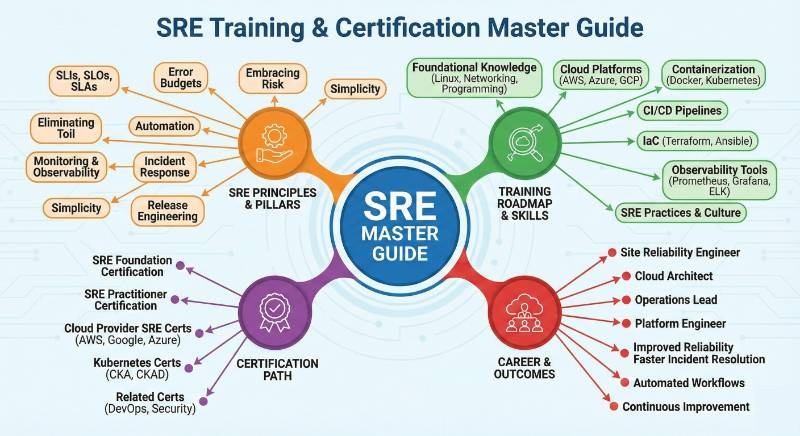
In today’s tech landscape, saying “it works on my machine” is simply no longer acceptable because systems must work at scale and remain resilient even when things inevitably break. Consequently, this reality has propelled Site Reliability Engineering (SRE) from a niche practice into a critical global discipline, making the shift towards SRE a definitive career upgrade for engineers and managers alike. However, to truly validate your expertise in this high-stakes field, professional certification becomes essential, serving as a structured pathway to acquire the mindset and skills necessary to ensure distributed systems remain available. Ultimately, the SRE Certified Professional (Training & Certification) is more than just a badge on your profile; rather, it is the essential foundation for securing your first SRE role or leading a reliability team, proving that you are an engineer who doesn’t just build software, but guarantees it works when it matters most.
Why SRE Certification Matters Now
First and foremost, reliability is now a core feature of any product. In fact, downtime costs more than just money; it costs reputation. For this reason, companies are aggressively hiring professionals who can move beyond traditional “sysadmin” firefighting. Instead, they need people who adopt an engineering approach to operations.
Furthermore, becoming an SRE Certified Professional demonstrates more than just tool knowledge. Ultimately, it proves you understand the philosophy of error budgets, the mathematics of availability, and the cultural shifts required to embrace failure as a learning opportunity. In short, it is the bridge between being a coder and being a system owner.
The SRE Certified Professional
Below, you will find a snapshot of the certification track discussed in this guide. Notably, this program is designed to take you from foundational knowledge to practical application.
| Certification Name | Track | Level | Who it’s For | Prerequisites | Key Skills Covered |
| SRE Certified Professional (SRECP) | SRE & Reliability | Professional / Practitioner | Software Engineers, DevOps Engineers, SysAdmins, Technical Leads | Basic understanding of Linux, Networking, and one programming language. | SLOs/SLIs, Error Budgets, Incident Management, Automation, Monitoring Strategy, Chaos Engineering principles. |
Deep Dive: SRE Certified Professional (Training & Certification)
In this section, we will break down the SRECP certification to help you decide if it is the right next step for your career progression.
What it is
Essentially, the SRE Certified Professional (SRECP) is a comprehensive program that validates your ability to apply software engineering principles to infrastructure and operations problems. Moreover, it moves beyond theory, focusing heavily on the practical implementation of SRE tenets to create scalable, highly reliable software systems.
Who should take it
Primarily, this certification is highly recommended for:
- Software Engineers looking to understand the operational lifecycle of their code.
- DevOps Engineers wanting to specialize in reliability and mature their practices.
- Traditional System Administrators transitioning into modern, code-driven roles.
- Engineering Managers who need to define reliability metrics and lead SRE teams.
Skills you’ll gain
By completing this certification, you will acquire competencies in:
- First, defining and implementing Service Level Indicators (SLIs) and Service Level Objectives (SLOs).
- Second, calculating and managing Error Budgets to balance innovation with stability.
- Additionally, designing effective monitoring and observability strategies (logs, metrics, traces).
- Furthermore, structuring and leading incident response processes and blameless post-mortems.
- Also, automating toil to reduce manual operational work.
- Finally, understanding the basics of capacity planning and Chaos Engineering principles.
Real-world projects you should be able to do after it
Remember, theory is useless without application. Therefore, upon completion, you should be comfortable handling projects such as:
- Designing an SLO framework: Auditing an existing service, defining critical user journeys, and then establishing achievable SLOs with stakeholders.
- Automating a manual recovery playbook: Taking a documented manual fix for a common outage and subsequently turning it into an automated script triggered by monitoring.
- Leading a complex incident response: Acting as the Incident Commander during a simulated or real outage. Simultaneously, you will coordinate communication and technical resolution.
- Implementing an observability dashboard: Building a dashboard that moves beyond “is the server up” to showing “can users complete transactions.”
Preparation plan
Naturally, your background dictates your study timeline. Here are three common paths:
The “Experienced DevOps” Path (7–14 Days):
If you already live in Kubernetes and define metrics daily, focus on SRE-specific terminology.
- Days 1-3: Start with a deep dive into the Google SRE Books (theory).
- Days 4-7: Next, review SRECP specific modules on Error Budgets and SLI math.
- Days 8-14: Finally, do practice exams and review case studies on incident management.
The “Software Engineer” Path (30 Days):
You know code, but need to learn the “Ops” side.
- Week 1: Begin by learning basic networking, Linux fundamentals, and container basics.
- Week 2: Then, focus heavily on monitoring, observability, and instrumentation concepts.
- Week 3: After that, study core SRE concepts: SLOs, toil reduction, and automation.
- Week 4: Lastly, review incident response protocols and take practice tests.
The “Career Transition” Path (60 Days):
For those newer to the field or coming from legacy IT.
- Weeks 1-3: Build a strong foundation in Linux, scripting (Python/Go), and cloud basics (AWS/Azure/GCP).
- Weeks 4-6: Next, take the official SRE Certified Professional training course modules systematically.
- Weeks 7-8: Finally, do hands-on labs. Build a small app, break it, monitor it, and fix it using SRE principles before the exam.
Common mistakes
Be sure to avoid these pitfalls during your preparation:
- Ignoring the “Culture” aspect: Since SRE is 50% technical and 50% cultural (blamelessness, psychological safety), don’t just memorize tool commands.
- Confusing DevOps with SRE: While related, SRE is a specific implementation of DevOps with stricter engineering definitions. Thus, understand the distinction.
- Overlooking basics: Make sure your Linux and networking fundamentals are solid before diving into complex distributed system theories.
Best next certification after this
Once you have secured the SRECP, consider these next steps based on your career goals:
- Same Track (Deepen Expertise): Specifically, look for advanced SRE certifications focusing on specific cloud providers (e.g., AWS or Google Cloud Professional Cloud DevOps Engineer).
- Cross-Track (Broaden Scope): Alternatively, try a DevSecOps certification to integrate security into your reliability practices. Or, consider MLOps if your company is moving toward AI-driven applications.
- Leadership: On the other hand, if you are moving into management, look for certifications focused on Engineering Leadership or IT Service Management.
Choose Your Path: The XOps Landscape
Currently, the tech world is splintering into specialized “Ops” disciplines. Notably, SRE is often the foundation for many of these.
- DevOps: The umbrella philosophy of unifying development and operations to shorten development lifecycles.
- SRE (Site Reliability Engineering): The practical realization of DevOps. It applies engineering discipline to operational problems to ensure reliability.
- DevSecOps: Integrating security practices early and continuously throughout the software development lifecycle (shifting left).
- AIOps / MLOps: AIOps uses AI to automate IT operations. Meanwhile, MLOps is the practice of deploying and maintaining machine learning models reliably in production.
- DataOps: Focuses on improving the communication, integration, and automation of data flows between data managers and consumers.
- FinOps: The cultural practice of bringing financial accountability to the variable spend model of cloud. This enables teams to make trade-offs between speed, cost, and quality.
Role → Recommended Certifications Mapping
Are you unsure which certification aligns with your current job title? Use this mapping as a guide.
| Current / Desired Role | Primary Recommendation | Secondary / Future Consideration |
| DevOps Engineer | SRE Certified Professional (SRECP) | DevSecOps Certification |
| SRE / Reliability Engineer | SRE Certified Professional (SRECP) | AIOps or Cloud-Specific Security Certs |
| Software Engineer (SWE) | SRE Certified Professional (SRECP) | MLOps (if moving to AI/ML teams) |
| Platform Engineer | SRE Certified Professional (SRECP) | Kubernetes specific certifications (CKA/CKAD) |
| Cloud Engineer | Cloud Provider Solutions Architect | SRE Certified Professional (SRECP) |
| Security Engineer | DevSecOps Certification | SRE Certified Professional (SRECP) |
| Data Engineer | DataOps Certification | SRE Certified Professional (SRECP) (for data platform reliability) |
| Engineering Manager | SRE Certified Professional (SRECP) | FinOps Certification |
Top Training Institutions for SRECP
When pursuing the SRE Certified Professional designation, choosing the right training partner is crucial. Otherwise, you might gain just book knowledge rather than practical skills. Here are top institutions that provide help in Training cum Certifications:
- DevOpsSchool: As a primary provider for the SRECP, DevOpsSchool offers comprehensive, structured training modules. Specifically, they are designed to take candidates from foundational concepts to advanced SRE implementation.
- Cotocus: Known for their specialized technical bootcamps. They offer deep-dive practical sessions that focus on the “Engineering” part of Site Reliability Engineering.
- Scmgalaxy: One of the oldest communities for software configuration management. They provide excellent community-driven content and structured certification paths for SRE and DevSecOps.
- BestDevOps: A niche provider focusing on high-end certifications. Their curriculum is updated frequently to match the changing landscape of cloud-native technologies.
- devsecopsschool: The go-to place for security-focused engineering. They offer integrated tracks that show how SRE and Security work together in a modern enterprise.
- sreschool: A dedicated portal for SRE professionals. It offers highly focused modules on observability, incident response, and error budgeting.
- aiopsschool: Specializes in the intersection of AI and Operations. Ideal for SREs looking to advance their career into the predictive monitoring space.
- dataopsschool: Focuses on the reliability of data systems. They provide certifications for engineers managing massive data lakes and complex ETL pipelines.
- finopsschool: The leading authority on cloud financial management. They offer training for engineers who want to add “Cost Efficiency” to their reliability toolkit.
Frequently Asked Questions (FAQs)
Here are common questions regarding the SRE Certified Professional (Training & Certification) and the general certification landscape.
Q1: Is the SRE Certified Professional difficult for someone without an “Ops” background?
A: Admittedly, it is challenging but achievable. If you come from a pure development background, you will need to dedicate extra time to understanding networking. Since the certification bridges code and systems, both sides are necessary.
Q2: What is the biggest value of getting SRE certified?
A: Beyond the knowledge, it establishes a common vocabulary with industry experts. Moreover, it validates to employers that you understand how to build resilient systems, not just write features.
Q3: Do I need to know programming to become an SRE Certified Professional?
A: Yes. SRE is about treating operations as a software problem. Although you don’t need to be a full-stack developer, competence in a scripting language (like Python, Go, or Bash) is essential for automation.
Q4: How does this certification differ from generic DevOps certifications?
A: Typically, DevOps certifications focus on the “how” of CI/CD pipelines. In contrast, the SRECP focuses on the “what happens after deployment,” specifically targeting reliability and incident management.
Q5: Are there prerequisites for taking the SRECP exam?
A: While there are no mandatory hard prerequisites, a foundational understanding of Linux is highly recommended. Additionally, familiarity with at least one public cloud provider will help you succeed.
Q6: How long does the certification remain valid?
A: Generally, certification renewal policies vary. Therefore, it is best to check the official provider link (listed at the top of this guide) for the most current information.
Q7: Will this certification help me get a remote job globally?
A: Absolutely. In fact, SRE is one of the most in-demand remote roles globally. Thus, a recognized certification proves you have the standardized skillset companies need.
Q8: What is the typical career path after becoming an SRECP?
A: Common progressions include Senior SRE, Staff/Principal SRE, or Manager of SRE. Eventually, many transition into Platform Engineering leadership.
Q9: Is it better to get a cloud-specific cert (like AWS DevOps) or the SRECP first?
A: It depends on your goal. Cloud certs teach you a specific vendor’s tools. However, the SRECP teaches you the methodology of reliability that applies across all clouds. Consequently, the methodology is often stronger as a foundational layer.
Q10: How much hands-on experience is required?
A: Although the training is designed to guide you, having at least 6–12 months of experience in a tech role will make the concepts much easier to grasp.
Q11: Can Engineering Managers benefit from this certification?
A: Yes. Managers need it to understand how to set realistic SLOs. Furthermore, it helps them foster a blameless post-mortem culture in their teams.
Q12: What if I fail the exam on the first try?
A: Don’t panic. Instead, use it as a learning experience. Analyze the areas where you scored poorly, revisit those training modules, and then re-attempt the exam.
Conclusion
To conclude, the transition from traditional operations or pure software development into Site Reliability Engineering is one of the most rewarding career moves in modern IT, consequently placing you at the intersection of complex challenges and critical business value. Furthermore, the SRE Certified Professional (Training & Certification) is more than just a badge on your profile; instead, it serves as a structured pathway to acquiring the mindset and skills necessary to ensure that today’s massive, distributed systems remain available. Ultimately, whether you are looking to secure your first SRE role or lead a reliability team, this certification provides the essential foundation, so start planning your preparation today because the industry needs engineers who don’t just build software, but guarantee it works when it matters most.
