Upgrade & Secure Your Future with DevOps, SRE, DevSecOps, MLOps!
We spend hours scrolling social media and waste money on things we forget, but won’t spend 30 minutes a day earning certifications that can change our lives.
Master in DevOps, SRE, DevSecOps & MLOps by DevOps School!
Learn from Guru Rajesh Kumar and double your salary in just one year.
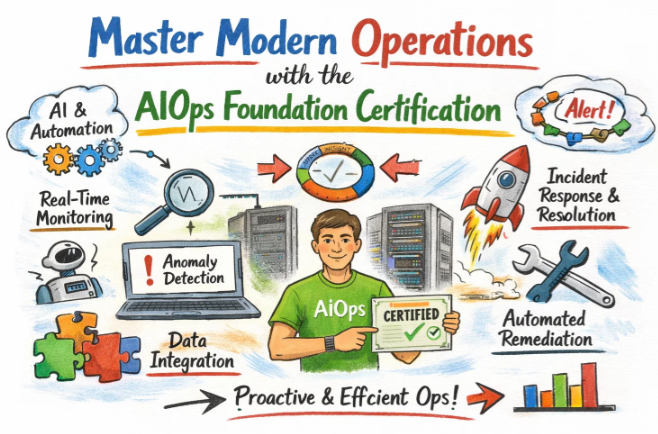
The transition from traditional monitoring to intelligent observability is the single biggest shift in modern infrastructure management. This guide explores the AIOps Foundation Certification, a program designed to bridge the gap between human-led operations and machine-learning-driven automation. For engineers working in DevOps, SRE, or platform teams, understanding how to handle massive telemetry data is no longer optional. This roadmap, hosted by AIOps School, provides a structured path for professionals to validate their expertise in artificial intelligence for IT operations. By the end of this guide, you will understand how this certification aligns with your career goals and provides the technical depth needed to lead digital transformation initiatives in global enterprises.
What is the AIOps Foundation Certification?
The AIOps Foundation Certification is a professional credential that validates an engineer’s ability to apply machine learning and data science principles to IT operations. Unlike theoretical data science courses, this program focuses heavily on the production environment, emphasizing how to reduce “noise” in alerting and automate incident response. It represents a shift from reactive troubleshooting to proactive, predictive maintenance using algorithmic analysis of logs, metrics, and traces.
In modern engineering workflows, the volume of data generated by microservices and cloud-native architectures is too vast for manual human oversight. This certification exists to teach professionals how to implement systems that can automatically detect anomalies and correlate events across complex stacks. It aligns with enterprise practices by focusing on reducing Mean Time to Resolution (MTTR) and improving system reliability through intelligent automation.
Who Should Pursue AIOps Foundation Certification?
This certification is built for professionals who sit at the intersection of development and operations. Systems Reliability Engineers (SREs), DevOps engineers, and Cloud Architects find the most immediate value, as they are responsible for the uptime of large-scale distributed systems. However, it is equally relevant for Data Engineers who want to understand the operational side of ML models and Security Engineers looking to enhance threat detection through behavioral analysis.
The program is structured to accommodate a wide range of experience levels. For beginners, it provides the fundamental vocabulary and conceptual framework needed to enter the field of intelligent operations. For experienced leads and engineering managers, it offers a strategic perspective on how to integrate AI tools into existing toolchains. Given the rapid digital expansion in India and global tech hubs, this certification provides a competitive edge in a market that increasingly demands high-scale automation skills.
Why AIOps Foundation Certification is Valuable and Beyond
The demand for AIOps skills is driven by the sheer complexity of modern software. As organizations move toward serverless architectures and thousands of microservices, traditional threshold-based monitoring fails. This certification ensures longevity in your career because it focuses on the underlying logic of algorithmic operations rather than a specific vendor tool. It prepares you to handle the next decade of infrastructure challenges where human-only operations are no longer sustainable.
Investing time in this certification provides a high return on investment because it addresses the core “burnout” problem in tech: alert fatigue. By learning how to implement AIOps, professionals become more valuable to employers who are desperate to stabilize their production environments while scaling their features. It moves an engineer from being a “firefighter” to an “architect of intelligent systems,” which is a significantly more stable and higher-paying career trajectory.
AIOps Foundation Certification Overview
The program is delivered via the official AIOps School platform and is designed to be accessible yet rigorous. The certification approach is grounded in practical application, requiring candidates to demonstrate an understanding of how data flows through an AIOps pipeline. It covers everything from data collection and normalization to the application of specific ML algorithms for clustering and pattern recognition.
The structure is intentionally modular, allowing students to understand the ownership and lifecycle of an AIOps project within an organization. It is not just about the code; it is about the process of selecting the right data sources and ensuring the outputs are actionable for the engineering teams. This practical focus ensures that once certified, a professional can immediately contribute to the design of an intelligent monitoring strategy.
AIOps Foundation Certification Tracks & Levels
The certification ecosystem is divided into three primary tiers: Foundation, Professional, and Advanced. The Foundation level focuses on the “what” and the “why,” ensuring a solid grasp of terminology, data types, and core AIOps use cases. It acts as the entry point for all professionals, regardless of their specific technical niche, and provides the baseline required for more specialized technical tracks.
As professionals progress to the Professional and Advanced levels, the focus shifts to specific domains such as AIOps for FinOps (cost optimization) or AIOps for SecOps (security automation). These tracks allow SREs to dive deeper into automated incident remediation, while managers can focus on the governance and strategic implementation of AI across the entire engineering organization. This tiered approach mirrors the natural career progression from an individual contributor to a technical leader.
Complete AIOps Foundation Certification Table
| Track | Level | Who it’s for | Prerequisites | Skills Covered | Recommended Order |
| AIOps Core | Foundation | All Engineers/Managers | Basic IT Ops knowledge | Data ingestion, ML basics, NLP in Ops | 1st |
| Intelligent SRE | Professional | SREs, Platform Engineers | Foundation Cert | Automated RCA, Anomaly detection | 2nd |
| Algorithmic FinOps | Professional | FinOps Practitioners | Foundation Cert | Predictive billing, Cost anomaly | 2nd |
| AIOps Architect | Advanced | Architects, Tech Leads | Professional Cert | Pipeline design, Tool selection | 3rd |
| AI Strategy | Advanced | Engineering Managers | Foundation Cert | ROI Analysis, Governance, Ethics | 3rd |
Detailed Guide for Each AIOps Foundation Certification
AIOps Foundation Certification – Foundation Level
What it is
This certification validates a professional’s understanding of the core pillars of AIOps, including data collection, pattern discovery, and probable cause analysis. It ensures that the candidate can speak the language of intelligent operations and understands the architectural flow of an AIOps system.
Who should take it
This is suitable for junior to mid-level engineers, project managers, and even senior leaders who need a clear understanding of how AI is changing the landscape of IT operations. It is intended for anyone who wants to move beyond legacy monitoring tools.
Skills you’ll gain
- Understanding the difference between Big Data and AIOps.
- Identifying the five stages of an AIOps maturity model.
- Knowledge of supervised vs. unsupervised learning in the context of logs.
- Ability to define and measure the success of AIOps initiatives.
Real-world projects you should be able to do
- Design a basic data ingestion pipeline for multi-source telemetry.
- Create a proposal for reducing alert noise using event correlation.
- Identify bottlenecks in traditional SRE workflows that can be solved with ML.
Preparation plan
- 7–14 days: Focus on terminology, reading whitepapers, and understanding the core AIOps architecture.
- 30 days: Deep dive into specific ML algorithms used in operations (clustering, regression) and review case studies.
- 60 days: Engage in hands-on labs, practice data normalization techniques, and take mock assessments to ensure concept mastery.
Common mistakes
- Focusing too much on the “AI” (mathematics) and not enough on the “Ops” (workflow integration).
- Ignoring the importance of high-quality data ingestion; AIOps is only as good as its data.
Best next certification after this
- Same-track option: AIOps Professional Certification.
- Cross-track option: SRE Practitioner Certification.
- Leadership option: AI Strategy for Technical Managers.
AIOps Foundation Certification – Professional Level
What it is
This level focuses on the technical implementation of AIOps tools and the creation of custom ML models for operational data. It validates the ability to build and maintain an automated system that can perform Root Cause Analysis (RCA) with minimal human intervention.
Who should take it
Mid-to-senior DevOps and SRE professionals who are responsible for the day-to-day health of production systems. It is for those who want to be the “builders” of the intelligent operations platform.
Skills you’ll gain
- Implementing real-time anomaly detection models.
- Automating incident remediation workflows through AIOps triggers.
- Integrating AIOps with existing ITSM tools like ServiceNow or Jira.
- Developing custom dashboards for predictive system health monitoring.
Real-world projects you should be able to do
- Build an automated incident response system that triggers scripts based on predicted failures.
- Deploy a centralized log analysis engine that uses NLP to categorize errors.
- Configure a noise-reduction layer that suppresses 90% of non-actionable alerts.
Preparation plan
- 7–14 days: Review Foundation concepts and start exploring AIOps tool integrations (e.g., ELK stack with ML).
- 30 days: Practice Python or R for basic data manipulation and model testing on operational datasets.
- 60 days: Complete a full end-to-end project involving data ingestion, analysis, and automated output.
Common mistakes
- Over-complicating the solution; often simple statistical models work better than deep learning for ops.
- Neglecting the feedback loop where humans must “train” the system on what is actually an incident.
Best next certification after this
- Same-track option: AIOps Architect Certification.
- Cross-track option: MLOps Professional.
- Leadership option: Director of Platform Engineering Path.
Choose Your Learning Path
DevOps Path
In the DevOps world, AIOps is used to speed up the CI/CD pipeline and provide “continuous verification.” Professionals on this path should focus on how AI can predict build failures or performance regressions before code reaches production. The goal is to create a seamless loop where operational feedback automatically informs the development cycle. By integrating AIOps, DevOps engineers can ensure that the rapid pace of deployment does not compromise the stability of the infrastructure.
DevSecOps Path
The DevSecOps path utilizes AIOps for behavioral security analysis and automated threat hunting. Instead of relying on static signatures, AIOps allows security professionals to detect “strange” behavior that might indicate a zero-day exploit or an internal breach. This path involves mapping AIOps certifications to security frameworks to ensure that compliance and safety are automated. It is about moving security from a “gatekeeper” role to an automated, intelligent layer within the pipeline.
SRE Path
For SREs, AIOps is the ultimate tool for achieving high availability and managing error budgets. This path focuses on “Self-healing” systems where the AIOps platform detects a breach of Service Level Objectives (SLOs) and takes corrective action automatically. SREs learn to use algorithmic correlation to find the “needle in the haystack” during major outages. It shifts the SRE role from manual dashboard watching to high-level system engineering and automation strategy.
AIOps Path
The dedicated AIOps path is for those who want to specialize entirely in the architecture of intelligent operations. This involves a deep focus on data engineering, machine learning pipelines, and the integration of diverse telemetry sources into a unified “brain.” Professionals here are responsible for the selection, implementation, and tuning of the AIOps platform itself. They act as the bridge between the data science team and the traditional infrastructure team, ensuring models are operationally relevant.
MLOps Path
While AIOps uses AI to help IT, MLOps uses IT principles to help AI; however, the two are deeply intertwined. The MLOps path focuses on the lifecycle of machine learning models—ensuring they are deployed, monitored, and retrained effectively. For an AIOps professional, this means understanding how to treat the AIOps models themselves as production software. This involves versioning models, monitoring for “model drift,” and ensuring that the AI providing the operations data remains accurate over time.
DataOps Path
DataOps is critical because AIOps is entirely dependent on a clean, reliable stream of data. This path focuses on the orchestration of data people, processes, and technology to provide high-quality telemetry to the AIOps engine. Professionals learn how to manage “data sprawl” and ensure that logs and metrics from thousands of sources are normalized and useful. Without a strong DataOps foundation, any AIOps initiative will fail due to poor data quality or inconsistent delivery.
FinOps Path
The FinOps path leverages AIOps to manage the complex and fluctuating costs of cloud environments. In a world of dynamic scaling, humans cannot manually track every cent spent on cloud resources. AIOps allows for predictive billing, where the system can warn a company of a projected budget overage before it happens. It also identifies “zombie” resources or inefficient scaling patterns that are costing the company money, providing automated recommendations for cost savings.
Role → Recommended AIOps Foundation Certifications
| Role | Recommended Certifications |
| DevOps Engineer | AIOps Foundation, MLOps Professional |
| SRE | AIOps Foundation, Intelligent SRE Professional |
| Platform Engineer | AIOps Foundation, AIOps Architect |
| Cloud Engineer | AIOps Foundation, Algorithmic FinOps |
| Security Engineer | AIOps Foundation, DevSecOps Specialist |
| Data Engineer | AIOps Foundation, DataOps Specialist |
| FinOps Practitioner | AIOps Foundation, Algorithmic FinOps Professional |
| Engineering Manager | AIOps Foundation, AI Strategy for Managers |
Next Certifications to Take After AIOps Foundation Certification
Same Track Progression
Deepening your expertise within the AIOps domain involves moving toward the Architect level. This is where you move away from using tools and start designing them. You will learn about multi-tenant AIOps architectures, edge computing AI, and advanced neural networks for time-series forecasting. This track is ideal for those who want to be recognized as the foremost experts in intelligent infrastructure within their organizations or as high-level consultants.
Cross-Track Expansion
Broadening your skills often means looking toward MLOps or SRE certifications to complement your AIOps knowledge. By understanding how to manage the lifecycle of an ML model (MLOps), you become better at maintaining the AIOps systems you build. Conversely, adding SRE credentials ensures you understand the deep systemic impacts of the incidents your AI is trying to solve. This “T-shaped” skill set makes you incredibly versatile and highly sought after by enterprise employers.
Leadership & Management Track
If your goal is to lead teams, the next step is moving toward Engineering Management or Director-level certifications. This involves focusing on the business side: calculating ROI for AI investments, managing the cultural shift from manual to automated operations, and handling the ethics of AI in the workplace. Leaders need to know not just how the technology works, but how to build a team of engineers who can effectively leverage these intelligent tools to drive business value.
Training & Certification Support Providers for AIOps Foundation Certification
DevOpsSchool
DevOpsSchool has established itself as a premier destination for technical upskilling, offering a comprehensive suite of courses that cover the entire software delivery lifecycle. Their approach to AIOps training is deeply rooted in practical, lab-based learning, ensuring that students do not just learn the theory but also gain hands-on experience with industry-standard tools. With a strong presence in India and a growing global footprint, they provide expert-led sessions that are tailored to the needs of working professionals. Their curriculum is updated regularly to reflect the latest trends in automation and machine learning, making them a reliable partner for anyone looking to advance their career in modern IT operations.
Cotocus
Cotocus is known for its boutique approach to high-end technical training, focusing on emerging technologies that drive digital transformation. They provide a highly specialized environment for learning AIOps, where the focus is on architectural depth and real-world problem-solving. Their instructors are typically industry practitioners who bring a wealth of “war stories” from the field, providing students with insights that cannot be found in a textbook. Cotocus emphasizes the integration of AI with cloud-native technologies, making it an excellent choice for architects and senior engineers who need to design complex, self-healing systems for enterprise-scale environments.
Scmgalaxy
Scmgalaxy is a community-driven platform that has evolved into a robust training provider, specializing in Software Configuration Management, DevOps, and now AIOps. They offer a wealth of free resources alongside their structured certification programs, fostering a culture of continuous learning and knowledge sharing. Their AIOps training focuses on the practicalities of data ingestion and event correlation, helping engineers reduce the noise in their monitoring stacks. By providing a mix of video tutorials, live sessions, and community forums, Scmgalaxy ensures that students have the support they need throughout their learning journey and beyond.
BestDevOps
BestDevOps focuses on delivering high-impact training that is specifically designed to meet the demands of the modern job market. Their AIOps Foundation programs are streamlined and focused, aiming to give professionals the most valuable skills in the shortest possible time. They prioritize the “Standard Operating Procedures” of AIOps, teaching students how to implement intelligent automation within existing corporate structures. This makes their training particularly useful for engineers in large organizations who need to navigate complex workflows and legacy systems while introducing modern, AI-driven efficiencies into their daily operations.
devsecopsschool.com
While their primary focus is on the intersection of security and operations, devsecopsschool.com provides essential context for how AIOps can enhance the security posture of an organization. Their training covers the use of machine learning for anomaly detection in security logs and automated incident response for potential breaches. They bridge the gap between traditional security and intelligent operations, ensuring that DevSecOps practitioners have the tools they need to stay ahead of sophisticated threats. Their courses are ideal for professionals who want to ensure that their AIOps implementation is secure by design and compliant with global standards.
sreschool.com
Sreschool.com is dedicated to the discipline of Site Reliability Engineering, and their AIOps curriculum is built specifically through that lens. They focus on how AI can be used to manage Service Level Objectives (SLOs) and error budgets more effectively. Their training emphasizes the “self-healing” aspects of AIOps, teaching SREs how to build systems that can automatically remediate common issues without human intervention. For an SRE looking to evolve into an “Intelligent SRE,” this platform provides the most direct and relevant training path, focusing on system reliability and performance at scale.
aiopsschool.com
As a dedicated provider for this specific field, aiopsschool.com offers the most comprehensive and deep-dive training available for AIOps. They cover the entire spectrum of the discipline, from the foundational concepts of data science to the advanced architecture of autonomous systems. Their programs are designed to be the “gold standard” for AIOps certification, providing a rigorous path for those who want to specialize exclusively in this domain. With a focus on both vendor-neutral principles and specific tool mastery, they prepare students for any AIOps challenge they might face in a production environment.
dataopsschool.com
Dataopsschool.com recognizes that the success of any AI initiative depends on the quality of the underlying data. Their training programs focus on building the robust data pipelines that feed AIOps engines. They teach students how to manage “data as a product,” ensuring that telemetry is clean, consistent, and delivered in real-time. For AIOps professionals, understanding the principles taught here is vital for troubleshooting why an ML model might be failing or providing inaccurate insights. Their courses provide the essential “plumbing” knowledge that makes the “brain” of AIOps function correctly.
finopsschool.com
Finopsschool.com addresses the critical need for cloud financial management, using AIOps as a key tool for cost optimization. Their training teaches professionals how to use predictive analytics to forecast cloud spend and identify waste automatically. In an era where cloud costs can easily spiral out of control, the skills taught here are in high demand among CFOs and engineering leaders alike. They provide a bridge between the technical side of infrastructure and the financial side of business, making their certified professionals invaluable assets for any company looking to optimize its cloud investment.
Frequently Asked Questions (General)
- Is this certification recognized globally?
Yes, the principles taught are vendor-neutral and based on industry-standard practices used by major enterprises worldwide, making the certification highly portable across different regions and companies. - How long does it take to complete the Foundation level?
Most professionals with a background in IT operations can complete the course and pass the exam within 30 to 45 days of dedicated study. - Are there any specific hardware requirements for the labs?
Most training is cloud-based, so a standard laptop with a reliable internet connection is sufficient to access the labs and tools provided in the course. - Do I need to be a data scientist to learn AIOps?
No, the Foundation level is designed for IT operations professionals. It teaches you how to apply machine learning tools, not how to write the underlying mathematical algorithms from scratch. - What is the passing score for the exam?
Typically, a score of 70% or higher is required to pass the certification exam, ensuring a solid grasp of both conceptual and practical topics. - Does the certification expire?
Most professional certifications suggest a renewal or update every two years to ensure you remain current with the rapidly evolving technology landscape. - Is there a community or alumni network?
Yes, many providers offer access to forums and LinkedIn groups where you can network with other certified professionals and share job opportunities. - Can I take the exam online?
Yes, most providers offer proctored online exams that you can take from the comfort of your home or office. - Are mock tests provided?
Standard training programs include mock assessments to help you get comfortable with the exam format and identify areas where you need more study. - How does this differ from a standard DevOps certification?
Standard DevOps focuses on the pipeline and culture, while AIOps specifically focuses on using data science and machine learning to automate the operations side of that pipeline. - Is Python knowledge mandatory?
While not strictly mandatory for the Foundation level, having a basic understanding of Python will greatly help you in the Professional level and for real-world implementation. - Will this certification help me get a salary hike?
While no certification guarantees a raise, AIOps is a “high-demand, low-supply” skill set, which generally commands a premium in the job market.
FAQs on AIOps Foundation Certification
- What is the primary goal of the AIOps Foundation Certification?
The goal is to provide a baseline understanding of how AI can be used to improve IT operations by automating data analysis and incident response. - Does the course cover specific tools like Splunk or Dynatrace?
The certification focuses on the principles of AIOps that apply to all tools, though it may use common tools for practical demonstrations. - What kind of data does AIOps focus on?
It focuses on the “Big Three” of observability: logs, metrics, and traces, as well as external data like deployment events or weather patterns. - Is this certification suitable for managers?
Yes, it provides managers with the strategic framework needed to oversee AIOps projects and understand the expected ROI. - How does AIOps improve Mean Time to Resolution (MTTR)?
It uses automated root cause analysis to identify the source of a problem much faster than a human could by correlating thousands of events. - What is the difference between Monitoring and AIOps?
Monitoring tells you that something is wrong; AIOps tells you why it is wrong and what to do about it. - Are there any prerequisites for the Foundation exam?
A general understanding of IT infrastructure and basic operations experience is recommended but not strictly required. - Can AIOps help with cloud cost management?
Yes, through the FinOps track, AIOps can predict spending patterns and identify resources that are no longer needed, saving significant costs.
Final Thoughts: Is AIOps Foundation Certification Worth It?
The transition to AIOps is not a trend; it is a necessity driven by the scale of modern technology. If you are still relying on manual thresholds and reactive firefighting, you are essentially trying to manage a jet engine with tools meant for a bicycle. This certification offers a structured way to modernize your skill set and move into the most innovative area of operations.
My advice to any engineer is to look at where the industry is going—autonomous, self-healing systems are the future. By obtaining your Foundation certification, you aren’t just adding a line to your resume; you are shifting your mindset to think like a modern systems architect. It is a worthwhile investment of your time that will pay dividends in career stability and professional growth for many years to come.
