Upgrade & Secure Your Future with DevOps, SRE, DevSecOps, MLOps!
We spend hours scrolling social media and waste money on things we forget, but won’t spend 30 minutes a day earning certifications that can change our lives.
Master in DevOps, SRE, DevSecOps & MLOps by DevOps School!
Learn from Guru Rajesh Kumar and double your salary in just one year.
Introduction
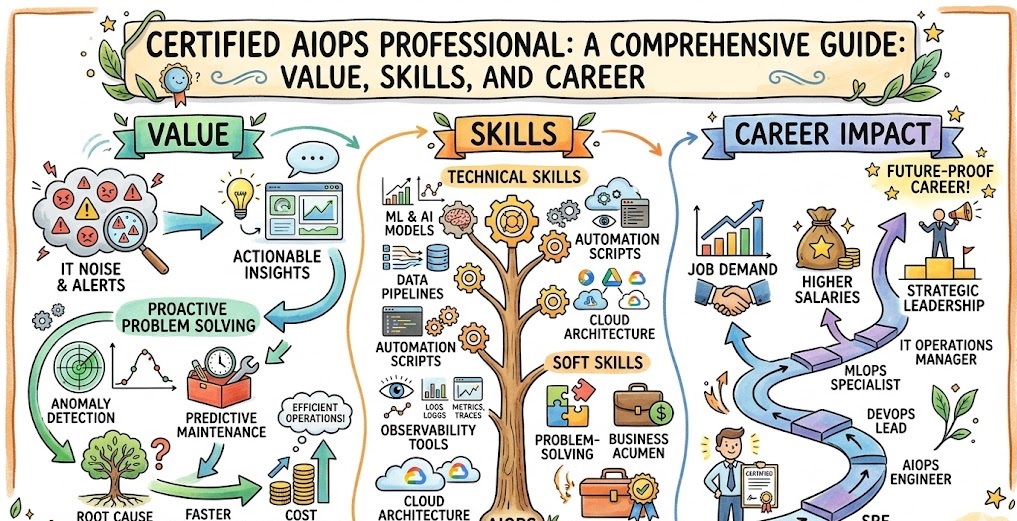
The digital landscape is shifting from manual monitoring to automated, intelligent systems. The Certified AIOps Professional is designed to help engineers bridge the gap between traditional operations and machine learning-driven automation. This guide is written for software engineers, SREs, and IT managers who want to understand how to apply artificial intelligence to IT operations.
In today’s cloud-native world, the sheer volume of logs and metrics is too much for humans to handle alone. By following this roadmap from AIOps School, professionals can learn to build resilient systems that self-heal and predict issues before they impact users. This guide provides a clear look at the certification structure to help you make an informed decision about your technical career.
What is the Certified AIOps Professional?
The Certified AIOps Professional represents a new standard in the IT operations industry. It focuses on using big data, analytics, and machine learning to automate many of the repetitive tasks currently performed by DevOps and SRE teams. Instead of just teaching theory, this program emphasizes practical, production-focused skills that are needed in modern enterprise environments.
This certification exists because modern engineering workflows require faster incident response and better resource management than human-only teams can provide. It aligns with enterprise practices by teaching how to integrate AI models directly into the CI/CD pipeline and monitoring stacks. For those working in complex distributed systems, this is a path toward becoming a more efficient and data-driven engineer.
Who Should Pursue Certified AIOps Professional?
This certification is highly beneficial for Site Reliability Engineers (SREs), Cloud Architects, and Platform Engineers who manage high-scale infrastructure. It is also suitable for Data Engineers who want to understand the operational side of ML models, as well as Security professionals looking to automate threat detection. Both beginners in the automation space and experienced senior engineers will find value in the curriculum.
For professionals in India’s growing tech hubs and those in global markets, this credential proves a deep understanding of modern IT efficiency. Managers and technical leaders should also consider this path to better lead teams through the transition to intelligent automation. Whether you are starting your journey or looking to pivot from traditional sysadmin roles, this certification provides the necessary technical foundation.
Why Certified AIOps Professional is Valuable Beyond Today
The demand for intelligent operations is growing as enterprises adopt multi-cloud and microservices architectures. This certification provides long-term value because it focuses on the logic and methodology of automation rather than just a single tool. As tools change, the core principles of anomaly detection and event correlation you learn here will remain relevant and applicable.
Longevity in the tech industry comes from staying ahead of the curve, and AIOps is the current frontier of operational excellence. Investing time in this certification offers a strong return on career growth, as companies are actively seeking professionals who can reduce “noise” in their alerting systems. By mastering these skills, you ensure that you remain a vital asset to any engineering organization looking to optimize its operational costs and uptime.
Certified AIOps Professional Certification Overview
The program is delivered through a structured learning path that combines instructional content with practical assessments. It is designed to be a comprehensive journey that takes a candidate from foundational concepts to advanced architectural patterns. The certification is hosted on a platform that specializes in emerging operational technologies, ensuring the content is always updated for current industry trends.
The assessment approach focuses on the candidate’s ability to solve real-world operational problems using AI-driven logic. There are different levels available depending on your current expertise and career goals. Each level is designed to validate specific competencies, from understanding basic algorithms to designing complex, self-healing infrastructures for global enterprises.
Certified AIOps Professional Certification Tracks & Levels
The certification is divided into three primary levels: Foundation, Professional, and Advanced. The Foundation level introduces the core concepts of data science for operations and the basic architecture of an AIOps platform. It is the starting point for those new to the field who need to understand the “why” and “how” of intelligent monitoring.
The Professional level dives deeper into specialized tracks such as AIOps for DevOps or AIOps for SRE. At this stage, candidates learn to implement specific tools and build models that correlate events across different infrastructure layers. The Advanced level is meant for architects and leaders who design the entire automation strategy for an organization, focusing on long-term scalability and business impact.
Complete Certified AIOps Professional Certification Table
| Track | Level | Who it’s for | Prerequisites | Skills Covered | Recommended Order |
| Core AIOps | Foundation | Beginners, Junior Ops | Basic Linux/Cloud | Data basics, Monitoring | First |
| SRE-AIOps | Professional | SREs, Cloud Engineers | 2+ years SRE | Anomaly detection, SLOs | Second |
| DevOps-AI | Professional | DevOps Engineers | CI/CD knowledge | Automated testing, Scaling | Second |
| Platform-AI | Advanced | Architects, Managers | 5+ years Ops | Governance, ML Platforms | Third |
| Data-Ops AI | Professional | Data Engineers | SQL/Python basics | Pipeline automation | Optional |
Detailed Guide for Each Certified AIOps Professional Certification
Certified AIOps Professional – Foundation
What it is This certification validates a professional’s understanding of the basic components of AI-driven operations. It confirms that the holder knows how to differentiate between traditional monitoring and intelligent observability.
Who should take it This is suitable for junior engineers, IT students, or managers who need a high-level technical understanding of the field. No deep coding experience is required, but a general interest in IT operations is helpful.
Skills you’ll gain
- Understanding of the AIOps conceptual framework.
- Knowledge of data collection methods for logs and metrics.
- Ability to identify common use cases for AI in IT operations.
- Familiarity with the differences between supervised and unsupervised learning in Ops.
Real-world projects you should be able to do
- Setting up a basic centralized logging system.
- Identifying redundant alerts in a standard monitoring dashboard.
- Mapping a manual operational process to an automated AI workflow.
Preparation plan
- 7-14 days: Focus on terminology and the core pillars of AIOps through documentation.
- 30 days: Review case studies of enterprise AIOps implementations and take practice quizzes.
- 60 days: Not required for this level unless you have no prior IT background.
Common mistakes
- Overcomplicating the math behind the algorithms instead of focusing on their application.
- Ignoring the cultural shift required to move away from manual monitoring.
Best next certification after this
- Same-track: Certified AIOps Professional – Professional Level
- Cross-track: SRE Foundation
- Leadership: ITIL 4 Foundation
Certified AIOps Professional – Professional
What it is This level validates the ability to implement and manage AIOps tools within a live production environment. It proves that the engineer can configure machine learning models to reduce operational toil and improve system reliability.
Who should take it Mid-level DevOps engineers and SREs with at least two years of experience in managing infrastructure. It is designed for those who are responsible for the day-to-day uptime and performance of applications.
Skills you’ll gain
- Configuring event correlation engines to reduce alert fatigue.
- Implementing automated root cause analysis (RCA) tools.
- Building predictive scaling models for cloud resources.
- Integrating AI insights into existing Slack or PagerDuty workflows.
Real-world projects you should be able to do
- Creating an automated incident response workflow that triggers on anomaly detection.
- Designing a dashboard that shows predicted resource exhaustion before it happens.
- Building a self-healing script that restarts services based on ML-driven insights.
Preparation plan
- 7-14 days: Deep dive into specific AIOps tooling and API integrations.
- 30 days: Build a lab environment to test anomaly detection on synthetic traffic.
- 60 days: Perform a full implementation project in a sandbox environment and document the results.
Common mistakes
- Relying too much on default tool settings without tuning them for specific workloads.
- Failing to clean the data before feeding it into an AIOps engine.
Best next certification after this
- Same-track: Certified AIOps Professional – Advanced Level
- Cross-track: Certified Kubernetes Administrator (CKA)
- Leadership: Engineering Manager Certificate
Choose Your Learning Path
DevOps Path
In this path, the focus is on integrating AI into the software development lifecycle. You will learn how to use machine learning to analyze code commits and predict which changes are likely to cause failures in production. This path is ideal for those who want to build smarter CI/CD pipelines that can automatically roll back updates based on performance regressions. It bridges the gap between fast delivery and high stability.
DevSecOps Path
The security path emphasizes the use of AI for threat detection and automated compliance. You will learn how to use behavior analysis to identify unusual patterns that might indicate a security breach. This goes beyond static rules and allows you to catch “zero-day” vulnerabilities through anomaly detection. It is a critical path for engineers working in highly regulated industries like finance or healthcare.
SRE Path
The SRE path is centered on reliability, availability, and performance. You will use AIOps to define better Service Level Objectives (SLOs) and use predictive analytics to avoid breaching them. The goal here is to reduce the “mean time to resolution” (MTTR) by using AI to pinpoint the exact source of a problem within seconds. This is the most popular path for those managing large-scale distributed systems.
AIOps Path
This path is for the dedicated operations specialist who wants to master the entire AIOps ecosystem. It covers the full spectrum from data ingestion and processing to visualization and automated action. You will learn the architecture of different AIOps platforms and how to choose the right one for your organization. It is the core path for anyone wanting to be recognized as a specialist in intelligent operations.
MLOps Path
The MLOps path focuses on the operational challenges of maintaining machine learning models themselves. While AIOps uses AI to help Ops, MLOps uses Ops principles to help AI. You will learn how to automate the training, deployment, and monitoring of ML models in production. This is essential for data engineers and platform engineers who support data science teams.
DataOps Path
DataOps focuses on the flow of data within an organization and how to automate the data pipeline. You will learn how to apply DevOps-like principles to data management to ensure high quality and fast delivery of data to AIOps engines. This path teaches you how to manage “data as code” and ensure that the information being used for AI decisions is accurate and timely.
FinOps Path
The FinOps path uses AI to optimize cloud spending and financial accountability. You will learn how to use predictive modeling to forecast cloud costs and identify wasted resources that can be automatically shut down. This is becoming a vital role as companies move to multi-cloud environments where costs can easily spiral out of control. It combines financial literacy with technical automation.
Role → Recommended Certified AIOps Professional Certifications
| Role | Recommended Certifications |
| DevOps Engineer | AIOps Foundation, DevOps-AI Professional |
| SRE | AIOps Foundation, SRE-AIOps Professional |
| Platform Engineer | AIOps Professional, Platform-AI Advanced |
| Cloud Engineer | AIOps Foundation, SRE-AIOps Professional |
| Security Engineer | AIOps Foundation, DevSecOps-AI Track |
| Data Engineer | AIOps Foundation, Data-Ops AI Professional |
| FinOps Practitioner | AIOps Foundation, FinOps-AI Track |
| Engineering Manager | AIOps Foundation, Platform-AI Advanced |
Next Certifications to Take After Certified AIOps Professional
Same Track Progression
After completing the professional level, you should look toward the Advanced or Expert tiers. These certifications move away from implementation and focus more on the strategic alignment of AIOps with business goals. You will learn how to build an internal AIOps platform that serves multiple teams across a large organization. This path establishes you as a thought leader in the space of intelligent automation.
Cross-Track Expansion
If you have mastered AIOps, it is wise to broaden your skills by looking at cloud-specific certifications like the AWS Certified Solutions Architect or the Google Professional Cloud DevOps Engineer. Understanding the underlying infrastructure helps you better configure the AI models that monitor it. You might also consider deep-diving into container orchestration with the CKA or CKAD to see how AI handles Kubernetes complexity.
Leadership & Management Track
For those looking to move into management, certifications like the PMP or specialized engineering leadership courses are a great next step. An AIOps background gives you a data-driven perspective on team productivity and system health. You can use this knowledge to advocate for better tools and budgets, proving the ROI of automation to executive leadership. It prepares you for roles like Director of Platform Engineering or CTO.
Training & Certification Support Providers for Certified AIOps Professional
DevOpsSchool
DevOpsSchool is a leading provider of technical training that focuses on hands-on, lab-based learning. They offer a deep curriculum for AIOps that includes live sessions with industry experts who have managed large-scale production environments. Their approach is highly practical, ensuring that students do not just pass an exam but actually gain skills they can use at work. They provide extensive study materials, recorded sessions, and a supportive community for engineers in India and across the globe. Their instructors bring years of real-world experience, helping students navigate the complexities of modern automation and cloud-native technologies effectively.
Cotocus
Cotocus specializes in consulting-led training, which means their courses are designed based on the actual problems they solve for corporate clients. This makes their AIOps training incredibly relevant for professionals working in enterprise settings. They focus on the integration of various tools and how to build a cohesive automation strategy. Cotocus provides a personalized learning experience, often tailoring their labs to match the specific technology stacks used by their students. Their commitment to technical excellence and professional growth has made them a trusted partner for many engineers looking to advance their careers in the DevOps and AIOps domains.
Scmgalaxy
Scmgalaxy is a massive community-driven platform that offers a wealth of knowledge for anyone in the software configuration management and DevOps space. They provide a variety of resources including tutorials, blogs, and specialized training programs for AIOps. Their strength lies in their vast repository of technical content and their ability to bring together experts from around the world. For someone preparing for the Certified AIOps Professional exam, Scmgalaxy offers the “tribal knowledge” and edge-case solutions that are often missing from standard textbooks. It is an excellent place for continuous learning and networking with peers.
BestDevOps
BestDevOps focuses on providing high-quality, curated training paths for professionals who want to reach the top tier of their careers. Their AIOps courses are structured to be efficient and high-impact, focusing on the most important skills needed by employers today. They offer mentorship programs that help engineers bridge the gap between technical knowledge and career advancement. BestDevOps is known for its clear explanations and focus on the latest industry trends, making it an ideal choice for busy professionals who need to upgrade their skills quickly. Their training modules are designed to be engaging and results-oriented.
devsecopsschool.com
This platform is dedicated entirely to the intersection of development, security, and operations. Their AIOps training has a strong security focus, teaching students how to use AI for vulnerability management and automated compliance. In an era where security threats are becoming more sophisticated, their curriculum is essential for any engineer who wants to build “secure by design” systems. They offer specialized labs that simulate security incidents, allowing students to practice using AI tools to detect and mitigate threats in real-time. Their instructors are seasoned security professionals who understand the operational challenges of modern tech stacks.
sreschool.com
Sreschool.com is the go-to resource for anyone aspiring to be a Site Reliability Engineer. Their AIOps curriculum is deeply integrated with SRE principles like error budgets, SLOs, and toil reduction. They teach students how to use machine learning to make systems more resilient and how to automate the incident management lifecycle. The training is highly technical and focuses on the architectural aspects of reliability. Students at Sreschool.com learn how to build “observable” systems that provide the high-quality data needed for effective AIOps. It is an ideal environment for engineers who want to master the art of uptime.
aiopsschool.com
As the primary host for the Certified AIOps Professional, this site offers the most direct and comprehensive path to certification. They provide the official curriculum, practice exams, and direct access to the creators of the certification program. Their training covers everything from the basics of data science to the advanced implementation of AIOps platforms. By focusing exclusively on AIOps, they are able to provide a depth of knowledge that more general platforms might miss. Their labs are designed to mirror the actual certification exam, giving candidates the confidence and skills they need to succeed in their professional journey.
dataopsschool.com
Dataopsschool.com addresses the growing need for better data management in the age of AI. Their training focuses on how to build and automate the data pipelines that power AIOps engines. They teach students how to treat data as a product and how to apply DevOps principles to data workflows. This is critical because the success of any AIOps implementation depends on the quality and availability of the data. Their courses cover topics like data versioning, automated testing for pipelines, and data governance. It is a vital school for anyone who wants to specialize in the “Data” part of AIOps.
finopsschool.com
Finopsschool.com is dedicated to the practice of cloud financial management. Their AIOps-related courses teach students how to use AI to drive cost transparency and optimization in cloud environments. They bridge the gap between finance, engineering, and business teams, helping everyone understand the financial impact of their technical decisions. The curriculum includes how to build automated “cost-anomaly” detection and how to use AI to forecast future spending. As cloud bills continue to rise, the skills taught here are becoming some of the most sought-after in the industry. It is a perfect fit for engineers with an interest in business logic.
Frequently Asked Questions (General)
- What is the difference between DevOps and AIOps?
DevOps focuses on the culture and process of breaking down silos between dev and ops teams. AIOps is a technical evolution that uses artificial intelligence to automate the complex operational tasks that DevOps teams manage. - Is this certification recognized globally?
Yes, the skills and methodologies taught are based on global industry standards used by major tech companies and enterprises worldwide. - How long does it typically take to get certified?
Depending on your experience, it can take anywhere from 30 days for a foundation level to 6 months for an advanced level. - Do I need to know how to code in Python?
While not strictly required for the foundation level, a basic understanding of Python is very helpful for the professional and advanced levels. - Is there a prerequisite for the Professional level?
It is recommended to have at least two years of experience in an operations or development role, or to have passed the Foundation exam. - How much does the certification cost?
The pricing varies based on the level and the training package you choose. It is best to check the official website for current rates. - Does AIOps replace SRE roles?
No, AIOps is a tool that helps SREs be more effective. It handles the “toil” so SREs can focus on high-level architectural improvements. - Can a manager benefit from this certification?
Yes, the foundation level is excellent for managers who need to understand how to lead teams through a transition to AI-driven operations. - What tools are covered in the training?
The training covers a mix of open-source tools like Prometheus and ELK, as well as enterprise AIOps platforms used in large companies. - Is there a lab or practical component?
Yes, the professional and advanced levels include hands-on labs where you must implement AIOps concepts in a real environment. - How long is the certification valid?
The certification is typically valid for two to three years, after which you may need to recertify to stay current with new technologies. - Will this help me get a job in India?
India has a massive IT sector that is rapidly moving toward automation. This certification is highly valued by major service providers and product companies alike.
FAQs on Certified AIOps Professional
- How difficult is the Certified AIOps Professional exam compared to others?
It is more practical than many “multiple choice” exams. You need to demonstrate a real understanding of how data flows through an operational system. - Do I need to be a Data Scientist to pass?
No, you do not need a degree in data science. You only need to understand how to apply specific ML models to IT operational data. - What is the primary focus of the Certified AIOps Professional?
The primary focus is on reducing operational noise, improving incident response, and using data to make better infrastructure decisions. - Are there any retake options if I fail the exam?
Yes, most providers offer a retake policy. You should check the specific terms on the hosting platform for the number of allowed attempts. - Does the course cover AIOps for multi-cloud environments?
Yes, a core part of the curriculum is managing complexity across different cloud providers like AWS, Azure, and Google Cloud. - Can I take the exam online?
Yes, the certification is designed to be accessible globally through an online proctored examination system. - Is there a community for certified professionals?
Yes, once certified, you gain access to an exclusive community of practitioners for networking and knowledge sharing. - What kind of career support is provided?
Many of the training providers mentioned offer resume reviews and interview preparation specifically for AIOps roles.
Final Thoughts: Is Certified AIOps Professional Worth It?
If you are looking at the future of IT operations, it is clear that manual monitoring cannot keep up with the scale of modern software. The Certified AIOps Professional is a solid investment for anyone who wants to move beyond basic automation and into the world of intelligent systems. It provides a structured way to learn a complex subject that is often misunderstood in the industry.
The value of this certification lies in its practical approach. You won’t just learn buzzwords; you will learn how to actually build systems that make your life as an engineer easier. For those in competitive markets, having a credential that proves your ability to manage AI-driven operations is a significant advantage. It is a challenging but rewarding path that aligns perfectly with the direction the industry is heading.
