Upgrade & Secure Your Future with DevOps, SRE, DevSecOps, MLOps!
We spend hours scrolling social media and waste money on things we forget, but won’t spend 30 minutes a day earning certifications that can change our lives.
Master in DevOps, SRE, DevSecOps & MLOps by DevOps School!
Learn from Guru Rajesh Kumar and double your salary in just one year.
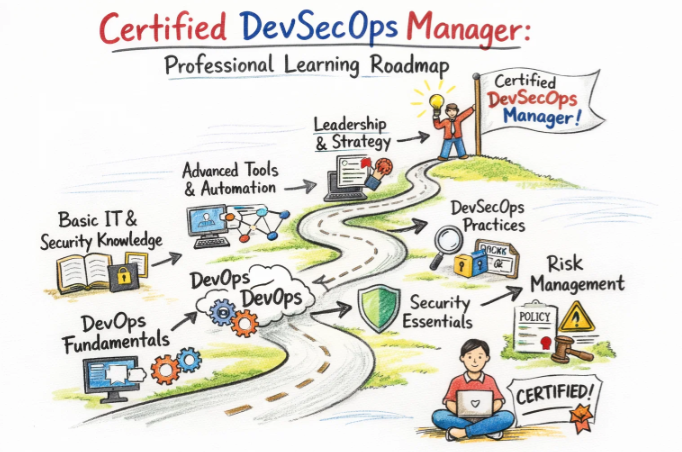
In today’s fast-paced engineering landscape, the role of a manager has fundamentally changed. It is no longer enough to just track tickets; you must now architect a culture where security is woven into the very fabric of delivery. This guide provides a strategic roadmap for those ready to step into this high-level leadership role through the Certified DevSecOps Manager program.
Success in this field requires more than just knowing tools; it requires a holistic view of the system. This is why many top-tier leaders are turning toward the Master in Observability Engineering Certifications Program. Understanding how to see across your entire stack is the only way to manage risk effectively while maintaining the speed your business demands.
Below is the definitive master plan for your professional growth.
Strategic Certification Matrix
This table outlines the essential credentials across the modern engineering spectrum. While we focus on DevSecOps leadership here, these tracks represent the pillars of a resilient organization.
| Track | Level | Who it’s for | Prerequisites | Skills covered | Recommended order |
| DevOps | Associate | Junior Engineers | Basic Linux/Cloud | CI/CD, Scripting, Docker basics | 1 |
| DevOps | Expert | Senior Engineers | 2+ years hands-on | IaC, Orchestration, Scaling | 2 |
| DevSecOps | Master | Team Leads & Managers | 3-5 years in Ops/Dev | Governance, Risk, Shift-Left Strategy | 3 |
| SRE | Specialist | Reliability Engineers | Strong Coding/Systems | SLIs/SLOs, Error Budgets, Toil reduction | 2 |
| AIOps/MLOps | Specialist | ML & Data Leads | Math + Python/Cloud | Model Lifecycle, Automated Tuning | 3 |
| DataOps | Specialist | Data Architects | SQL, ETL, Big Data | Pipeline integrity, Data governance | 3 |
| FinOps | Specialist | Managers & Cloud Leads | Cloud billing access | Unit economics, Cost allocation | 2 |
| Observability | Master | Senior SREs & Architects | Deep telemetry knowledge | Distributed tracing, Event correlation | 4 |
Deep Dive: Certified DevSecOps Manager (CDOM)
The Certified DevSecOps Manager is the gold standard for those who want to lead the next generation of secure engineering teams.
What it is
The Certified DevSecOps Manager (CDOM) is a senior-level credential that focuses on the governance and strategic oversight of secure software delivery. It isn’t just about running a scan; it’s about managing the people, processes, and technologies that allow an organization to release software that is secure by design. It covers the leadership aspects of integrating security into DevOps, focusing on compliance, threat modeling at scale, and managing the total cost of security operations. Much like the Master in Observability Engineering Certifications Program, this certification focuses on high-level visibility—giving you the data you need to make informed leadership decisions.
Who should take it
This path is designed for those who are ready to move from “doing” to “leading.”
- Engineering Managers looking to standardize security across their squads.
- Lead DevOps Engineers transitioning into management roles.
- Security Directors who need to understand how to integrate with agile teams.
- CTOs and Architects responsible for the long-term roadmap of secure delivery.
- Compliance Officers who want to automate the auditing process through code.
Skills you’ll gain
This program transforms your perspective from a technical contributor to a business-aligned leader.
You will master the art of balancing speed with safety. The curriculum ensures you understand the “why” behind every security gate.
- Security Leadership: Building a culture where developers take ownership of their own security posture.
- Policy as Code: Implementing automated governance that prevents non-compliant code from ever reaching production.
- Risk Management: Learning how to prioritize vulnerabilities based on business impact rather than just technical severity.
- DevSecOps Tooling Strategy: Choosing the right mix of SAST, DAST, and SCA tools that don’t slow down the developer experience.
- Strategic Observability: Using metrics to prove the value of your security investments to executive stakeholders.
Real-world projects you should be able to do after it
Upon completion, you won’t just have a certificate; you’ll have the capability to deliver high-stakes executive results.
- Building a Global DevSecOps Strategy: You will be able to design a multi-year roadmap that aligns security goals with the company’s product release schedule.
- Automating Regulatory Compliance: You can lead a project to turn HIPAA, SOC2, or GDPR requirements into automated checks within a Jenkins or GitLab pipeline.
- Orchestrating Vulnerability Remediation: You will have the skills to build a cross-functional system that identifies security flaws and automatically assigns them to the right teams for fixing.
- Cost Optimization for Security: You will be able to perform a FinOps-style audit of your security tools to ensure the organization is getting maximum value for its spend.
Preparation Plan (7–14 days / 30 days / 60 days)
- 7–14 Days (The Executive Sprint): This is for senior leaders who already live and breathe these concepts. Focus strictly on the exam format and the specific governance frameworks mentioned in the CDOM curriculum. Spend 4 hours a day on mock assessments.
- 30 Days (The Professional Track): Spend the first two weeks reviewing the technical modules (pipelines and tools). Spend the last two weeks focusing on the “Manager” modules: risk management, compliance, and team leadership.
- 60 Days (The Foundation Builder): Use the first 30 days to get hands-on with the technical basics of DevSecOps. Use the final 30 days to study the management theory and complete the practical capstone projects required for the certification.
Common Mistakes
Even the most talented engineers can fail this certification if they don’t shift their mindset.
- Focusing Only on Tools: Many candidates think knowing how to run a Snyk scan is enough. As a manager, you must know how to handle the results and how to fix the process that allowed the bug to exist.
- Ignoring the Developer Experience: If you build a secure pipeline that is too slow, developers will find a way around it. You must learn to balance security with developer productivity.
- Neglecting Observability: You cannot manage what you cannot see. Failing to implement deep logging and tracing will leave you blind when a security incident actually occurs. This is a primary reason for the rising popularity of the Master in Observability Engineering path.
Best Next Certification After This
Once you have mastered DevSecOps management, look toward rounding out your executive profile.
- For Cost Control: FinOps Practitioner (to manage the massive costs of cloud security and infrastructure).
- For Reliability: SRE Master (to ensure your secure systems are also highly available).
- For Strategic Visibility: Master in Observability Engineering (to gain a 360-degree view of your entire technical estate).
Choose Your Path: 6 Specialized Learning Journeys
Your career can go in many directions after you master the basics. Here are the six most common paths:
- DevOps Path: This is the foundation. It is for those who love making things work together. You focus on the “pipeline” and making sure software moves from a developer’s laptop to the customer as fast as possible.
- DevSecOps Path: This is for the protectors. You take the DevOps path and add a heavy layer of security. You ensure that speed never comes at the cost of safety.
- SRE Path: This is for the “doctors” of the tech world. You focus on health and uptime. Your goal is to make sure the site never goes down, and if it does, it heals itself.
- AIOps/MLOps Path: This is the future. You use artificial intelligence to manage systems. Instead of humans looking at screens, you build machines that watch the machines.
- DataOps Path: This is for the data lovers. You apply DevOps principles to data pipelines, making sure information is clean, secure, and moves quickly to the people who need it.
- FinOps Path: This is for the business-minded. You focus on the cost of the cloud. You make sure the company isn’t wasting money on servers they don’t need.
Role → Recommended Certifications
| Role | Recommended Certifications |
|---|---|
| DevOps Engineer | Certified DevOps Engineer, Certified DevSecOps Manager |
| SRE | SRE Certified Professional, Certified DevSecOps Manager |
| Platform Engineer | Certified Cloud Platform Engineer, Certified DevSecOps Manager |
| Cloud Engineer | Cloud Security Architect, Certified DevSecOps Manager |
| Security Engineer | Certified Security Engineer, Certified DevSecOps Manager |
| Data Engineer | DataOps Professional, Certified DevSecOps Manager |
| FinOps Practitioner | FinOps Certified Professional, Certified DevSecOps Manager |
| Engineering Manager | DevSecOps Leadership, Certified DevSecOps Manager |
Top Training Institutions for Leadership
These organizations provide the necessary depth to clear the Certified DevSecOps Manager exam and succeed in the role.
- DevOpsSchool: This institution has built a reputation as the primary hub for DevOps and DevSecOps training. Their programs are specifically designed for working professionals, offering flexible schedules and a massive library of practical labs.
- Cotocus: They specialize in corporate-level training, helping entire teams transition to DevSecOps together. Their focus on industry-standard tools makes them a favorite for large enterprises.
- Scmgalaxy: A technical powerhouse that provides some of the most detailed documentation and community support in the industry. They are excellent for those who want to understand the deep mechanics of automation.
- BestDevOps: They offer a more personalized approach to mentoring, focusing on the career growth of the individual. Their courses are great for those looking to pivot into leadership.
- Devsecopsschool: The dedicated home for this specific certification. Their curriculum is updated constantly to match the current exam requirements and the latest security threats.
- Sreschool: The go-to source for reliability engineering. If you want to master SLOs and incident management, this is the place.
- Aiopsschool: Leading the charge in the future of operations, they provide the best training for integrating machine learning into your monitoring workflows.
- Dataopsschool: They provide the specialized knowledge required to apply DevOps principles to the world of big data and analytics.
- Finopsschool: The most comprehensive source for learning cloud financial management and cost optimization strategies.
General Career FAQs
- Which certification should I take first? Start with a vendor-neutral DevOps certification to learn the core principles before specializing in Security or Reliability.
- Is the Indian market different from the global market for these roles? The core tech is the same, but the Indian market is currently seeing a massive surge in demand for managers who can handle global compliance standards.
- How do I prove the value of these certs to my boss? Show them the “Real-world projects” list from the CDOM section. Explain how you can reduce their risk and automate their compliance.
- Are these certifications valid forever? Most require renewal every 2–3 years to ensure you are up to date with the latest technology.
- Can a Software Engineer skip directly to DevSecOps? Yes, if you have a strong understanding of the deployment lifecycle, you can pivot directly into DevSecOps.
- What is the hardest part of the management certification? Shifting from “How do I fix this?” to “How do I build a team that prevents this?”
- Do I need to be a coding expert? You need to be “code-literate”—you must be able to read and understand script logic even if you aren’t writing it every day.
- How much can I expect my salary to grow? Master-level managers often see a 20-40% increase in market value depending on their location and previous experience.
- Why is Observability mentioned so much? Because modern systems are too complex to monitor with traditional tools. Observability is the “eyes” of a DevSecOps manager.
- Is the exam proctored? Yes, most master-level exams like the CDOM are proctored and require a high degree of integrity.
- Are there any prerequisites for CDOM? A few years of experience in either Dev, Ops, or Security is highly recommended.
- How do I find a mentor? Institutions like DevOpsSchool often have community forums where you can connect with senior leaders.
Certified DevSecOps Manager FAQs
- What makes the CDOM different from a CISSP? The CISSP is broad and often legacy-focused. The CDOM is specifically built for the high-speed, automated world of DevOps.
- How much hands-on lab work is in the CDOM? About 50% of the program is focused on practical application and project work.
- Does the CDOM cover cloud security? Yes, it focuses heavily on AWS, Azure, and GCP security best practices.
- Is this good for a Startup Manager? Absolutely. Startups need to build secure foundations early, and the CDOM gives you the blueprint to do it cheaply and fast.
- Can I take the exam online? Yes, official providers like devsecopsschool.com offer online examination options.
- What happens if I fail the first time? Most programs offer a retake option after a short cooling-off period to allow for more study.
- Is there a community for CDOM holders? Yes, there are exclusive alumni groups where you can share best practices and job leads.
- How does this help with SOC2 audits? It teaches you how to automate the evidence collection, making the audit process much faster and less painful.
Conclusion
Navigating the path to becoming a Certified DevSecOps Manager is a journey that transforms your professional identity. It moves you from the engine room of the organization to the bridge, where you are responsible for the safety and speed of the entire vessel. By mastering the balance between rapid innovation and rigorous security, you become an indispensable asset in the global engineering market. This guide has provided you with the technical requirements, the preparation strategies, and the visionary paths available to you. Whether you choose to double down on the technicalities of SRE or the economics of FinOps, remember that the foundation of all modern leadership is visibility. Engaging with programs like the Master in Observability Engineering Certifications Program will ensure that you are never managing in the dark. Now is the time to invest in your growth, choose your specialization, and lead your organization into a more secure and reliable future. Your next chapter as a technical leader begins with the decision to master these disciplines today.
