Upgrade & Secure Your Future with DevOps, SRE, DevSecOps, MLOps!
We spend hours scrolling social media and waste money on things we forget, but won’t spend 30 minutes a day earning certifications that can change our lives.
Master in DevOps, SRE, DevSecOps & MLOps by DevOps School!
Learn from Guru Rajesh Kumar and double your salary in just one year.
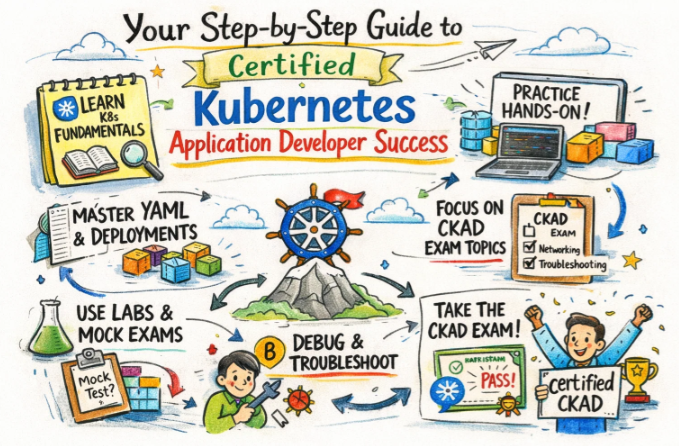
The way we build and ship software has changed forever. In the past, developers wrote code and handed it off to someone else to run. Those days are over. Today, if you want to be a top-tier engineer, you have to understand the environment where your code lives. Kubernetes is the standard for that environment. It is the common language of modern software infrastructure.
I often speak with engineers and managers who want to know how to prove they are ready for this new world. My answer is the Certified Kubernetes Application Developer (CKAD) program. This isn’t a typical exam where you just pick an answer from a list. It is a hands-on challenge. You are given a terminal and a set of problems to solve. It proves you can actually do the work, not just talk about it.
This guide is for engineers and leaders who want a clear path to mastering Kubernetes. We will look at what the CKAD involves, how to get ready, and where it can take your career.
The Big Picture: Cloud and Kubernetes Certifications
Before looking closely at the CKAD, it helps to see how it fits with other certifications. Use this table to plan your learning journey.
| Track | Level | Who it’s for | Prerequisites | Skills Covered | Recommended Order |
| Cloud Basics | Entry | Newcomers | None | Cloud and Container basics | 1 |
| Kubernetes App Dev | Professional | Software Engineers | Container basics | App Design, Pods, Services | 2 |
| Kubernetes Admin | Professional | SREs / Ops | Linux skills | Cluster setup and networking | 3 |
| Security | Specialist | Security Pros | CKA Cert | Hardening and system safety | 4 |
| Automation | Associate | DevOps Engineers | General Cloud | Infrastructure as Code | 5 |
| Management | Foundation | Engineering Leads | Work experience | DevOps culture and metrics | 6 |
Deep Dive: The CKAD Program
The CKAD is the most important certification for anyone writing code that runs in a container. It focuses on the parts of Kubernetes that matter to developers.
What it is
The Certified Kubernetes Application Developer (CKAD) is a performance-based exam from the Cloud Native Computing Foundation (CNCF). You get two hours to solve real-world tasks in a command-line environment. It confirms that you can build, configure, and troubleshoot applications on a Kubernetes cluster.
Who should take it
This is for Software Engineers and Application Developers who work with containers. It is also very helpful for Engineering Managers. When a manager understands how Kubernetes works, they can make better plans and help their team solve technical problems faster.
Skills you’ll gain
Preparing for the CKAD gives you a deep understanding of how to run applications at scale. You will move away from manual steps and start using automated, reliable methods.
- Design and Build: You will learn to create Pods and use different patterns like sidecars to add features to your apps.
- Deployment: You will learn how to update your software without taking it offline and how to use Helm for easier installs.
- Monitoring: You will gain the skills to set up health checks so Kubernetes can fix your app automatically if it fails.
- Configuration: You will learn to manage settings and secrets safely without putting them in your code.
- Networking: You will learn how to let different parts of your app talk to each other and keep that communication secure.
Real-world projects you should be able to do after it
After you finish your training, you will have the confidence to handle major tasks in a production environment.
- Building Self-Healing Apps: You can set up systems that automatically restart or replace containers if they stop working.
- Managing Sensitive Data: You will know how to use Kubernetes Secrets to handle passwords and API keys safely.
- Zero-Downtime Updates: You can push new versions of your code while users are still using the app, with no interruptions.
- Network Security: You can write rules that control which parts of your system are allowed to talk to each other.
- Resource Management: You will be able to tell Kubernetes exactly how much memory and CPU your app needs so the whole system stays stable.
Preparation plan (7–14 days / 30 days / 60 days)
The time you need depends on how much you already use Kubernetes.
The 14-Day Sprint (For Current Users)
If you use Kubernetes every day, you just need to focus on the exam format.
- Week 1: Go through the official syllabus. Find any topics you don’t use often at work.
- Week 2: Practice using the command line exclusively. Take mock exams to get used to the two-hour time limit.
The 30-Day Roadmap (For Software Engineers)
This is the best path if you know containers but are new to Kubernetes.
- Days 1-10: Learn the core building blocks like Pods, Deployments, and Services.
- Days 11-20: Focus on more advanced topics like Ingress, Storage, and Security.
- Days 21-30: Take multiple mock exams. Focus on speed and avoiding small mistakes.
The 60-Day Foundation (For Beginners)
If you are new to the world of containers, take your time to build a strong base.
- Month 1: Focus on Linux commands and Docker. You must understand containers before you can manage them with Kubernetes.
- Month 2: Follow the 30-day plan above. Spend extra time on hands-on labs for every new concept.
Common mistakes
Many people fail because of how they manage their time, not because they don’t know the tech.
- Writing YAML from scratch: This takes too long. Use commands to generate the files for you.
- Getting stuck: If a task is too hard, skip it and come back later. Don’t waste 20 minutes on one small problem.
- Wrong context: Always make sure you are working on the right cluster. The exam will give you commands to switch between them.
- Typing errors: A single extra space in a configuration file can cause a failure. Always double-check your work before moving on.
Choose Your Path: 6 Learning Directions
Kubernetes is just the beginning. Depending on your interests, you can take your career in several different directions.
1. DevOps
Focus on making the delivery of software as smooth as possible. You will learn to build automated pipelines that take code from a developer’s laptop all the way to production.
2. DevSecOps
Focus on security. You will learn how to protect the software and the infrastructure at every step, making sure that speed doesn’t lead to safety risks.
3. SRE (Site Reliability Engineering)
Focus on keeping things running. You will use software to manage systems, making sure they are always available and performing well for users.
4. AIOps/MLOps
Focus on the future of data. You will learn how to run and scale AI and machine learning models on Kubernetes clusters.
5. DataOps
Focus on data flow. You will work on automating the pipelines that move and process data, ensuring that teams always have the information they need.
6. FinOps
Focus on the business side. You will learn how to manage cloud costs, making sure the company gets the most value from the money it spends on technology.
Role → Recommended Certifications
Here is a simple guide to which certifications fit different job roles.
| Your Role | Core Certification | Next Step |
| Software Engineer | CKAD | Cloud Associate |
| DevOps Engineer | CKA | Terraform Associate |
| SRE | CKA | CKAD |
| Platform Engineer | CKA | CKS |
| Security Engineer | CKS | DevSecOps Foundation |
| Data Engineer | DataOps Foundation | CKAD |
| FinOps Practitioner | FinOps Certified | Cloud Basics |
| Engineering Manager | Cloud Basics | CKAD |
What to take next?
Once you have your CKAD, you have three great options to keep growing.
- Stay on Track (Deepen Skills): Take the CKA (Administrator) exam to learn how to manage the clusters you are deploying apps to.
- Cross-Track (Broaden Skills): Learn Terraform. This helps you manage the servers and networks that Kubernetes runs on.
- Leadership Track: Look into the DevOps Foundation. This focuses on the culture and people side of engineering.
Top Training Institutions for CKAD
If you want structured help to pass your exam and learn the skills properly, these organizations are excellent choices.
- DevOpsSchool: This school provides deep, hands-on training led by experts who have worked in the industry for a long time. They focus on real skills that you can use at work immediately, not just passing the test.
- Cotocus: They offer specialized technical workshops and training for corporate teams. They are a great choice if you want your whole engineering department to reach a high standard of Kubernetes knowledge.
- Scmgalaxy: A long-standing provider that focuses on configuration and source code management. Their training is practical and covers the entire lifecycle of software development.
- BestDevOps: They focus on training that gets results. Their courses are designed to help you build the speed and accuracy you need to succeed in the CKAD exam environment.
- devsecopsschool: This institution focuses on merging security with development. It is a perfect choice if you want to learn how to build secure apps on Kubernetes from the start.
- sreschool: Their training is built around the principles of reliability. You will learn how to ensure your applications are always stable and easy to monitor.
- aiopsschool: This school is ideal if you want to work with AI. They teach you how to handle the specific challenges of running machine learning tasks on a cluster.
- dataopsschool: They focus on the data side of engineering. You will learn how to manage large-scale data systems and the pipelines that keep them running.
- finopsschool: This is a unique resource for learning the financial side of the cloud. It helps engineers and managers understand how to optimize their resource use to save money.
Strategic FAQs: 12 Questions for Leaders and Senior Engineers
1. How hard is the CKAD exam?
It is a challenging exam because it is purely hands-on. You cannot guess your way through it. You must show that you can actually configure a working system.
2. How much time should my team spend studying?
A software engineer should plan for about 30 days of study. This includes time for learning the concepts and practicing with the command line.
3. Are there prerequisites for the exam?
No formal ones, but your team should know Linux and have a basic understanding of containers before they start.
4. Is CKAD or CKA better for my developers?
CKAD is better for developers. CKA is better for the people who manage the infrastructure. Most teams benefit from having people with both.
5. Is this certification recognized globally?
Yes. It is the industry standard for Kubernetes skills and is respected by major tech companies all over the world.
6. Can mock exams replace real training?
No. Mock exams help with speed, but real training ensures your team understands why they are doing what they are doing.
7. Is the certification tied to one cloud provider?
No, it is vendor-neutral. The skills will work on AWS, Azure, Google Cloud, or your own local servers.
8. How long does the certification last?
It is valid for two years. This helps ensure that engineers stay up to date with the fast changes in Kubernetes.
9. What happens if an engineer fails?
The exam fee includes one free retake. This is a great way to learn what the exam is like without too much pressure.
10. How does this benefit an Engineering Manager?
It gives you the technical depth to lead your team effectively. You will understand what is possible and how to set realistic goals for cloud-native projects.
11. Can documentation be used during the test?
Yes, candidates can look at the official Kubernetes documentation. This makes the exam more like a real workday where you look things up when needed.
12. Should we focus on YAML or commands?
Focus on commands (imperative style) for the exam because they are much faster. YAML is better for production, but speed is key during the test.
Practical FAQs: 8 Questions About the CKAD Exam
1. Where do I find the official info?
The official site is here: CKAD Official URL. The training is provided by DevOpsSchool.
2. How long is the exam?
The exam lasts for two hours and is done entirely in a browser-based terminal.
3. What score do I need to pass?
You need a score of 66% to earn your certification.
4. Can I take the exam from home?
Yes, it is a remote-proctored exam. You just need a quiet room, a webcam, and a stable internet connection.
5. When do I get the results?
Results are typically emailed to you within 24 to 48 hours after you finish the exam.
6. Do I need to know how to set up a cluster?
No, the CKAD assumes the cluster is already running. You just need to know how to deploy applications to it.
7. Can I use my own computer?
Yes, you can use your own laptop or desktop as long as it meets the basic technical requirements for the proctoring software.
8. Is there a way to save time during the exam?
Yes, always set up a few basic aliases, like alias k=kubectl, as soon as you start. This saves you hundreds of keystrokes.
Conclusion
Stepping into the world of Kubernetes is a major move for any software professional. It represents a shift from simply writing code to understanding the entire lifecycle of an application. The Certified Kubernetes Application Developer (CKAD) program is the most practical way to prove you have made that shift. It is a challenging but rewarding journey that forces you to build real-world skills through action. Whether you are an engineer looking to advance your career or a manager wanting to build a stronger team, focusing on this certification is a smart investment. The cloud-native world is only growing, and those who master these tools now will be the leaders of tomorrow’s engineering teams. Take the first step, find a good training partner, and start building your future in Kubernetes today.
