Upgrade & Secure Your Future with DevOps, SRE, DevSecOps, MLOps!
We spend hours scrolling social media and waste money on things we forget, but won’t spend 30 minutes a day earning certifications that can change our lives.
Master in DevOps, SRE, DevSecOps & MLOps by DevOps School!
Learn from Guru Rajesh Kumar and double your salary in just one year.
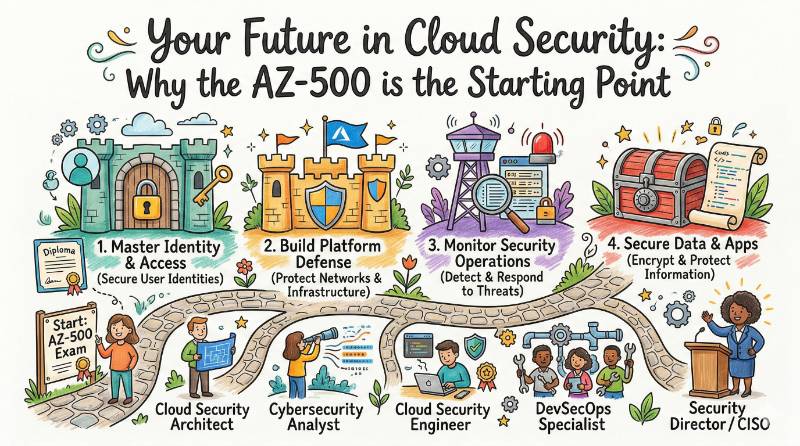
In the early days of computing, we thought of security as a physical fence. We built walls around our servers and felt safe. Today, that fence has disappeared. The new boundary is Identity. In a world where your team works from home, coffee shops, and different time zones, knowing how to protect your cloud assets is the most valuable skill an engineer can possess. I have watched many systems grow, and I have seen many fail. The difference is always how security was handled at the start, not as an afterthought.
The Microsoft Azure Security Technologies (AZ-500) certification is more than just a badge. It is a deep, technical dive into the tools that keep global businesses running safely. This guide is designed for the engineers who build these systems and the managers who lead them. It breaks down exactly what you need to know to move from a general cloud user to a security expert.
AZ-500 Certification: The Master Overview
Before we get into the details, let’s look at the basic facts of this certification. This table provides the essential roadmap for your security journey.
| Track | Level | Who it’s for | Prerequisites | Skills Covered | Recommended Order |
| Azure Security | Associate | Software Engineers, SREs, IT Managers, Platform Engineers | Azure Admin skills + fundamental networking | Identity, Platform Protection, Data Security, Security Ops | AZ-900 → AZ-104 → AZ-500 |
Deep Dive: The Microsoft Azure Security Technologies (AZ-500)
What it is
The AZ-500 is a specialized certification that tests your ability to implement security controls across the entire Azure ecosystem. It isn’t just about theory. It tests how you manage identity, protect networks, secure data, and handle security alerts. It focuses on the practical use of tools like Entra ID (formerly Azure AD), Azure Firewall, Key Vault, and Microsoft Sentinel. Passing this shows you can build a “Zero Trust” environment where every access request is verified.
Who should take it
This program is designed for technology professionals who handle day-to-day cloud operations.
- DevOps and Site Reliability Engineers (SREs): If you deploy infrastructure, you need to know how to lock it down.
- Cloud and Platform Engineers: Those building the foundation of a company’s cloud footprint.
- Security Analysts: Professionals moving from traditional security to the cloud.
- Engineering Managers: Leaders who need to understand the security posture of their products to make informed business decisions.
Skills you’ll gain
By the time you finish this program, you will look at the cloud through a different lens. You won’t just see a virtual machine; you will see a resource that needs specific identity rules, network isolation, and encryption. You gain the ability to act as the primary defender of your company’s digital assets.
- Identity Management: You will master Multi-Factor Authentication (MFA), Conditional Access, and Privileged Identity Management (PIM) to control who does what.
- Infrastructure Hardening: You will learn to build “defense-in-depth” using Azure Firewalls, Network Security Groups (NSGs), and private endpoints.
- Data Safeguarding: You will know how to manage secrets in Key Vault and how to encrypt every byte of data at rest and in motion.
- Security Operations: You will learn to use Microsoft Sentinel to hunt for threats and use automation to respond to incidents before they cause damage.
Real-world projects you should be able to do after it
Knowledge is only real when you put it to work. After completing this certification, you will have the skills to lead high-impact projects.
- Designing a Zero-Trust Network: Building an environment where no user or device is trusted by default, even if they are inside the network.
- Implementing Just-In-Time (JIT) Access: Ensuring that engineers only have admin rights when they need them and for a limited time.
- Automated Security Governance: Using Azure Policy to automatically find and stop any team from creating insecure resources.
- SIEM/SOAR Implementation: Setting up Microsoft Sentinel to collect logs from across the company and automatically block malicious IP addresses.
Preparation plan
Success in the AZ-500 comes from balancing reading with doing. I suggest these timelines based on your current experience:
- 7–14 days (The Expert Sprint): If you are already a senior Azure engineer, focus on practice exams. Identify the areas where Microsoft’s way of doing things differs from your current habits and fill those gaps.
- 30 days (The Standard Path): Spend one hour every weekday on Microsoft Learn modules and two hours every weekend on hands-on labs. This is the most successful path for working engineers.
- 60 days (The Deep Learning Path): Ideal for managers or those new to security. Take your time to build every lab twice. The first time, follow the steps. The second time, try to do it from memory.
Common mistakes
I have seen many talented people fail because they treated this like a basic exam. It is a technical hurdle that requires specific attention.
- Neglecting the “Security Operations” Section: Many focus only on Firewalls and passwords, but logging and Sentinel are huge parts of the exam.
- Ignoring Key Vault Details: You need to know the difference between access policies and RBAC for Key Vault.
- Not Doing the Labs: Reading about a firewall is not the same as configuring one. If you don’t use the Azure portal, you will struggle with the scenario questions.
Best next certification after this
- Same Track: SC-100 (Microsoft Cybersecurity Architect) for those who want to design global security strategies.
- Cross-Track: AZ-400 (Designing and Implementing Microsoft DevOps Solutions) to master the “DevSecOps” way of working.
- Leadership Path: AZ-305 (Designing Microsoft Azure Infrastructure Solutions) to move into a Solutions Architect role.
Choose Your Path: The 6 Learning Roadmaps
Azure Security is the thread that runs through every modern technical career. Here is how it applies to different paths:
- DevOps Path: Focus on “Policy as Code.” Use your AZ-500 knowledge to ensure that your CI/CD pipelines never deploy an insecure resource.
- DevSecOps Path: This is the ultimate bridge. You integrate security testing directly into the development cycle, making security a part of the code, not a barrier.
- SRE Path: Focus on system stability. Use security monitoring to prevent DDoS attacks or unauthorized changes that could cause system downtime.
- AIOps/MLOps Path: Secure your machine learning models. Ensure that the data used for training is encrypted and that only authorized users can access the models.
- DataOps Path: Focus on data sovereignty. Use Azure security tools to ensure that your data stays in the right region and is protected from unauthorized views.
- FinOps Path: Secure your budget. Use Azure Policy to prevent the creation of expensive, high-end resources that aren’t needed, protecting the company from “bill shock” caused by mistakes or bad actors.
Role → Recommended Certifications Mapping
| Your Role | The Best Learning Sequence |
| DevOps Engineer | AZ-104 → AZ-500 → AZ-400 |
| SRE | AZ-104 → AZ-500 → AZ-700 |
| Platform Engineer | AZ-104 → AZ-500 → AZ-305 |
| Cloud Engineer | AZ-900 → AZ-104 → AZ-500 |
| Security Engineer | AZ-500 → SC-200 → SC-300 |
| Data Engineer | DP-203 → AZ-500 |
| FinOps Practitioner | AZ-900 → AZ-500 |
| Engineering Manager | AZ-900 → AZ-500 |
Top Institutions for Training and Certification
Choosing where you learn is just as important as what you learn. These institutions provide specialized support for the AZ-500.
- DevOpsSchool: A leader in practical, lab-based learning. They focus on real-world scenarios and provide mentorship that helps engineers transition into senior roles. Their trainers are known for simplifying complex cloud security concepts.
- Cotocus: They specialize in high-end cloud consulting and training. Their focus is on enterprise-grade security architecture, making them a great choice for teams that need to implement global security standards.
- Scmgalaxy: A massive community platform that offers both training and a wealth of technical resources. It is perfect for those who want to stay connected with other DevOps professionals and learn through collaboration.
- BestDevOps: Known for their streamlined, efficient courses. They focus on the most important technical skills needed to pass the exam and do the job effectively on day one.
- DevSecOpsSchool: The go-to place for those who want to specialize in the intersection of security and automation. They provide deep insights into how to build security into every stage of the software lifecycle.
- Sreschool: Focuses on the reliability side of security. They help you understand how to use security tools to maintain 99.99% uptime for your applications.
- Aiopsschool: Teaches you how to manage security logs and threats using artificial intelligence. This is the future of security operations, and they are at the forefront.
- Dataopsschool: Specializes in securing the data pipeline. They help data engineers understand how to apply AZ-500 principles to data lakes and large-scale databases.
- Finopsschool: Explains the link between security and cost. They teach you how to use cloud policies to prevent financial waste while maintaining a secure environment.
FAQs: Career, Strategy, and Outcome
- Is the AZ-500 exam difficult? It is considered one of the more challenging associate-level exams because it requires deep technical knowledge across many different services.
- How long should I study? For most working engineers, a solid 30 to 45 days of consistent study is the best approach.
- Do I need AZ-104 first? While not required, it is highly recommended. Understanding how to manage Azure makes it much easier to learn how to secure it.
- What is the passing score? You need a 700 out of 1000 to pass.
- How much does the exam cost? Usually $165 USD, but pricing varies by region (often lower in India).
- Does this cert help with salary? Yes. Security is a specialized niche. Certified professionals often see a significant increase in demand and pay.
- Is this good for managers? Absolutely. It helps you understand what your team is doing and allows you to talk to clients about security with confidence.
- Does the certification expire? Yes, it is valid for one year. However, you can renew it for free through a simple online assessment on the Microsoft site.
- Are there labs in the exam? Sometimes. You should always be prepared to perform actual tasks in a live Azure interface during the test.
- What is the best way to study? A mix of official documentation, a structured training course with labs, and practice exams.
- Can I skip AZ-900? If you already have cloud experience, yes. You can go straight to AZ-104 or AZ-500.
- Is it better than AWS Security? It’s not about “better.” If your company uses Azure, this is the most valuable security certification you can have.
FAQs: Technical and Operational
- What is Entra ID (Azure AD)? It is the core identity service in Azure. It handles who can log in and what they can access.
- What is Privileged Identity Management (PIM)? A tool that gives users admin rights only when they need them, for a limited time, and with full logging.
- How do I protect my network? By using a combination of Azure Firewall, Network Security Groups (NSGs), and Application Security Groups (ASGs).
- What is Azure Key Vault? A secure place to store passwords, connection strings, and encryption keys so they aren’t hard-coded in your software.
- What is Microsoft Sentinel? A cloud-native tool that collects logs from all your resources to find and stop hackers.
- What is the difference between encryption at rest and in transit? At rest means the data is encrypted while stored on a disk. In transit means it is encrypted while moving across the internet.
- Do I need to learn KQL? Yes. Kusto Query Language (KQL) is used to search logs in Azure Monitor and Sentinel.
- What are Managed Identities? A way for your applications to connect to other Azure services (like a database) without you having to manage any passwords.
Conclusion
Mastering Microsoft Azure Security Technologies is about more than just checking a box for your career. It is about becoming the person your organization trusts with its most important secrets. In my years of experience, I have found that tools change, but the principles of good security—isolation, least privilege, and constant monitoring—remain the same. The AZ-500 certification gives you the technical depth to turn these principles into a reality. This guide has shown you the roadmap, the career paths, and the training you need to succeed. Whether you are an engineer in India or a manager leading a global team, the cloud is only as safe as the people who manage it. Take the time to master these skills, and you will not only secure your environment, but you will also secure your future as a leader in the cloud industry.
