Upgrade & Secure Your Future with DevOps, SRE, DevSecOps, MLOps!
We spend hours scrolling social media and waste money on things we forget, but won’t spend 30 minutes a day earning certifications that can change our lives.
Master in DevOps, SRE, DevSecOps & MLOps by DevOps School!
Learn from Guru Rajesh Kumar and double your salary in just one year.
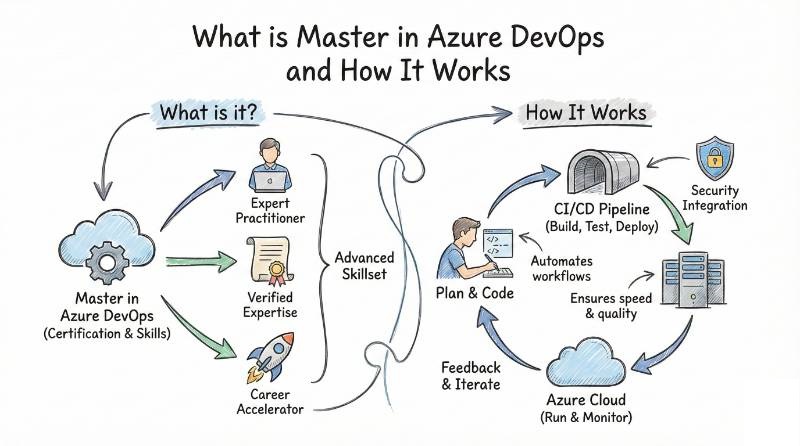
In the high-stakes world of enterprise software, the gap between a standard engineer and a top-tier specialist is defined by one thing: the ability to orchestrate complex systems at scale. Having navigated the shift from manual legacy deployments to fully automated cloud ecosystems, I have seen how mastering the Azure stack can turn a professional into an indispensable asset.
This guide is for those ready to move beyond basic tasks and take command of the entire delivery lifecycle. The Master in Azure DevOps is not just a badge; it is a strategic toolkit for the modern technical leader.
The Architecture of the Master in Azure DevOps Program
The Master in Azure DevOps program, powered by DevOpsSchool, is an integrated learning path. It doesn’t just teach tools; it builds a foundation of cloud administration and expert-level automation.
| Track | Level | Who it’s for | Prerequisites | Key Competencies | Sequence |
| Azure Essentials | Foundational | New Entrants, Managers | None | Cloud Logic, Governance, Costs | Step 1 |
| Infrastructure Admin | Associate | IT Pros, SysAdmins | Foundational Knowledge | Networking, Identity, Security | Step 2 |
| DevOps Strategy | Expert | Engineers, Architects | Admin or Dev Associate | CI/CD, IaC, Pipelines, Feedback | Step 3 |
Inside the Program: Master in Azure DevOps (CDE)
What it is
The Master in Azure DevOps (Certified DevOps Engineer) is an elite-level certification track. It focuses on the convergence of people, processes, and technology, specifically using the Microsoft Azure ecosystem to drive value.
Who should take it
- Senior Engineers: Who need to move from “writing code” to “managing the flow.”
- Operational Leaders: Who want to understand the mechanics of automated delivery.
- Architects: Who must design scalable, secure, and compliant cloud environments.
Skills you’ll gain
- Lifecycle Governance: Using Azure Boards to align business goals with engineering output.
- Reliable Code Flow: Building robust CI/CD pipelines in Azure Pipelines that handle enterprise-grade complexity.
- Policy as Code: Implementing automated security and compliance using Azure Key Vault and RBAC.
- Modern Infrastructure: Managing environments with Terraform and Bicep rather than manual configurations.
Real-world projects you will execute
- Global App Delivery: Deploying a containerized web application across multiple Azure regions.
- Security Shield: Integrating automated vulnerability scanning into a live production pipeline.
- Infrastructure Blueprint: Using code to spin up and tear down entire environments in minutes, not days.
Common Pitfalls
- Ignoring the Foundations: You cannot automate what you don’t understand. Mastery of Azure Networking and Identity is non-negotiable.
- Static Thinking: In a master program, you must learn to think in “versions.” Everything—from code to infrastructure—should be version-controlled.
- Lack of Feedback Loops: If your pipeline doesn’t have monitoring and alerts, it’s only half-complete.
Best next certification after this
After completing the Master in Azure DevOps certification, consider advancing your expertise by pursuing these certifications:
- DevOps Engineer Expert: This will deepen your DevOps knowledge and help you tackle more advanced concepts in software delivery and automation.
- Certified Kubernetes Administrator: As Kubernetes is critical in container orchestration, this certification will complement your Azure DevOps skills.
- Certified ScrumMaster: For those aiming to manage DevOps teams, the ScrumMaster certification will enhance your ability to manage agile workflows.
Expanded Preparation Plan: The Journey to Expertise
True mastery requires a structured approach. Use these three phases to transition from a practitioner to a strategist.
7–14 Days: The Discovery Phase
- Goal: Understand the “Cloud Mindset.”
- Activities: Explore the Azure portal. Focus on how subscriptions, resource groups, and regions interact. Build a simple website manually to understand the underlying infrastructure you will soon automate.
- Outcome: Solid understanding of Azure Fundamentals.
30 Days: The Implementation Phase
- Goal: Master Control and Governance.
- Activities: Shift your focus to Azure Administrator topics. Practice setting up Virtual Networks (VNets) and managing User Access. Learn the basics of PowerShell and the Azure CLI.
- Outcome: The ability to manage and secure a basic cloud environment.
60 Days: The Mastery Phase
- Goal: Architecting Automation.
- Activities: This is the deep dive into Azure DevOps. Master YAML for pipelines, Docker for containerization, and Terraform for Infrastructure as Code. Build at least 10 different end-to-end pipelines.
- Outcome: Full readiness for the CDE certification and expert-level job roles.
Choose Your Path: 6 Specialized Career Tracks
Once you have mastered the core Azure DevOps platform, you can pivot into these specialized areas:
- DevOps: The classic path focusing on speed and continuous delivery.
- DevSecOps: The security track where you build defense directly into the automation.
- SRE (Site Reliability Engineering): Focusing on the science of uptime and system resilience.
- AIOps/MLOps: Bridging the gap between data science and production using Azure ML.
- DataOps: Bringing the speed of DevOps to big data and analytics pipelines.
- FinOps: The strategic art of cloud cost optimization and financial transparency.
Role → Recommended Certifications Mapping
- Lead DevOps Engineer: Master in Azure DevOps + Kubernetes (CKAD).
- Reliability Engineer (SRE): Master in Azure DevOps + SRE Certified Professional.
- Platform Architect: Master in Azure DevOps + Terraform Associate.
- Cloud Security Lead: Master in Azure DevOps + Azure Security (AZ-500).
- Principal Data Engineer: Master in Azure DevOps + Azure Data Engineer (DP-203).
- Cloud Cost Manager: Master in Azure DevOps + FinOps Certified.
- Technical Manager: Master in Azure DevOps + Certified DevOps Manager.
Top Institutions for Training and Certification
To reach the master level, you need more than just videos; you need high-touch mentorship and lab-intensive environments:
- DevOpsSchool: This is the gold standard for hands-on learning. They don’t just teach the exam; they teach the job. Their mentors are industry veterans who provide real-world insights and lifetime technical support.
- Cotocus: Highly recommended for corporate teams. They specialize in high-level consulting and training that aligns with specific business goals and complex cloud migrations.
- Scmgalaxy: A massive repository of knowledge. If you are looking for community support, detailed troubleshooting blogs, and open-source tool integration, this is your hub.
- BestDevOps: Perfect for those who prefer a structured, step-by-step approach. They simplify the most complex Azure topics into manageable lessons for busy professionals.
- devsecopsschool: The premier destination for security-focused engineers. Their curriculum is deeply integrated with modern threat modeling and automated security testing.
- sreschool: Focuses exclusively on the “Operations” side of DevOps. Learn about error budgets, SLIs, SLOs, and building resilient systems on Azure.
- aiopsschool: For the forward-thinking engineer. They bridge the gap between traditional operations and artificial intelligence.
- dataopsschool: Specializes in automating data flows. Essential for those working with Big Data and complex Azure Data Factory environments.
- finopsschool: Teaches the crucial skill of cloud cost transparency and optimization—a high-demand skill in the current economy.
Next Certifications to Take
Stay ahead of the curve by looking toward these three horizons:
- Certified Kubernetes Administrator (CKA): Deepen your expertise in container orchestration and management.
- Azure Solutions Architect Expert: Transition into a role where you design and implement complex cloud-based solutions.
- Certified Cloud Security Professional (CCSP): Specialize in securing cloud environments with a focus on DevOps practices.
FAQs: Career & Value Outcomes
1. How difficult is it to reach the Master level? It is a challenging journey because it requires a balance of logic, administration, and architectural thinking.
2. How much time will it really take? Plan for roughly 100 to 120 hours of focused study and lab work.
3. Are there prerequisites for the expert title? Yes, you generally need to hold an Azure Administrator or Developer associate certificate first.
4. What is the best learning sequence? Fundamentals first, followed by Administration, and finally the Expert DevOps track.
5. Is this certification valued globally? Absolutely. Microsoft Azure is the preferred enterprise cloud globally, making this certification a universal technical passport.
6. What are the salary impacts? Certified professionals often command a 30% to 50% premium over their non-certified peers.
7. Can I start from a non-technical role? It is possible, but you must follow the 60-day comprehensive track to build your core technical skills.
8. Are the labs mandatory for certification? While the exam is the final test, the labs in the Master program are what make you truly competent in a job setting.
9. Does this help with remote work? Azure DevOps is one of the most remote-friendly skill sets in the current market.
10. How long does the certificate last? It lasts for one year, with free annual renewals provided by Microsoft.
11. Is coding knowledge a must? You need to be comfortable with scripting and logic, but you don’t need to be a deep-code software developer.
12. Why choose Azure over other clouds? Azure provides the best integration for organizations already using Microsoft’s enterprise ecosystem.
FAQs on Master in Azure DevOps (CDE)
1. How is the Master program different from the AZ-400 exam? The exam tests your knowledge; the Master program builds your skills using extra tools like Terraform and Kubernetes.
2. Who is the provider of the Master in Azure DevOps (CDE)? It is a flagship program provided by DevOpsSchool in collaboration with global trainers.
3. Where can I find the official details? Visit Master in Azure DevOps.
4. Is this suitable for managers? Yes. It provides the technical depth managers need to drive efficient, modern engineering teams.
5. Are the sessions live? Most programs at DevOpsSchool are live and instructor-led for maximum interaction.
6. Does it cover Infrastructure as Code? Yes, IaC with Terraform and ARM is a central part of the curriculum.
7. Is there placement support? Yes, top-tier institutes provide resume reviews and interview preparation as part of the package.
8. Can I start with no prior cloud knowledge? The program is built to take you from the very beginning (Fundamentals) to the expert level.
Testimonials
“Moving into the Master program at DevOpsSchool was the best decision I made for my career. The lab environments are as close to real production as it gets.” — Karan M., Cloud Architect.
“As a manager, I needed to bridge the gap between our developers and our operations team. This program gave me the roadmap to make that happen.” — Sonia L., Engineering Lead.
Conclusion
Mastering Azure DevOps is about more than just earning a certificate; it’s about gaining the vision to lead technical transformations. In my experience, those who invest the time to truly understand the flow of software delivery are the ones who define the future of their organizations.
The journey from a beginner to an expert is demanding, but the rewards—in terms of career stability, salary, and impact—are unmatched. Start your journey today, commit to the process, and become the master of your technical destiny.
