Upgrade & Secure Your Future with DevOps, SRE, DevSecOps, MLOps!
We spend hours scrolling social media and waste money on things we forget, but won’t spend 30 minutes a day earning certifications that can change our lives.
Master in DevOps, SRE, DevSecOps & MLOps by DevOps School!
Learn from Guru Rajesh Kumar and double your salary in just one year.
Engineering teams today face a massive challenge. Software must be faster, safer, and more reliable than ever before. To meet this demand, the traditional boundaries between development and operations have disappeared. If you want to stay relevant in this fast-moving industry, you must evolve from a specialist into a versatile architect.
This guide explores the Master in DevOps Engineering (MDE) program. This certification is not just a piece of paper. It represents a deep understanding of the entire software lifecycle. Whether you are a working engineer in India or a manager leading global teams, mastering these skills is the key to high-level career growth.
The Evolution of the Modern Engineer
In the past, knowing how to write code or manage a server was enough. Now, organizations require “Full-Stack” operational expertise. You need to understand how to secure the pipeline (DevSecOps), ensure 99.99% uptime (SRE), and manage cloud costs (FinOps).
The Master in DevOps Engineering (MDE) program bridges these gaps. It creates a unified learning path for professionals who want to lead technical transformations. By the end of this guide, you will understand exactly how to navigate this ecosystem and which path fits your career goals.
MDE Certification Master Ecosystem
Choosing the right certification requires a clear roadmap. The table below outlines the essential certifications within the Master in DevOps Engineering framework. This ensures you know exactly where to start and how to progress.
| Track | Level | Who it’s for | Prerequisites | Skills Covered | Recommended Order |
| DevOps Core | Foundation | Beginners, Developers | Basic Linux | Git, Docker, CI/CD, Maven | 01 |
| Automation | Professional | Engineers (2+ yrs) | DevOps Foundation | Kubernetes, Terraform, Ansible | 02 |
| Reliability | SRE Specialist | System Engineers | MDE Professional | Prometheus, Grafana, SLOs | 03 |
| Security | DevSecOps | Security Analysts | MDE Professional | Vault, SonarQube, Compliance | 04 |
| AIOps/MLOps | Data Expert | Data Engineers | Advanced Ops | Model deployment, Monitoring | 05 |
| FinOps | Financial Ops | Managers, Leads | Cloud Basics | Cost Optimization, Tagging | 06 |
Master in DevOps Engineering (MDE)
The MDE program is the flagship certification for those seeking true technical leadership. It combines multiple disciplines into one cohesive journey.
What it is
The Master in DevOps Engineering (MDE) is an intensive training and certification program. It focuses on mastering the tools, cultures, and practices required to automate software delivery and infrastructure management.
Who should take it
This program is perfect for Software Engineers, System Administrators, and IT Managers. If you are looking to move into a Senior DevOps or Lead Platform Engineer role, this is the right choice for you.
Skills you’ll gain
- Designing end-to-end automated CI/CD pipelines.
- Managing containerized applications with Kubernetes at scale.
- Implementing Infrastructure as Code (IaC) using Terraform.
- Advanced monitoring and observability for distributed systems.
- Integrating automated security gates into the delivery process.
Real-world projects you should be able to do after it
- Deploy a multi-region microservices architecture on AWS/Azure/GCP.
- Create a self-healing system that automatically recovers from failures.
- Set up a fully automated security scanning pipeline for production code.
- Build a dashboard that tracks real-time deployment frequency and failure rates.
Preparation plan
- 7–14 Days: Focus on the “DevOps Mindset” and basic automation tools like Git and Docker.
- 30 Days: Deep dive into CI/CD logic with Jenkins and configuration management with Ansible.
- 60 Days: Full mastery including Kubernetes orchestration and advanced Infrastructure as Code.
Common mistakes
- Learning the tools without understanding the underlying DevOps culture.
- Neglecting the importance of Linux networking and shell scripting.
- Ignoring security until the very end of the learning process.
Best next certification after this
- DevSecOps Certified Professional (DSOCP).
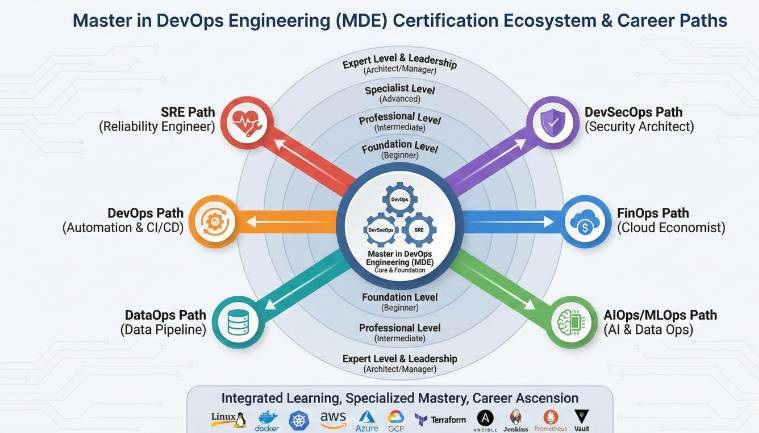
Choose Your Path: 6 Specialized Learning Tracks
DevOps is a broad field. To become a master, you should eventually specialize in one of these six critical paths.
1. The DevOps Path
This is the foundational track. It focuses on the core principles of continuous integration and continuous delivery. You will spend your time mastering version control, build tools, and basic cloud deployment. It is the best starting point for most software engineers.
2. The DevSecOps Path
Security cannot be an afterthought. In this track, you learn how to “shift left.” This means moving security tests earlier in the development process. You will work with vulnerability scanners, secret management tools, and compliance automation.
3. The SRE (Site Reliability Engineering) Path
SRE is about applying a software engineering mindset to system operations. You focus on reliability, scalability, and performance. This path is ideal for those who enjoy troubleshooting complex systems and building highly available architectures.
4. The AIOps/MLOps Path
As AI becomes more common, we need ways to manage machine learning models in production. This track combines traditional DevOps with data science. You will learn how to automate the training, testing, and deployment of AI models.
5. The DataOps Path
Data pipelines are becoming as complex as software pipelines. DataOps focuses on improving the quality and cycle time of data analytics. It is a vital path for data engineers who want to bring agility to their data warehouses.
6. The FinOps Path
Cloud costs can quickly spiral out of control. FinOps brings financial accountability to the variable spend model of the cloud. You will learn how to optimize resources and ensure that every dollar spent on the cloud provides maximum value.
Role → Recommended Certifications Mapping
Use this guide to align your current role with the most effective certification journey.
- DevOps Engineer: MDE Professional → Kubernetes Specialist → DevSecOps Expert.
- SRE: MDE Professional → SRE Certified Professional → Chaos Engineering Specialist.
- Platform Engineer: MDE Expert → Cloud Architect Certifications → Infrastructure Lead.
- Cloud Engineer: Cloud Foundation → MDE Foundation → MDE Professional.
- Security Engineer: DevSecOps Specialist → MDE Foundation → Security Architect.
- Data Engineer: DataOps Certified Professional → MDE Foundation → MLOps Specialist.
- FinOps Practitioner: FinOps Certified Engineer → MDE Foundation → Cloud Economics.
- Engineering Manager: MDE Foundation → Certified DevOps Manager (CDM).
Top Institutions for Training and Certification
Selecting the right training partner is essential for your success. These institutions specialize in the Master in DevOps Engineering (MDE) curriculum.
DevOpsSchool
DevOpsSchool is a leading provider of DevOps training globally. They offer a highly practical, project-based curriculum that prepares you for real-world challenges. Their MDE program is widely recognized by top-tier tech companies.
Cotocus
Cotocus focuses on specialized IT training and consulting. They provide deep technical dives into Kubernetes and cloud-native technologies. Their trainers are active industry practitioners who bring current insights to the classroom.
Scmgalaxy
Scmgalaxy is a massive community and training hub for SCM and DevOps professionals. They offer extensive resources, tutorials, and certification paths. It is an excellent place for continuous learning beyond the initial certification.
BestDevOps
BestDevOps offers simplified and effective training modules. They focus on making complex concepts easy to understand for beginners. Their certification programs are designed to get you job-ready in the shortest time possible.
devsecopsschool
This institution focuses exclusively on the security aspect of DevOps. If you want to become a security champion within your team, their specialized tracks are the industry standard for learning DevSecOps tools.
sreschool
SRESchool is dedicated to the discipline of Site Reliability Engineering. They teach the frameworks used by tech giants like Google and Netflix to maintain massive, global systems.
aiopsschool
AIOpsSchool prepares engineers for the future of automated operations. They focus on using artificial intelligence to monitor and manage IT infrastructure, reducing the manual burden on ops teams.
dataopsschool
DataOpsSchool provides the blueprint for managing modern data lifecycles. They help data professionals apply DevOps principles to data pipelines, ensuring faster insights and higher data quality.
finopsschool
FinOpsSchool is the premier destination for learning cloud financial management. They bridge the gap between finance, engineering, and business teams to optimize cloud investments.
Frequently Asked Questions (FAQs) – General Outcomes
1. How difficult is it to become a Master in DevOps Engineering?
It requires dedication and hands-on practice. While the concepts are straightforward, mastering the integration of multiple tools takes time and consistent effort.
2. How much time should I dedicate to study?
If you are working full-time, spending 5-10 hours a week will allow you to complete the core certification in about three months.
3. Are there any prerequisites?
A basic understanding of the Linux command line and some experience with a programming language like Python or Java is very helpful.
4. What is the best sequence for certifications?
Start with MDE Foundation, move to MDE Professional, and then pick a specialty like SRE or DevSecOps based on your interests.
5. What is the market value of these certifications?
MDE-certified professionals are among the highest-paid in the IT industry. Companies are actively searching for individuals who can manage entire lifecycles rather than just specific tools.
6. Will this help me transition from QA to DevOps?
Yes. Many QA engineers use the MDE program to learn how to automate testing within the CI/CD pipeline, making them ideal candidates for DevOps roles.
7. Can I take these exams online?
Yes, most certification providers associated with this program offer online proctored exams for your convenience.
8. Is the certification recognized globally?
The MDE framework is used by organizations worldwide. The skills you learn are universal across all major cloud providers and industries.
9. Do I need to learn every tool mentioned?
No. You should understand the category of tools. For example, if you master Jenkins, you can easily adapt to GitLab CI or GitHub Actions.
10. How do these certifications impact career growth?
They move you from “doing tasks” to “designing systems.” This shift in perspective is what leads to senior leadership roles like Architect or CTO.
11. Is there a lab environment provided?
Top institutions like DevOpsSchool provide 24/7 access to cloud-based labs so you can practice on real infrastructure.
12. What if my company doesn’t use DevOps yet?
This is actually the best time to learn. You can become the leader who introduces these practices to your organization, positioning yourself for a promotion.
FAQs on Master in DevOps Engineering (MDE)
1. What makes MDE different from other DevOps certs?
MDE is a comprehensive “Master” program. It doesn’t just teach one tool; it teaches the integration of DevOps, SRE, and Security into a single professional identity.
2. How often is the MDE curriculum updated?
The curriculum is refreshed regularly to include the latest industry trends like AI integration and advanced cloud-native practices.
3. Does MDE cover multi-cloud strategies?
Yes. A core part of the “Master” level is learning how to manage infrastructure across different providers like AWS and Azure simultaneously.
4. Is there a practical project required for MDE?
Yes. To earn the MDE title, you must complete a capstone project that demonstrates your ability to build a full automated ecosystem.
5. Who provides the official MDE certification?
The program is provided by DevOpsSchool.
6. Can I skip the Foundation level?
If you have significant industry experience, you can take a placement test to move directly to the Professional or Expert levels.
7. Is coding a major part of the MDE exam?
The exam focuses on “Coding for Infrastructure.” You need to be comfortable with YAML, JSON, and basic scripting rather than complex application development.
8. What is the validity of the MDE certification?
The certification reflects your mastery of the domain. While the title is permanent, we recommend attending alumni workshops to stay current with new tool versions.
Next Certifications to Take
Once you have achieved your Master in DevOps Engineering, you should look toward the next horizon to maintain your competitive edge.
- Same Track (Advanced Mastery): Certified Kubernetes Security Specialist (CKS). This deepens your expertise in the most important orchestration platform today.
- Cross-Track (Broadening Expertise): Certified FinOps Practitioner. Understanding the financial side of the cloud makes you an invaluable asset to any business-focused engineering team.
- Leadership (Career Ascension): Certified DevOps Manager (CDM). This path prepares you to lead large-scale digital transformations and manage diverse engineering teams.
Mastering DevOps Engineering is a journey, not a destination. By following this guide and choosing the right certification path, you are investing in a future where you lead the way in technical excellence. Reach out to the recommended institutions today to start your journey.
Conclusion
The transition from a traditional engineering role to becoming a Master in DevOps Engineering (MDE) is more than just a title change; it is a fundamental shift in how you solve problems. In an era where “software is eating the world,” the ability to automate, secure, and stabilize that software is the most valuable skill set you can possess.
By following this guide and pursuing the MDE certification, you are moving beyond being a user of tools and becoming an architect of ecosystems. Whether you choose to specialize in the reliability of SRE, the security of DevSecOps, or the efficiency of FinOps, the core principles of the MDE program provide the bedrock for a sustainable and high-impact career.
The path to mastery requires consistency, hands-on practice, and a commitment to continuous learning. As technology continues to evolve with AI and cloud-native advancements, those who hold the MDE credential will be the ones leading the charge. Now is the time to take that first step—choose your path, select your training partner, and begin your journey toward technical excellence.
