Upgrade & Secure Your Future with DevOps, SRE, DevSecOps, MLOps!
We spend hours scrolling social media and waste money on things we forget, but won’t spend 30 minutes a day earning certifications that can change our lives.
Master in DevOps, SRE, DevSecOps & MLOps by DevOps School!
Learn from Guru Rajesh Kumar and double your salary in just one year.
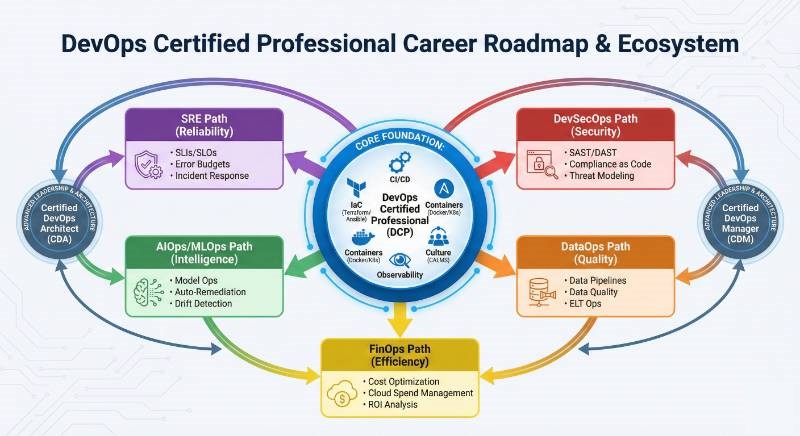
The DevOps Certified Professional (DCP) is the industry’s answer to the growing need for high-level technical expertise that spans the entire software delivery lifecycle. In an era where speed and reliability are the primary currencies of business, the DCP serves as a hallmark of quality for engineers and managers alike.
Master Certification Overview Table
| Track | Level | Who it’s for | Prerequisites | Skills Covered | Recommended Order |
| Core DevOps | Professional | Engineers & Managers | Basic Linux/Git | CI/CD, K8s, IaC, Cloud | 1st |
| SRE | Specialist | Reliability Engineers | DCP Knowledge | SLOs, Error Budgets | 2nd |
| DevSecOps | Specialist | Security Engineers | DCP Knowledge | Vulnerability Scanning | 2nd |
| AIOps/MLOps | Advanced | AI/ML Engineers | Python + DevOps | Model Lifecycle | 3rd |
| DataOps | Advanced | Data Engineers | SQL + DevOps | Pipeline Automation | 3rd |
| FinOps | Management | Finance & Tech Leads | Cloud Experience | Cost Optimization | 4th |
Detailed Focus: DevOps Certified Professional (DCP)
What it is
The DevOps Certified Professional (DCP) is an intensive training and certification program designed to validate your expertise across the full spectrum of DevOps. It bridges the gap between software development and IT operations, focusing on high-velocity delivery through automation and cultural change.
Who should take it
This certification is essential for Software Engineers, System Administrators, QA Professionals, and Engineering Managers. It is particularly valuable for those looking to transition into roles such as DevOps Architect, Cloud Engineer, or Site Reliability Engineer (SRE).
Skills you’ll gain
- Infrastructure as Code (IaC): Mastering Terraform and Ansible to treat servers like code.
- Containerization & Orchestration: Deep knowledge of Docker and managing production workloads with Kubernetes.
- Continuous Integration & Deployment: Building sophisticated CI/CD pipelines using Jenkins, Git, and GitHub Actions.
- Cloud Native Patterns: Designing applications specifically for distributed environments.
- Observability & Monitoring: Implementing proactive monitoring using Prometheus, Grafana, and ELK.
Real-world projects you should be able to do
- Build a fully automated “Zero-Touch” deployment pipeline that moves code from commit to production.
- Set up a multi-cloud Kubernetes cluster with auto-scaling and self-healing capabilities.
- Automate a security-compliant infrastructure that triggers alerts upon any configuration drift.
- Migrate a legacy monolithic application into a microservices architecture using containers.
Preparation Plan
- 7–14 Days (The Fast Track): For those with significant hands-on experience. Focus on clearing theoretical gaps and taking at least five full-length mock exams.
- 30 Days (The Standard Route): The most common path for working engineers. Dedicate 2 hours daily. Spend weeks 1-2 on CI/CD and Containerization; weeks 3-4 on IaC and Kubernetes.
- 60 Days (The Deep Dive): For beginners or managers transitioning from non-technical backgrounds. Spend the first 20 days mastering Linux and Git fundamentals before moving to core tools.
Common Mistakes
- Ignoring Fundamentals: Trying to learn Kubernetes without understanding how a Linux kernel works.
- Tool-First Thinking: Mastering the “how” of a tool but forgetting the “why” of the DevOps philosophy.
- Skipping Networking: Many failures in production (and on the exam) come from a lack of understanding of DNS, VPCs, and Subnets.
Best Next Certification After This
- Same Track: Certified DevOps Architect (CDA).
- Cross-Track: DevSecOps Certified Professional.
- Leadership: Certified DevOps Manager.
Choose Your Path: 6 Specialized Learning Tracks
Modern technology has become too vast for a single person to know everything. To command the highest salaries, you must specialize.
1. The DevOps Path (The Foundation)
Focuses on the core CI/CD pipeline and the generalist skill set required to automate the development lifecycle.
2. The DevSecOps Path (The Protector)
Integrates security at every stage of the pipeline. You focus on automated threat modeling, vulnerability scanning, and compliance as code.
3. The SRE Path (The Stabilizer)
Focuses on the “Ops” side—scalability, reliability, and incident management. This path is for those who enjoy solving complex architectural puzzles to keep systems running 24/7.
4. The AIOps/MLOps Path (The Innovator)
Applies DevOps principles to Machine Learning. This ensures that AI models are not just experiments but are production-ready and scalable.
5. The DataOps Path (The Scientist)
Focused on data quality and the automation of data pipelines. This is critical for organizations relying on Big Data for decision-making.
6. The FinOps Path (The Strategist)
Concentrates on the financial management of the cloud. It ensures that the speed of DevOps doesn’t lead to out-of-control cloud bills.
Role → Recommended Certifications Mapping
To help you decide your next move, here is how the industry maps certifications to specific career titles:
| Current Role | Target Goal | Recommended Certifications |
| Software Engineer | Senior Developer | DCP + Kubernetes Master |
| System Admin | Cloud Engineer | DCP + AWS/Azure Architect |
| SRE | Principal SRE | DCP + SRE Certified Professional |
| Security Analyst | DevSecOps Lead | DCP + DevSecOps Certified Professional |
| Data Scientist | MLOps Engineer | DCP + AIOps/MLOps Professional |
| DBA | DataOps Engineer | DCP + DataOps Certified Professional |
| Finance Manager | FinOps Lead | DCP + Certified FinOps Professional |
| Engineering Lead | Director of Eng. | DCP + Certified DevOps Manager |
Next Certifications to Take
To truly stand out, you should look beyond the initial certificate. Based on industry data from GurukulGalaxy, here are the three most high-impact paths following your DCP:
- Same Track (Specialization): Certified Kubernetes Administrator (CKA). Kubernetes is the “OS of the Cloud.” Mastering it is non-negotiable for senior roles.
- Cross-Track (Versatility): Certified DevSecOps Professional (DSOCP). In a world of increasing cyber threats, an engineer who can write secure automation is twice as valuable.
- Leadership (Career Growth): Certified DevOps Manager (CDM). This is designed for those looking to stop “doing” the work and start “leading” the strategy.
Top Institutions for Training and Certification
Selecting the right training partner is essential for your success. These institutions provide the necessary hands-on labs and curriculum required to pass the DCP.
- DevOpsSchool: The primary provider for the DCP. They are world-renowned for their instructor-led training, massive repository of real-world projects, and lifetime community support.
- Cotocus: A specialized consulting and training firm that focuses on high-end corporate training and technical bootcamps for senior engineers.
- Scmgalaxy: An excellent community-driven platform providing deep-dive tutorials on Software Configuration Management and advanced DevOps tools.
- BestDevOps: Offers streamlined, high-impact training modules designed to help working professionals clear certifications in a shorter timeframe.
- devsecopsschool: The global leader in security-specific DevOps training, focusing on automated security scanning and compliance frameworks.
- sreschool: A specialized institution focused entirely on reliability engineering, error budgets, and complex system monitoring.
- aiopsschool: Dedicated to the intersection of AI and operations, providing the only structured curriculum for MLOps and AIOps professionals.
- dataopsschool: Focused on the unique challenges of data engineers, offering specialized training in data pipeline automation and cloud data warehousing.
- finopsschool: The leading authority on cloud financial management, helping professionals master the art of cloud cost optimization.
Frequently Asked Questions
- Is DevOps certification still worth it in 2026? Yes. As automation becomes more complex, the demand for certified professionals who understand the “Big Picture” continues to grow.
- What is the difficulty level of the DCP? It is considered “Professional-Intermediate.” It requires both theoretical knowledge and the ability to solve problems in a lab environment.
- Does DCP cover multiple clouds? Yes. It is designed to be cloud-agnostic, teaching principles that apply to AWS, Azure, and Google Cloud equally.
- Can I take this certification if I don’t know how to code? You should at least be comfortable with scripting (Bash or Python) to get the most value out of the course.
- How long is the training? Most instructor-led programs last between 40 to 60 hours of active training.
- Will this certification help me get a job abroad? Yes, the DCP is recognized globally and aligns with international standards for DevOps hiring.
- Is there a practical component to the exam? Yes, the assessment includes project work and practical scenarios that you must solve.
- What is the average salary hike after getting certified? On average, certified professionals report a 35% increase in compensation compared to their non-certified peers.
- Do managers really need this technical certification? Managers need it to understand the bottlenecks in their pipelines and to lead their technical teams with authority.
- How do I renew the certification? Renewal typically happens every three years through a refresher exam or by progressing to a Master-level certification.
- Are the labs provided during training? Yes, reputable providers like DevOpsSchool provide cloud-based lab environments.
- Is there a community to help after I pass? Yes, you will gain access to global alumni networks and specialized forums.
FAQs Specific to DevOps Certified Professional (DCP)
- What is the official URL for DCP? You can find the full syllabus and registration at the official DCP page.
- Who is the main provider of the DCP program? DevOpsSchool is the primary authorized training and certification body.
- What makes DCP different from a Jenkins or Docker cert? DCP covers the entire ecosystem. It’s about how the tools work together, not just one specific piece of software.
- Can I transition from QA to DevOps using DCP? Absolutely. DCP provides the infrastructure and automation skills that most QA engineers are currently missing.
- What is the minimum score to pass? You need to achieve a score of at least 70% in the final assessment.
- Does DCP include training on AIOps? Yes, modern DCP versions include introductory modules on how AI is impacting operations.
- Is there career support? Yes, the program includes resume reviews and interview preparation tailored to the DevOps market.
- Are the sessions live or recorded? Most participants choose the live instructor-led sessions for the interaction, though recorded versions are available for self-paced learning.
Conclusion
The transition to DevOps is not just a trend; it is the natural evolution of how high-performing companies build products. For the individual engineer or manager, the DevOps Certified Professional (DCP) represents a commitment to this evolution. By following the paths outlined in this guide and selecting the right training partner, you are not just obtaining a certificate—you are future-proofing your career in an increasingly automated world.
